
UK £18.00 (including postage)
Rest of £28.00 (including postage)
World
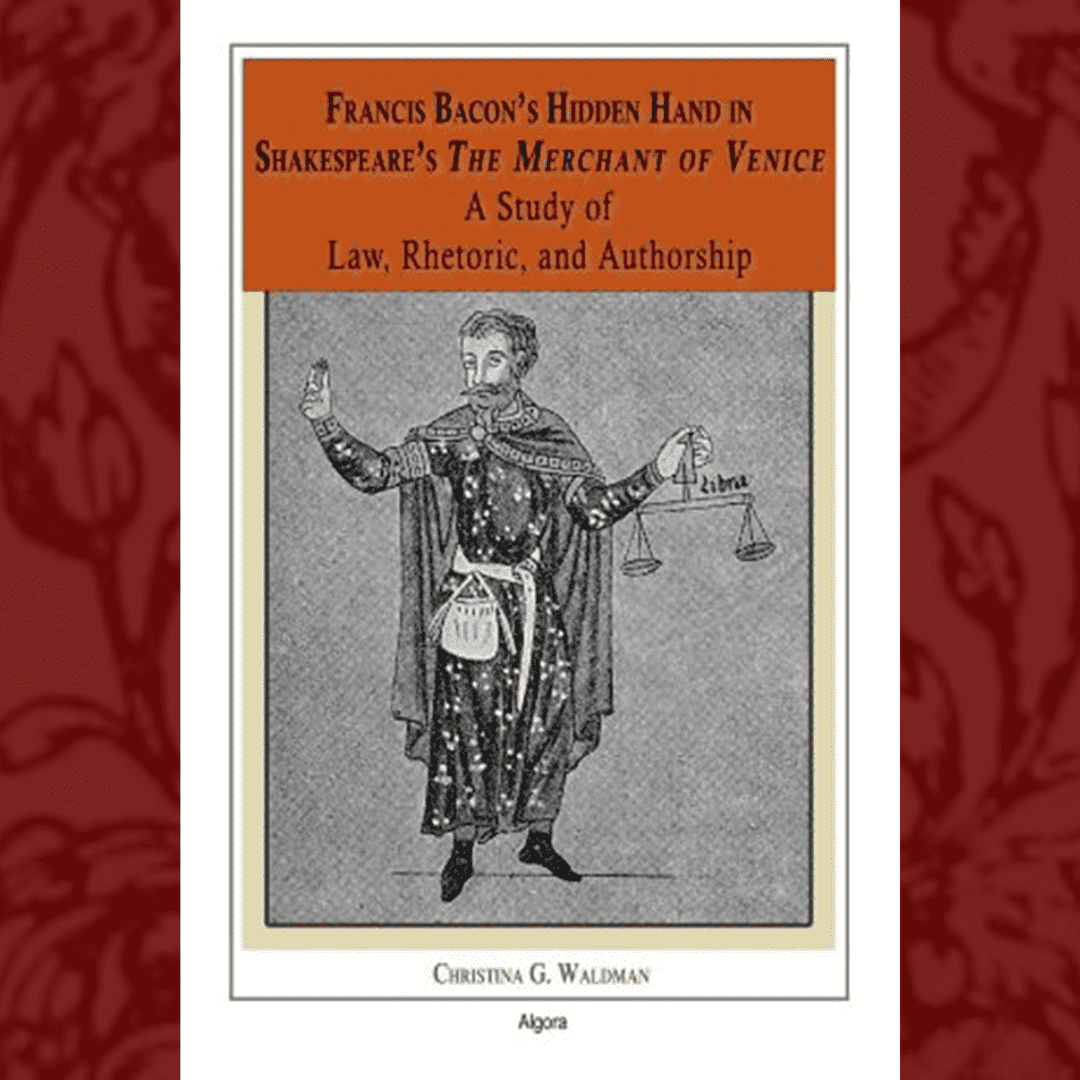
Francis Bacon's Hidden Hand in Shakespeare's The Merchant of Venice: A Study of Law, Rhetoric, and Authorship
Waldman, Christina G., Francis Bacon's Hidden Hand in Shakespeare's The Merchant of Venice: A Study of Law, Rhetoric, and Authorship, Algora Publishing, New York, 2018, pp. 310.
"This well-written book adds importantly to a long tradition. . . .Christina Waldman ably makes the case here for Shakespeare’s contemporary Francis Bacon as the author of The Merchant of Venice. Creatively weaving various strands of analysis based on thorough and pathbreaking research."
(Daniel Kornstein, New York City trial lawyer, author of Kill All the Lawyers? Shakespeare's Legal Appeal)
"A thoroughly impressive work of iconoclastic scholarship. . . a ‘must read’ contribution to the ever growing library of Shakespearian scholarship. [It is] as thoughtful and thought-provoking as it is meticulously researched and documented[.]" (Julie Summers, Midwest Book Review)
The Society is delighted to be able to offer this ground-breaking work from FBS member Christina Waldman, an American lawyer. It's a compelling and persuasive read. While some parts of the book may interest readers with a legal background more than others, there is much here to interest general readers, as well.
Her book was inspired by Mark Edwin Andrews’ Law versus Equity in The Merchant of Venice: A Legalization of Act IV, Scene 1 (Boulder: University of Colorado, 1965). In that book, Andrews, an able law student writing in 1935 (who went on to become Assistant Secretary of the U.S. Navy under President Truman), intriguingly linked Francis Bacon to The Merchant of Venice. Christina examines clues from within the play itself, the works of Francis Bacon, and legal history to explore Andrews’ theories. She presents puns and suggests intriguing possible historical precedents for names and symbols, adding layers of appreciation and pleasure to the reading.
Did Francis Bacon write this play, incorporating himself into its background as Bellario, the old Italian jurist? Although he never actually appears in the play, he plays pivotal behind-the-scenes roles, as by helping to prepare Portia for court.
Bacon, as we know, was an innovator and reformer, an original thinker whose ideas helped pave the world’s path into modernity. He took "all knowledge to be his province." Because his genius embraced many areas, this book touches upon a number of intertwined disciplines: law, history, philosophy, linguistics, rhetoric, and theology. It asks: what is the relationship of law to equity? Of equity to rhetoric? How might that be expressed metaphorically? Why were law and poetry once more likely to be intrinsically intertwined than they are today?
The author explores "coincidences" or matches between words coined by Bacon and Shakespeare. She explores the similarity of characters’ names to those of twelfth century Italian jurists, even suggesting the play could be seen as being set in twelfth-century Venice during the Italian legal renaissance (Dante, Boccacio, and Petrarch were all legally trained). This revival in legal learning was based upon a rediscovery of Roman texts, codified under the Emperor Justinian, which had been lost for four centuries. From the founding of the University of Bologna around 1088, the study of Roman law spread first to France, then to the rest of Europe, reaching England where it influenced Bracton. From its inception, the University of Bologna welcomed women law students. A few women—daughters of jurists, mostly—even lectured in the law! Might Portia have been legally trained? After all, she refers to herself as a teacher. A fair reading, perhaps?
Francis Bacon, who was tasked by Queen Elizabeth with law reform (as his father Sir Nicholas Bacon had been before him), was an English common law lawyer. Yet—as Boston College legal professor Daniel Coquillette explores in his book describing Bacon’s jurisprudence, Francis Bacon (Stanford and Edinburgh, 1992), and in his various articles—the influence of the civil law on Francis was not slight, but substantial. However, in Protestant England, Bacon could not express his civil law leanings openly, lest his political enemies make short work of his political career (as they eventually did anyway). For, the Roman law included canon law which his enemies saw as “tainted” by Catholicism.
Christina is confident that there is much more to discover in this play; it is full of secrets. In law school, legal history was her favourite subject. She writes for a publisher of legal reference books and is a member of the Selden Society. She is also the author of a children’s fantasy novel, The Voice of the Wooden Dragon (Buffalo, NY: NFB Publishing, 2024). More details here
See Biography of Christina G. Waldman