
"The most mysterious pages of this grand story are still waiting for their first discoverers. . ."
In 1938, the authoritative European cryptographer, General François Cartier, who headed the cryptographic service of France military during WWI, published an analytical book "The Problem of Cryptography and History.”
This entire work was dedicated to recovering the secret autobiography of Francis Bacon, which was encrypted using his own biliteral cipher and embedded in parts across numerous printed books by various authors of the Elizabethan era.
As an undoubtedly competent professional cryptographer, General Cartier meticulously examined and unequivocally confirmed the accuracy of the deciphered information found in dozens of old books.
However, the major problem for that deciphered information was that historians and literary scholars, unlike the authoritative military cryptographer, turned out to be completely unprepared to recognize the authenticity and significance of such documentary evidence.
This is because Bacon's “secret autobiography” revealed many secrets that were too uncomfortable for the long-established official history. From Bacon's claims that he was the secret son of Queen Elizabeth and the natural brother of the rebellious Earl of Essex, to a detailed account of why and how his works for theater and poetry had to be published under the mask of William Shakespeare. . .
Historians and literary scholars, of course, couldn't refute Cartier's clear and verifiable cryptographic evidence. But they were quite successful in completely ignoring the book of the French general.
Shortly after General Cartier's death in 1953, a book titled “The Shakespearean Ciphers Examined” was quickly prepared as a refutation. Its author was another highly respected cryptographer, William F. Friedman, nowadays revered as the “father of American military cryptology.”
Friedman's book, which totally dismissed the existence of ciphers in ancient books, was immediately hailed as the “complete and final resolution” of the cryptographic arguments surrounding the authorship of Shakespeare's works.
For over 60 years, there were no more similar books, published by veterans of military intelligence cryptography, discussing the topic of Baconian ciphers in the Shakespearean era books. So the third book in this series only appeared in 2022. It was first published in Russian and by the end of 2023 had been fully translated to English.
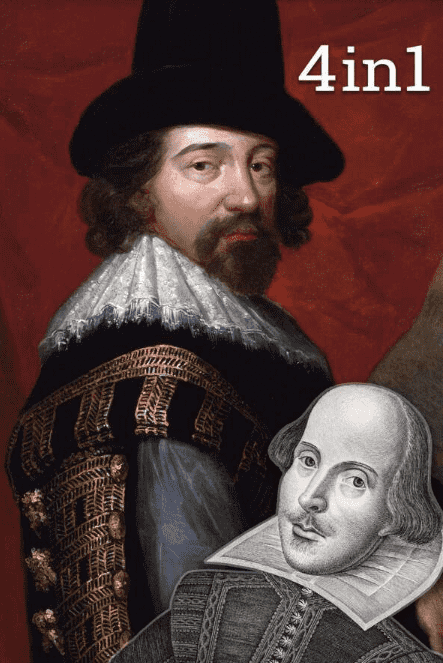
The new book is titled “4in1: Mask of Shakespeare, Mysteries of Bacon, Book by Cartier, Secrets of the NSA.” At the end of the 20th century its author was a colonel, cryptographer and specialist in open-source intelligence (OSINT) in one of Russia's special services. In the following years, he was engaged in journalistic investigations for IT press publications.
Having access to the complete texts of books from Cartier and from Friedman, as well as a multitude of documents (declassified from the NSA archives; surfaced on the Internet from library repositories in a digitized form; as well as found in contemporaries' memoirs and historians' monographs), the “4in1” investigation presents two fundamentally important results.
First, it fully confirms the validity of the conclusions of the French General Cartier, while also presenting a translation of the most significant fragments of his book in combination with the deciphered texts of Bacon's autobiography.
Second, it thoroughly and documentarily demonstrates that the book by the American cryptologist William F. Friedman (and his co-author wife Elizebeth S. Friedman) is a deliberately fabricated lie crafted according to standard secret service recipes. The investigation also gathered documents evidencing not only the intentional deception constructed by the authors but also their most probable motives for participating in such an unsavory story.
Nearly all the documents discovered and used in this investigation as evidence, as well as the complete texts of the book "4in1" in both Russian and English, are available on the website https://4in1.ws for free review and study.
The main surprise of this investigation, however, is the revelation of facts regarding the concealment of particularly interesting fragments from the chapters of Bacon's secret autobiography. In other words, it has been reliably established that a portion of the deciphered Bacon's texts remains unknown, as it has never been published anywhere. But at the same time, it's generally understood where these fragments should be sought.
Which means that the most mysterious pages of this grand story are still waiting for their first discoverers. . .