
Two Minds of a Kind
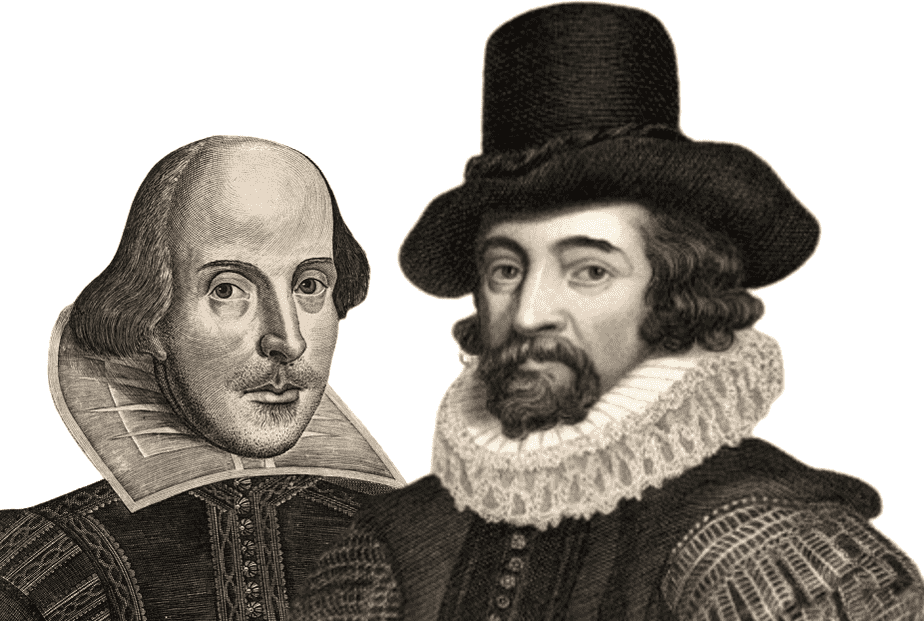 The two towering minds of the Elizabethan and Jacobean periods were Sir Francis Bacon and William Shakespeare.
Bacon is among the most poetic of philosophers and Shakespeare the most philosophical of poets.
The Shakespeare plays have attracted a degree of cultural reverence and vehement emotion normally reserved for religion. Since almost nothing is known about the life of William Shakspere from the historical standpoint, he has become a near mythic character, a recipient of the projections of successive ages.
Certain basic facts and questions need to be clarified and highlighted in order to enable a reasoned discussion to take place about authorship.
- Many writings were published anonymously in Elizabethan England.
- Some were published pseudonymously, i.e. either with a pen-name, or under a borrowed name.
- Francis Bacon is known to have been a concealed poet.
- There was often confusion and speculation about the author or authors of a book.
The above details are well-known to Elizabethan specialists, including those Stratfordians who concern themselves with the history of literature. It is important to begin with these, because, while emphasising the difference between 16th and 21st literary practice, none of these yet gives any reason to doubt William Shakespeare's authorship. However, we are immediately faced with the need for deeper background knowledge, especially when we discover that:
In 1597, when only two poems had been published under the name William Shake-Speare, and no plays at all, it was unambiguously hinted by the poets Hall and Marston that the author was not Shakespeare, the actor, but the lawyer Francis Bacon.
Solid Historical Foundations
What will become increasingly clear is that the authorship question is based on solid historical foundations. It inevitably arises for anyone who is seriously interested in Elizabethan literature and culture. It is especially important for anyone who wishes to understand the Shakespeare plays in their true historical context rather than through the distorting lenses of discredited 19th and 20th century projections. In the 21st century, these issues can finally be treated in a scholarly and fair-minded way.
Due to a couple of centuries of academic overspecialisation, the curious situation arose that in the 19th century, many non-academics knew more about the historical and intellectual context of Bacon and Shakespeare than experts in philosophy or literature. When the authorship question erupted, there was no adequate science of cultural history as an interdisciplinary study.
Bacon the Poet Philosopher
The outdated cultural divide between art and science, wrongly portrayed artists like Shakespeare as an unintellectual, inspired rustic and a scientist like Bacon as a cold, unimaginative thinker. And yet Bacon is among the most poetic of philosophers and Shakespeare the most philosophical of poets. The authorship question may, or may not, be settled by reasoning about facts, but this is not the important point for Baconians. Above all, the shared mentality at work in the Shakespeare and Bacon writings should emerge from a comparative study of the two.