
Please note that it is a condition of the terms of use of these images that they cannot be duplicated or shared. They are licensed exclusively to the Francis Bacon Society for the cultural and educational benefit of its patrons.
Collectively, the fourteen images in this gallery of portraits constitute the most accurate impression available of how Sir Francis Bacon appeared to his contemporaries. All except one were reputedly executed during his lifetime, between babyhood and advanced old age.
It is extraordinary that so little is known regarding the portraits of such a central figure in the history of Western civilisation. This deficiency of art historical research has led to some confusion over the dates and identities of the artists of several of the portraits, and controversy still remains as to whether or not Francis is depicted in at least one of the images included in this collection. Even so, these art works passed down to us over four and a half centuries provide an essential, tangible link with the transformative heart and mind of Sir Francis Bacon, Baron Verulam, Viscount St Alban.
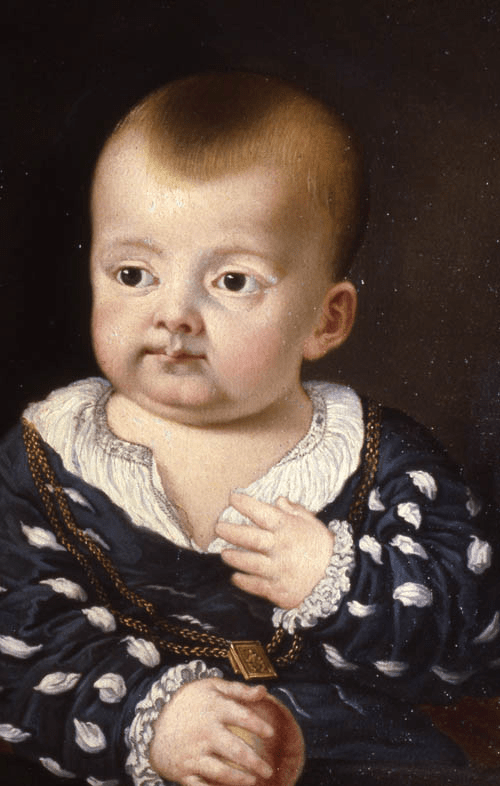
Date: c.1562. Artist: Unknown.
Location: Gorhambury Estate, St Albans, Hertfordshire.
Medium: Oil on board.
Provenance: Never sold.
Image credit: Unknown, An Infant Holding an Apple, 16th century, Oil on panel. Acquired by Sterling Clark, 1914. The Clark Art Institute, 1955.945 clarkart.edu
Paintings of babies were not uncommon among the families of the Elizabethan elite. Francis’s first portrait, however, is charged with symbolism verging on the mystical. Why would a child less than two years old be depicted as holding in his right hand an apple, the pre-eminent symbol of the knowledge of good and evil? And why is his other hand placed in a superior position directly over his heart? Other than representations of the infant Christ, how many other paintings of children are composed with such deliberate esoteric symbolism? What is more, the picture contains a secret. In his book, “Dedication to the Light” (1984), Peter Dawkins exposes the significance of the two miniature portrait pendants suspended on two gold chains, one hiding the other. Dawkins’ close examination of the pendants concludes that they hint at Francis’s royal parentage – that he was indeed the legitimate progeny of Robert Dudley and Elizabeth I. Two versions of this mysterious portrait exist: the original which resides at Gorhambury House, and a copy which is in the Clark Art Institute Collection in Williamstown, Massachusetts. Although the Gorhambury portrait is probably the more reliable in terms of facial likeness, only low resolution digital images of the original portrait are available. Fortunately, permission has been
granted by the Clark Art Institute to use a larger image of their copy in order to see the pendants more clearly. The identities of the artists of both portraits are unknown.
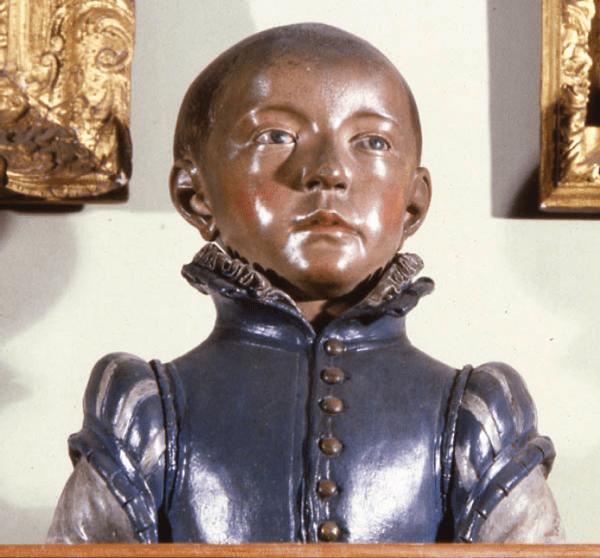
Date: 1566-73? Artist: Unknown
Location: Gorhambury Estate, St Albans, Hertfordshire
Medium: Polychrome terracotta
Provenance: Never sold
Image credit: Souce unknown
Perhaps the most controversial portrait in the collection is this exquisite, life-like bust of a boy whose precise age is difficult to determine. The anonymous sculptor has masterfully captured the expression and bearing of a child of unusual confidence, alertness and intelligence. His steady, penetrating gaze seems to be contemplating the future, or the mystery of life itself. Whether this is a portrait of Francis or Anthony Bacon is for the viewer to decide, but until proven otherwise, its inclusion here is based on the weight of the long-held tradition that the boy in question is Francis. The bust must be seen in its intended context of a group portrait in order to appreciate its original purpose and significance. The same sculptor, possibly an Italian, was commissioned to create companion portraits of Sir Nicholas and Lady Anne Bacon to stand beside the young boy. The question arises: if Francis and Anthony were biological brothers why is there not a fourth bust? Perhaps it is for the same reason that there is no extant portrait of Anthony Bacon as a baby. One possibility is that the bust is a demonstration of the Bacon’s devotion to the Queen as foster parents to her secret offspring.