


Francis Bacon's Ancestral Trees
by Eric Roberts & Julie Kemp
In the Spring of this year 2024, two members of the Francis Bacon Society, art historian Eric Roberts & genealogist Julie Kemp began some important research into Francis Bacon's ancestral trees. They researched both the acknowledged and hidden genealogy and between them have collated, compiled and created three quite extraordinary Francis Bacon ancestral trees.
The Society is both proud and delighted to present these to the wider world along with illuminating and explanatory notes from the creators.
These three beautiful and unique trees are now available exclusively from the Francis Bacon Society Gift store as A3 posters and make an extraordinary gift for any Baconian.
Francis Bacon's Orthodox Ancestry - The Day Tree
Francis Bacon's Concealed Ancestry - The Night Tree
Francis Bacon's Extended Family - The Gorhambury Tree
Please note these images cannot be duplicated or shared. They are for use on the FBS website for the cultural and educational benefit of its patrons and are the copyright of The Francis Bacon Society. All proceeds from sales are for the furthering of the Society's research and educational initiatives.


An Explanatory Note on the Visualisation of Francis Bacon's Ancestral Trees
by Eric Roberts
Designing an ancestral chart for someone as illustrious and significant as the “Father of the Modern World” isn’t something we decided on lightly. Yet, the project has had a momentum of its own, from its beginnings in early-February to completion at the end of March.
Our intention was to produce a poster showing Francis Bacon’s royal descent over four generations from King Henry VII, based on Julie’s research over many years. She had compiled an extensive family tree on her Ancestry site and this provided a structure on which to build.
Neither Julie nor I were aware of any previous attempts to represent Bacon’s royal pedigree. While Baconiana is rich in articles referring to his concealed royal birth none, it would seem, provide a diagrammatic chart showing who his real parents, grandparents and great grandparents were. Nor were SirBacon.org and the Francis Bacon Research Trust sites able to furnish us with any existing graphic representations of Francis’s royal lineage. Wider searches also proved fruitless. It seemed that we were blazing a trail of sorts.
With the past at one’s fingertips, visual inspiration was online in abundance. One superb example of a nobleman’s genealogy stood out because of its orchestration of colour against a pale blue sky. The spatial effect of this is enhanced by perspective: the principal subject dominates the central foreground, his ancestors diminishing in scale as they recede back in time and space.
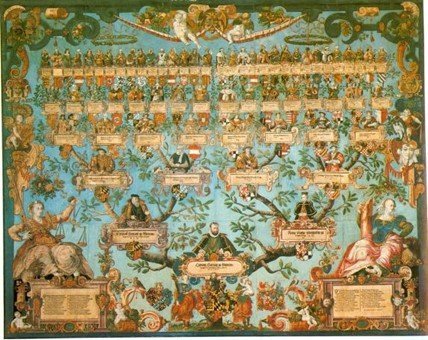
This image provided the impetus to start work on a first draft and I proceeded to hunt for portraits of every person in Julie’s Ancestry tree. Borrowing heavily from Lederlein’s woodblock engraving, the frames and backgrounds of each portrait were removed. This enabled the assembled cast of free-standing characters to be grouped together against an as yet undetermined background.

Seeing all the ancestors arranged on a page prompted Julie to suggest, rather drastically I thought at the time, that we jettison almost half of them and only represent the direct path of the bloodline. Clarity won over comprehensiveness and this led to a first draft of the poster. At this stage, the background was still provisional.
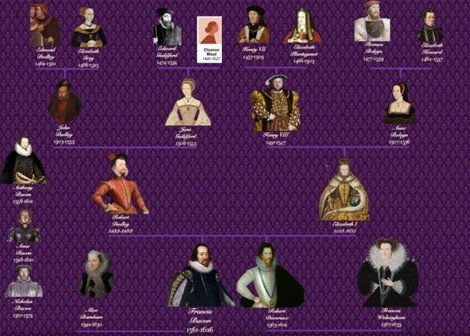
 A couple of weeks were spent in limbo, looking for the right imaginary space in which to place Francis Bacon’s ancestors. There were two main options: a central tree, as in Lederlein’s engraving; or some sort of architectural structure, preferably from the Elizabethan era.
Old books on English architecture, such as Vitruvius Britanicus or the British Architect (1717) were full of fascinating illustrations, none of which I could see how to adapt to our needs. In frustration, I turned to the wishing well of A.I. image generation.
At first the results seemed promising, yet something wasn’t right.
The main problem was the visual disconnect between the monochrome A.I. background and the ancestral figures which were in colour.
The same dilemma applied to the search for an image of a tree to support the portraits. A 19th century book of engravings of ancient English oaks was the closest I could get to what I was looking for. Another dip in the wishing well yielded similar results.
It was only when a slight alteration to the prompt was made that an image appeared which might just work. Although it was in some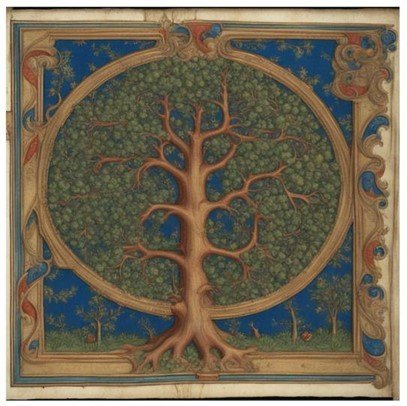 ways crude, with arbitrary artefacts here and there, it had a certain charm and, serendipitously, the structure worked.
The next step was to see whether the portraits with their extracted backgrounds and the A.I. generated tree sat well together. They didn’t. In fact, the group of royal personages perched in a tree seemed slightly ridiculous. Something was missing.
Perhaps it was the large internal circular border surrounding the tree that suggested the solution of re-framing all the portraits so as to resemble miniatures, much in vogue among the aristocracy during Elizabethan and early-Jacobean times. Oval frames were also widely seen in engraved portraits, such as Simon van der Passe’s famous image of Bacon as Lord Keeper in 1617.
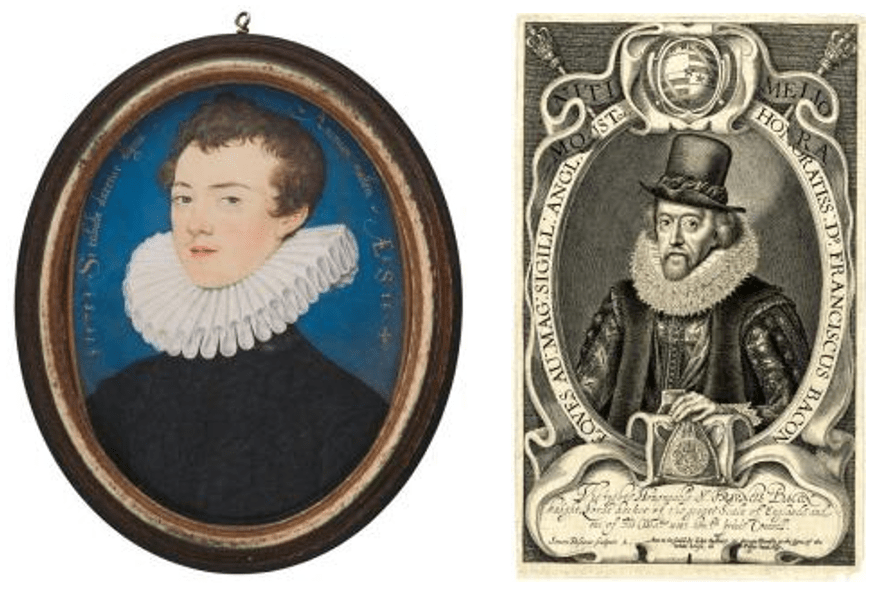
In their new oval frames, the portraits seemed more at home in the overall scheme of things, “like fruit” as someone suggested. Having established an imaginary space, I decided to darken the background by adjusting the exposure to see what effect this would have on the portraits. To my surprise, I found that this simple adjustment instantly transformed the scene from day into night. It was immediately obvious that Francis Bacon’s clandestine royal heritage, painstakingly reconstructed by Julie, was more suited to a nocturnal setting than the original brightly lit scene.
It was at this point, half way into the project, that the idea of two posters arose. Why not also show Francis Bacon’s orthodox genealogy alongside his royal ancestry? On reflection, it became obvious that from the age of about sixteen* he carried the burdensome cross of his dual genealogy. The terrible secret of his legitimate royal birth must have acted as fuel on the fire of his burning desire for a brighter future for humanity. *c. 1576, when he first became aware that his parents were not Sir Nicholas and Lady Bacon, but the Earl of Leicester and the Queen of England.
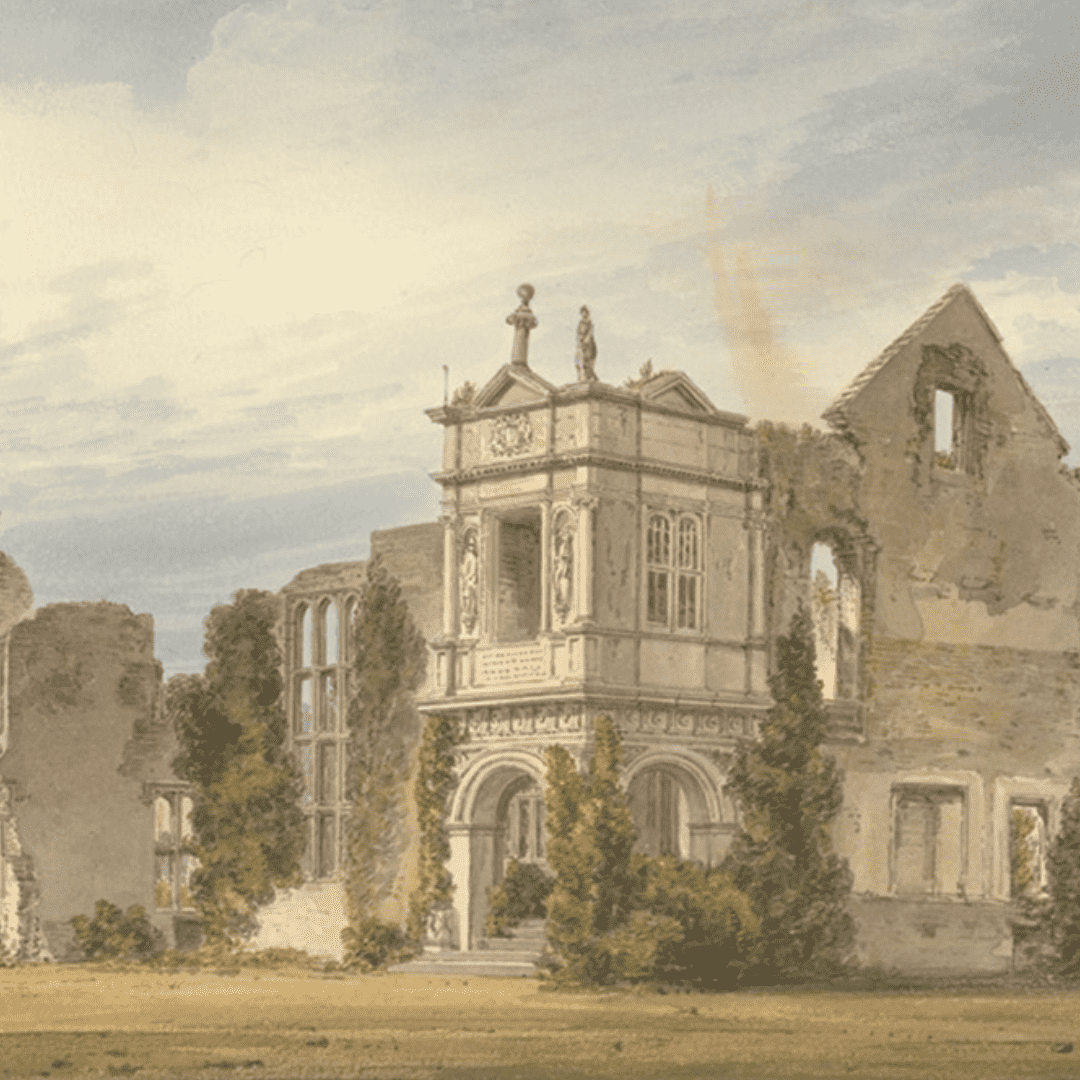
Following consultations, it was decided to proceed along these lines: one tree for Bacon’s conventional ancestry (day) and one for his concealed identity (night). Thanks to Julie’s knowledge and research skills, this was not too difficult a task. The goal was now clear and, software crashes aside, work proceeded smoothly. Lastly, it was decided that a third poster was required in order to show Francis Bacon’s extended family on both sides, his cousins and half-siblings. Often referred to in writing, these relations played a significant role in Bacon’s political career and social life. This supplementary chart has been superimposed on a 19th century watercolour painting of Old Gorhambury House, just to add a sense of history and place.
A few words about the portraits themselves. Even I’m shocked by my own manipulative approach to precious portraits from the past. Images of the original paintings have been brutally cropped, and even reversed in some cases. Where there were no extant portraits of certain ancestors, A.I. provided a simulation or dummy figure whose face could then be rendered anonymous with pixelation. This playful approach to historic portraits is, I hope, forgivable, as there would have been too many unobtainable portraits to complete the orthodox genealogy.
This first attempt at visualisation is only one of countless ways to represent the same, transgressive information. The Night poster is nothing if not controversial. Thanks to the Francis Bacon Society, Julie Kemp’s research into Francis Bacon’s ancestry can now be broadly disseminated, hopefully for many years to come.
Our thanks to Sally Gibbins for her advice throughout the process, and to SirBacon forum members who provided criticism and encouragement along the way. My thanks to Julie for trusting me with her work. As I wrote to her early on, you are the architect and I am the decorator.
Climbing the Trees
Researching Sir Francis Bacon's Royal Ancestry
by Julie Kemp

After years of online research into my family’s genealogy, I reached a point where I could go no further. In the process, I’d discovered that my father’s English heritage can be traced back to King Henry VIII’s mistress, Elizabeth “Bessie” Blount – my 11th great-grandmother. Then I came across a book by Australian psychiatrist and psychotherapist, Dr George Blair-West, The Way of the Quest, a semi-fictional, self-help guide based on the life of Francis Bacon. The book resonated so strongly with me that I decided to develop a family tree for Francis Bacon. Using the Ancestry website as a means of learning more about this most remarkable man, the more I learned the more there was to discover.
I soon became overwhelmed (and remain so) at the range and depth of research and scholarship found on such sites as the Francis Bacon Society, the Francis Bacon Research Trust and SirBacon. As I learned more about Francis Bacon’s concealed identity, both as an unacknowledged prince of England and as the author of the Shakespeare works, his royal ancestry or pedigree became more apparent. Eventually, I was able to assemble a tree showing four generations of ancestors dating back to the reign of Henry VII.
The Two Trees
In February this year, I made contact with a fellow Australian member of the FBS, Eric Roberts. I gave him full access to several of my Ancestry sites so that he could read the historical profiles on each person and see how they were related to Francis Bacon. A collaboration soon developed with the aim of designing a poster based on my work.
At some point, we realised that Francis Bacon had two complementary genealogies: one known to all the world, the other known only to his most trusted associates. This fact prompted the idea of making two posters, not one. As Eric worked on the design of the trees, my task now was to build another ancestral tree based on existing conventional genealogies showing Francis Bacon’s descent from the Bacon and Cage families in the 15th-century. Needless to say, there were unresolvable anomalies to deal with regarding the exact names and dates for many of the earlier ancestors, but what these two trees show are the many influential figures present in both his assumed public lineage (Day), and his secret royal ancestry (Night).
Parents
Francis Bacon’s sudden realisation, at the age of 15 or 16, that his true, biological parents were not Sir Nicholas and Anne Bacon, but rather the ultimate “power couple” of the Elizabethan Age, Robert Dudley and the Queen of England, must have surely broken his world in two. Such close proximity to absolute power would eventually destroy his younger brother, Robert Devereux, but Francis chose the middle way by concealing his true identity and ruling with his quill.
The Earl of Leicester, Robert Dudley, and the young queen took an interest from the outset in the intelligent little boy, so lovingly nurtured and cultivated by his foster parents, the Bacons. It may have been Dudley himself, with his love of spectacle and theatre, who first encouraged the young prodigy to write for the stage. The pious Lady Bacon frowned upon such frivolous behaviour, having the spiritual well-being of her ward upper-most in her mind.
As the adoptive guardian of a secret prince of England, Sir Nicholas Bacon not only provided the boy with the best possible education, but he also endowed his charge with the practical wisdom of his East Anglian upbringing. Perhaps Francis Bacon’s gift for conceiving a need for something, and then systematically setting out to solve the practicalities of how it should be implemented, was something that he learned from his foster father. The Bacon family motto, Mediocria Firma, stood him in good stead all his life.
Brothers
Growing up together in York House and later at Gorhambury, Anthony was Francis’s lifelong friend and close collaborator. Having been liberally endowed by his father with lands that provided him with regular income, Anthony willingly facilitated and sometimes financed Francis’s many endeavours, such as his clandestine literary output under the name of “William Shakespeare”. They shared a keen interest in intelligence gathering and learnt the deep and complex arts of cryptography, so essential to a developing nation state that was under threat from so many quarters at home and abroad. Anthony’s final illness and death in 1601 at the age of 43 must have been an inconsolable loss to Francis.
His younger, biological brother, the Earl of Essex, Robert Devereux, also proved to be a staunch ally of Francis in their adulthood. They both used their talents to assuage their mother, the queen, when one or the other was out of favour. The queen valued and used them very differently but each was devoted to her, albeit one lost his head due to his impetuosity from which Francis could not save him.
Conclusion
With so many well-connected and highly educated ancestors in both his genetic and familial lines of descent, we can see that this giant of English literature did not simply appear out of nowhere.
As the last of the Tudors, he embodied the violence and the brilliance of the age. Yet, he was able to sublimate the painful dichotomy of his two-fold identity in the creation of the Shakespeare canon.
Hopefully, the accompanying posters will help in the understanding of the exceptional circumstances into which Francis Bacon was born.