
Disclaimer: It should be clearly understood that Baconiana is a medium for the discussion of subjects connected with the Objects of the Society, but the Council does not necessarily endorse opinions expressed by contributors or correspondents.
Baconiana
The Online Journal of the Francis Bacon Society
Volume 1 | Number 9
November 2021
Edited by Dr John Torbert
Contents
II. A 19th Century Argument for Francis Bacon as the True Author of Shakespeare, by Col. H.L. Moore
IV. I, Prince Tudor, Wrote Shakespeare by Mark W. Finnan
V. Was the Very Mysterious Death of Sir Nicholas Bacon the Result of Poisoning? by A Phoenix
VI. Bacon-Shakespeare Secret Republican Father of the Modern World by A Phoenix
I. Editorial
History of Baconiana Journals
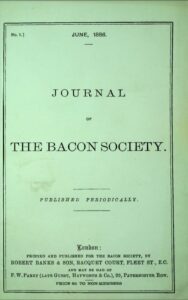
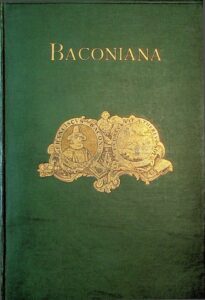
The first Issue (No. 1) of the Journal of The Bacon Society was printed in June 1886 followed by Nos. 2-6, issued up to August 1887, comprising Volume One. The journals were printed in paperback form and later could be ordered by volume, bound in book form. In May 1892, the name of the journal was changed to Baconiana. As time passed, Baconiana went through several Series, each time re-starting with issue No. 1. The “First Series” of Baconiana only had 2 issues, The “New Series” began in 1893 and went on to include 40 issues. The “Third Series” of Baconiana began in January 1903, with 196 issues ending in June 1999. Finally, the Online Journal of the Francis Bacon Society began in July 2007 and this issue is its No. 9. Hence, a total of 258 issues of Baconiana have been produced in one form or another since this Society was established to promote the study of the Works and Life of Francis Bacon. All these journals are available on The Francis Bacon Society website, bar one, which is to be added shortly. Additionally, there is a helpful Index comprising a Bibliography of topics and authors which encompasses all of the issues from 1886 through 1999.
https://francisbaconsociety.co.uk/baconiana-journals/
Introduction
In this issue we have a never before published contribution from one of The Francis Bacon Society’s charter members, Colonel Horace L. Moore from Lawrence Kansas USA. Colonel Moore is one of the 71 names on the list of Members, Associates and Honorary Members in the Bacon Society’s First Annual Report (Issue #4; August 1887). And, he was an early author for the Journal of the Bacon Society, contributing an article entitled A Comparison of Bacon’s Advancement of Learning and the Play of Hamlet. (Baconiana (No. 5, December 1887).
In 2019, nearly 130 years after Colonel Moore’s article was published, his great-great-grand-daughter, while clearing her parent’s estate, found some hand-written scrolls; one was the above-mentioned article printed in 1887; another was the article printed here for the first time. This article entitled A 19th Century Argument for Francis Bacon as the True Author of Shakespeare” is a good reminder of the strength of argument for Bacon’s authorship of Shake-speare that has existed for many generations.
One of the most ardent supporters of Francis Bacon was Alfred Dodd, author of the book Francis Bacon’s Personal Life Story. He also wrote five articles for Baconiana between 1935 to 1947. In the Preface to his book, Dodd admits that as a young man growing up, he assumed to be true, the allegations of orthodox historians that Francis Bacon was an ambitious courtier, eager for power, and a corrupt judge. Then Dodd makes an interesting statement:
“For years I had been a devout worshipper at the shrines of Lord Macaulay, Lord Campbell, Dr. Abbott, Dean Church, Professor J. Nichol, and other eminent scholars…Then…something occurred that urged me not to accept their conclusions as final…So I began a pilgrimage of hard reading and personal research…I began my literary journey with an intense dislike of this corrupt genius. I ended with the conviction that these well-known critics were totally wrong in their views respecting his character and disposition… harsh and unjust …my detestation had slowly turned to admiration, so that at the end of the trail I was compelled to say, in all honesty to myself, slightly misquoting Ben Jonson, I love the man and do honour his memory above all others.’’
Have you ever wondered what occurred to Alfred Dodd that induced him to become the staunch defender of Francis Bacon that he became? Many people don’t know it, but in a similar manner to the way that other Baconians were and are initially attracted to Francis Bacon by “strange”, maybe “psychic” influences, so was Alfred Dodd. He explains the events that introduced him to Francis Bacon in his little book The Immortal Master. In this issue, Maryellen McCabe provides a summary of experiences that Dodd described: The Immortal Master, and the Mystical Experiences of Alfred Dodd with Sir Francis Bacon.
Mark Finnan makes a contribution: ‘I, Prince Tudor, Wrote Shakespeare, that reminds us of Francis Bacon’s Genius and superhuman ability to tap into a source of information not available to most humans. This capability of accessing a higher source of consciousness is famously described by his trusted contemporary, Dr Rawley, who served Bacon in the latter years of his life and was given the responsibility for the care and publication of Bacon’s unfinished papers. – “If ever there was a Beam of Knowledge derived from God upon a Man in these modern days, it was upon him, for though he was a great reader of Books, yet he had not his Knowledge from Books, but from some Grounds and Notions within himself.”
From a truly encyclopaedic knowledge of Bacon’s writing, of other contemporary writers, and seemingly most everything ever written about Bacon and others of his time, A. Phoenix contributes three articles:
1) In Queen Elizabeth’s time when everything seems to be part of a giant enigma, is it really likely that Sir Nicholas Bacon died because his barber let him take a nap for a few hours next to an open window? Was the Very Mysterious Death of Sir Nicholas Bacon the Result of Poisoning?
2) Pertaining to Francis Bacon’s multi-pronged desire for a Reformation of the Whole Wide World, it is well known from his outward writings that he promoted a more systematic approach to acquiring knowledge (which we now call “Science”) while at the same time stressing the need to do this with the spirit of Charity, and for the purpose of improving the condition of all mankind. But, did Francis Bacon go further, envisioning a better form of government conducive to a more egalitarian society? In the age of kings and queens, it would be political heresy to outwardly advocate for an alternative form of government to monarchy. But he did; he subtly prepared the ground and planted the seeds of such an idea, for a better form of government, by occasionally including in the Shakespeare Plays demonstrations of beneficial or virtuous aspects of past republican societies and leaders. In Bacon-Shakespeare Secret Republican Father of the Modern World, the author fully explains how Bacon did this.
3) On Progress in 1592, Queen Elizabeth visited Lady Russell’s estate where she and and members of her Privy Council were presented a 3-part Entertainment published shortly afterwards as Speeches Delivered to her Maiestie at the Last Progresse, At The Right Honorable The Lady Rvssels, at Bissam. The author provides solid evidence that these little-known speeches, generally thought to have been prepared by Lady Russell herself, are actually some early works of Francis Bacon in The Anonymous Bisham Entertainment (1592) Written by Francis Bacon for the Visit of his Royal Mother Queen Elizabeth at the Estate of his Aunt Lady Elizabeth Russell and its links to a Significant Number of his Shakespeare Plays.
Dr John Torbert November 2021
II. A 19th Century Argument for Francis Bacon as the True Author of Shakespeare
Col. Horace L. Moore[1]
The first time that I ever heard of Francis Bacon I heard that he was “the wisest, brightest, and meanest of mankind”. I have since heard that the man who said this of Bacon, might himself well be put down as the meanest of mankind, although he would stand no chance of being included among the wisest or brightest.
What Macauly says of Bacon is known to everybody. He charges him with ingratitude in his treatment of the Earl of Essex, with cruelty in the treatment of Peacham, and with corruption in the administration of the great office of Lord Chancellor of the Kingdom. I shall tell you what I think of all these as I go on, and give you my reasons for the opinion that I entertain.
There is another matter that I shall attend to. There are people who entertain the opinion that Wm Shakespeare could not have written the plays that are known by his name. And this opinion is by no means a new one. Many scholars and thinkers were troubled with doubts on this subject when the proposition that Bacon wrote the plays was first formulated by the American woman Delia Bacon.
Coleridge says “In spite of all the biographies, ask your own hearts, ask your common sense to consider the possibility of this man (Shakespeare) being the anomalous, the wild, the irregular genius of our daily criticism. What! Are we to have miracles in sport? or does God choose idiots by whom to convey divine truths to man?” Hallam says: “If there was a Shakespeare of earth as I suspect, there was also one of heaven, and it is of him we desire to learn more”.
Finally, these doubts floating in the air took shape and the first person who denied the authorship to Shakespeare was Col. Joseph C Hart in a book published by Harper Brothers in 1848[2], or 8 years before the publication of Delia Bacon’s article in Putnam’s Monthly. It will be seen that Col. Hart mentions no name to take the place of Shakespeare but maintains that Shakespeare could not have been the author. I quote: “Alas Shakespeare! Lethe’ is upon thee! But if it drowns thee, it will give up, and work the resurrection of some better man and more worthy. Thou hast had thy century; they are about having theirs. He was not the mate of the literary characters of his day, and none knew it better that himself. It is a fraud to thrust his surreptitious fame upon us. He had none that was worthy of being transmitted. The enquiry will be, who were the able literary men who wrote the dramas imputed to him. The plays themselves or rather a small portion of them will live as long as English literature is regarded worth preserving. The authorship of the plays is no otherwise material to us, except as a matter of curiosity and to enable us to render exact justice; but they should not be assigned to Shakespeare alone, if at all”.
Then came Delia Bacon claiming that Francis Bacon was the head of a school that wrote the dramas. And then Judge Holmes, who rejected the idea of a joint authorship and claimed that Bacon, and he alone, was the author of the Shakespeare drama.
In what I shall have to say about Francis Bacon I shall quote the facts mostly from his biographer James Spedding: The Works and from The Life and Letters. The facts touching the life of Shakespeare are taken from the Outline of the Life of Shakespeare by J.O. Halliwell–Phillips. I am also indebted to a pamphlet by the editor of Bacon’s Promus subtitled Did Francis Bacon Write Shakespeare?
Nicholas Bacon was Lord Keeper of the Seal during the first 20 years of the reign of Queen Elizabeth with the rank of Lord Chancellor. The youngest of his children was Francis Bacon born January 22 1561. Bacon’s mother was a daughter of Sir Anthony Cooke, who was a tutor to Edward the VI. This woman was thoroughly educated in what was considered an education at that time. She corresponded with her sons in Greek, translated Italian theological works into English, and English works into Latin. She was a woman of great spirit. Her creed was the creed of John Calvin and in her notions of morality, she was a strict Puritan.
In 1564, Wm Shakespeare was born at Stratford upon Avon. His father was John Shakespeare and his mother’s maiden name was Mary Arden. Neither of these people were able to read or write. I want to say here that nobody proposes to hold Wm Shakespeare responsible for the fact that his parents were uneducated but the fact is mentioned to show that his family lacked something of the educational habit possessed by the other.
Twelve years from the birth of Bacon finds him at Trinity College Cambridge. He had been bought up in the court of Queen Elizabeth. The sprightly young lad had attracted the attention of the queen and she was in the habit of calling him her young Lord Keeper.
In the year 1573, Shakespeare was 9 years old. His biographers insist on supposing that he was attending school at Stratford-upon-Avon although there is no evidence that he ever went to school a day in his life.
Four years later, that is in 1577, Bacon left the college, having as Spedding says, ‘’run through the whole circle of the liberal arts”, he had acquired a dislike for the philosophy of Aristotle. Spedding adds “If our study of nature be this barren, he thought our methods of study must be wrong. Might not a better method be found?” The suggestion was simple and obvious. But in him the gift of seeing in prophetic visions what might be and ought to be was united with the practical talent of devising means and handling minute details. He could at once imagine like a poet and execute like a clerk of the courts.
Spedding has no idea that Bacon wrote Shakespeare and his testimony must be taken as entirely unbiased. In the year 1576 Francis Bacon was enrolled as a student at law at Grays Inn. In 1577 we find Bacon with the British ambassador at the court of France. Spedding says “the business of the mission to which he was attached took him in the wake of the court through several of the French provinces – from Paris to Blois, from Blois to Tours, from Tours to Poitiers when in the autumn of 1577 he resided three months.” In Bacon’s eighteenth year, Hilliard painted Bacon’s portrait and under the painting wrote “If one could but paint his mind”. I desire to mention here that one of the first plays written is the first part of Henry VI and to say that the scene of that play is laid in the provinces of France that Bacon had travelled through.
Of Wm Shakespeare, Halliwell-Phillips says “Sometime afterwards, most likely in 1579 when he was in his sixteenth year he was apprenticed by his father to a butcher” and adds when he killed a calf, he would do it with a high style and make a speech.
Bacon remained in France till the beginning of 1579 learning French Italian and Spanish, studying political economy and acquainting himself more particularly with the characters and resources of the reigning sovereigns of Europe. In the beginning of 1579 on the 7th of February at Paris, Bacon relates that he dreamed that his father’s house in London was plastered with black mortar, and in a few days, he heard that his father had died of a sudden illness. It had been the intention of his father to provide for him, but his sudden death prevented this and left Francis without a fortune and dependent on his own resources. He labored under another serious disadvantage as far as political preferment was concerned. His kinsmen the Cecils were in power, and through jealousy they not only refused to assist him but destroyed his chances with the Queen by reporting to her that he was a dreamer entirely unfit for any sort of business. He was forced to continue the study of the law and to adopt it as a profession. He said long afterwards that the study and practice of the law was against the “bent of his genius”. He said that he had been as a stranger in a strange land.” He resided at St Albans after his return to London. The scene of the 2nd part of Henry VI is land at St Albans.
In 1579 nothing is known of Wm Shakespeare. Some of his biographers have guessed that at this time he was teaching school in the country, and others that he was at work in an attorney’s office. These guesses have been made to meet the demand of the plays for an author that possessed learning and that knew the law. There is a tradition that he continued in the employ of the butcher.
1582, Spedding says: “After this we have no more of Bacon till April 15th 1582, but as we find that he was there residing as before in Grays Inn, where he was admitted Utter Barrister on the 27th of June following”. We may suppose that he had been going on quietly with his legal studies. Spedding adds “What particular studies engaged him in 1582 we are not told”. But I may add that sketches of several of the earlier plays are attributed to this period of Bacon’s life.
In 1582 we learn that William Shakespeare marries. This seems to be authentic, but there are also traditions of his having gone to Bidford to out drink the residents of that place and that he got the worst of it. There is also a tradition that he killed Lucy’s deer and poached in the parks until “after being oft whipped” he fled from Stratford to escape criminal prosecution and imprisonment.
In the following year 1583 Bacon is selected to Parliament and at about the same time writes his letter of advice to Queen Elizabeth. He still continues to live in retirement or in umbra as he himself says in a letter to Lord Burleigh. He still pursued his legal studies and in 1586 he becomes a Bencher. The following year Christmas revels were celebrated at Grays Inn consisting of masques and dumb shows, and a tragedy entitled “The Misfortunes of Arthur” to be exhibited before the Queen, for which Bacon wrote at least some additional speeches.
It is in this year 1587 that Shakespeare is said to have come to London with Burbage’s company of players, which had been playing for the first time at Stratford and then earned his living by holding horses at the Globe Theater. He is as yet unsuspected of being the author of anything.
The next five years 1587 to 1592 are important ones in the life of Bacon. They reveal him still pursuing his studies at Grays Inn and also taking active part in the debates in the House of Commons, where he has acquired an ascendency as an orator. In 1591 at the age of 31 he wrote to Lord Burleigh in which he says he has “vast contemplative ends”, that he has “taken all knowledge to be my province” and that his means are not sufficient to enable him to carry out his plans. He asks the support of Burleigh and continues “… and if your Lordship will not carry me on, this will I do: I will sell the inheritance that I have and pursue some lease of quick revenue or some office of gain to be executed by deputy, and so give over all care of service and become some sorry book maker, or a true pioneer in that mine of truth (as was said) lay so deep”. There is no question that at this time Bacon was in embarrassed circumstances, and had frequent recourse to borrow money from the Jews and Lombards and was once thrown into a sponging-house on account of a bond that was not to fall due for two months. The opportune return of his brother Anthony from his travels abroad relieved him temporarily from these embarrassments. There are people who believe that these incidents were the foundations of the Merchant of Venice in which the poet immortalized the hard and implacable Jew in Shylock and the generous brother Anthony as Antonio. It is at this time that Bacon describes himself as “poor and sick, working for bread”. His legal business was small and of little value as a source of revenue. His determination to purchase some lease of quick revenue, and to become a sorry book maker is shortly followed by the production of the plays and the appearance in 1593 of the Venus and Adonis and in 1594 of the Rape of Lucrece, and at the same time Robert Greene discovers that a new poet has arisen in the person of Wm Shakespeare.
Shakespeare has now been in London 5 years, and in that short time has become a literary star of such magnitude as to excite the envy of Robert Greene. That these 5 years in London were years of intense mental as well as physical activity may be inferred from the fact that in that time Shakespeare in addition to his duties as horse-holder and afterwards actor at the theatre is the reputed author of the following plays acted prior to the year 1590: Titus Andronicus, Pericles, Taming of the Shrew, Love’s Labour’s Lost , Two Gentleman of Verona , Henry VI (3 parts), and All’s Well That ends Well .
In passing I desire to say a word about this 1st part of Henry VI. It was one of the first of the Shakespearean plays written at about the time Shakespeare ran away from Stratford. At a time when Shakespeare had little knowledge of books, unless he was born with a knowledge of Latin and Greek, of ancient history and mythology, of medicine and law, and this other knowledge that in the case of ordinary mortals comes by hard work and not by inspiration. But of this play Gervinus, the great German commentator, says “This extraordinary ostentation of manifold learning in the play is not like Shakespeare”. I agree with him. The “manifold learning” is most unlike the Shakespeare of history. “This ostentatious display of manifold learning” so soon after being employed as a butcher and being “oft whipped”, is the height of absurdity.
Bacon has now made the acquaintance of the young theatre going Lords and courtiers Essex, Southampton, Rutland and the rest and in 1593 the Venus and Adonis is dedicated to Southampton. In this same year Bacon made his celebrated subsidy speech in Parliament, in which he incurred the displeasure of the Queen and defeated his hopes for political preferment. Discouraged by this, he returned to his chambers at Grays Inn where he spent his time wrapt in secret and philosophical studies. The entries in his Promus of Formularies and Elegances of this date are evidence that his reading included such ancient authors as Horace, Ovid, Virgil, Seneca, Erasmus, besides French, Spanish, and Italian works. He was taking a survey of all the ancient and modern learning and noting down the principal land marks in the Promus “to satisfy my remembrance the more strongly”.
In 1594 Bacon was called in to assist in the preparation of the Christmas Revels at Grays Inn, which were to be unusually elaborate and for which he wrote a masque acknowledged by Mr. Spedding to be genuine. Upon this occasion the Shakespeare Comedy of Errors made its first appearance on the stage.
Bacon was next concerned with the aid of the Earl of Essex to procure for himself the appointment of Solicitor General, in which he is unsuccessful. We next find him writing a “device” to be presented by Essex on Queen’s Day, entitled “The Device of the Indian Prince”. This “device” is repeated in the second act of Midsummer Night’s Dream which appeared on the stage a few months later.
During all these years from 1587, the date of Shakespeare’s arrival in London, to 1595 we hear that he was serving at the door of the Globe Theatre, of his appearance in 1593 with Burbage’s Company before Queen Elizabeth and a supposed gift to him by Southampton in recognition of the dedication of Lucrece.
From 1595 to 1600 we only catch an occasional glimpse of Bacon. His Ill success in obtaining political preferment from Elizabeth has driven him again to his poor cell at Grays Inn or Twickenham where he seems to be employed in his philosophical writings. I quote from Spedding: “The reluctance with which he felt to devote his life to the ordinary practice of a lawyer cannot be wondered at. It is easier to understand why Bacon was resolved not to do that, than what other plan he had to clear himself of the difficulties which were now accumulating upon him, and to obtain means of living and working…... What course he betook himself to as the crisis at which we have now arrived, I cannot possibly say. I do not find any letter of his which can possibly be assigned to the winter of 1596, nor have I met any among his brother’s papers with anything which indicates what he was about.”
The hypothesis that Bacon had entered in to an arrangement with Wm Shakespeare to furnish plays for the Globe Theatre helps Mr Spedding out of this difficulty. It accounts for the production of the plays, which never can be done if Shakespeare alone is brought into the account. It answers the question as to what Bacon was about, which Mr Spedding is perplexed with. We know that the acting of the plays at the Globe and Blackfriars made Shakespeare a rich man. I think we shall some time know that the production of the plays furnished Bacon with that lease of quick revenue which he wrote Lord Burleigh he was so anxious for.
At this time 1597 Shakespeare was a shareholder and manager of the Globe and Blackfriars Theatres, and had at this time accumulated money enough to buy New Place at Stratford upon Avon. He has also acquired property in the Parish of St Helen’s Bishopsgate and here I will leave him for the present, Manager, Actor, already rich and rapidly accumulating property.
The Earl of Essex. It was about the year 1592 that Bacon made the acquaintance of the Earl of Essex. Francis and Anthony Bacon at this time were his secretaries. The Earl of Essex did for Francis Bacon, or attempted to do all that one man can ask from another. Essex asked the Queen to appoint Bacon Attorney General and pressed his suit with all the ardour possible. Essex promised to put up his whole vest of favour and credit with the Queen for Mr. Bacon’s preferment before that of Mr. Edward Coke. He did all that he could do to secure this place for him and when he failed in that he tried to get him appointed Solicitor General but without success. When Essex failed in this, he determined to do something for Bacon and so presented him with a piece of land said to be in Twickenham Park.
Macauly says of Essex, “The person on whom, during the decline of his influence, he chiefly depended, to whom he confided his perplexities, whose advise he solicited, whose intercession he employed, was his friend Bacon. The lamentable truth must be told, this friend, so loved, so trusted, bore a principal part in ruining the Earl’s fortunes, in shedding his blood, and blackening his memory.”
It is important to know whether this charge is true or not. I have admitted that Essex tried to help Bacon to a place in the government, did all that he could for him, and when that suit failed the Earl presented him with a piece of land worth 1,800 pounds. All that is known about this transaction is the account left by Bacon. I quote: “After the Queen had denied me the Solicitors place, for which his Lordship had been a long and earnest suitor on my behalf, it pleased him to come to me from Richmond to Twicknam Park, and brake with me and said ‘Master Bacon, the Queen hath denied me yon place for you, and hath placed another; I know you are the least part of your own matter, but you fare ill because you have chosen me for your means and dependence; you spent your time and thoughts in my matters: I die (these were his very words) if I do not somewhat towards your fortune: you shall not deny to accept a piece of land which I will bestow upon you …”
A few days later Bacon wrote to Essex and closed with the following words. “For your Lordship, I do think myself more beholding to you than to any man, and I say, I reckon myself as a common, (not popular, but common), and as much as is lawful to be enclosed of a common, so much your lordship shall be sure to have”. This was four or five years before Essex committed treason. He was still a loyal subject to the Queen, but seems as though Bacon foresaw the storm that was coming, and while he did all he could to hold Essex to his allegiance, Essex did another thing. Bacon never lost an opportunity to impress upon the Earl the fact that a subject’s first allegiance was to the sovereign. When they were talking over the gift of the land Bacon said in substance. “I can be no more yours than I was! It must be with the ancient savings – that is faith to the king, and his other lords. I am but as a common. You have for your own share only so much as is lawful to be enclosed; that is I can only offer you such services as can be lawfully rendered by one whose chief service is due to the state.” Bacon’s talk sounds like the answer of Banquo when Macbeth proposed “to make honor for him”. Banquo answered: “So I lose none in seeking to augment it, but still keep my bosom franchised and allegiance clear, I shall be counselled.”
The friendship between Bacon and Essex was as fast as ever during the next three years. Bacon used all the means in his power to keep the Queen on friendly terms with the Earl, but the fact is that Essex’s ambition led him on to higher aspirations than could be executed by any loyal subject. And while the Queen would not brook disloyalty, Essex could not brook restraint. There are in Spedding letters by the dozens written by Bacon to Essex advising him to keep on friendly terms with the Queen and loyal to his sovereign.
In 1599 Essex was appointed Lord Deputy to Ireland. Bacon used his utmost endeavour to keep Essex from accepting that command. Spedding quotes from Bacon’s Apology: “I am sure I never in anything in my life-time dealt with him in like earnestness, by speech, by writing and by all means I could devise, for I did as plainly see his overthrow chained as it were by destiny to that journey as it is possible for a man to ground a judgement upon future contingents. But my Lord, howsoever his ear was open, yet his heart and resolution was shut against that advise.”
Camden says of Essex at this time. “such did he bear himself, that he seemed to his adversaries to want nothing more than to have an army under his command and to bind martial men unto him; and some feared he entertained some monstrous design, especially seeing he showed his contumacy more and more against the Queen, that had been most bountiful to him.” His treason was already in the air. Men said that he was a most unsafe man to trust and they were already getting into that mental condition in which nothing that he might do would surprise them. Bacon was not the only man who was suspicious of the result.
Essex went to Ireland. He wasted an army of 18,000 men. At the end of a strenuous campaign of two months he had less than 4,000 men for duty without having fought any considerable battle. He returned from Ireland not only without orders but against the positive orders of the Queen, and without warning appeared at the Court. The Queen received him kindly on Friday. Saturday, he was commanded to keep his own chambers untill he had seen the Council. Sunday, he had been heard by the Council. Monday, he had been committed to custody, but in the custody of the Lord Keeper who was his best friend in the Council. The result was that the storm blew over and while Essex was not restored to the favour of the Queen, he was released and permitted to come and go as he pleased, only he was not permitted to appear at Court.
It must be borne in mind that at this very time there was a conspiracy on foot between Essex, Mountjoy, Southampton and the King of Scotland, to depose Elizabeth and change the succession. Of course, nobody outside of the conspirators knew any of this. Bacon had influence enough with the Queen and the Council to cause Essex to be arraigned, not upon the Star Council but as a sort of Joviate Trial at York House where Bacon as a law officer of the Crown spoke for the prosecution, if a prosecutor it can be called. Bacon’s speech was an apology for Essex and resulted as I said in his release. Bacon saw the Queen and pleaded with her to restore the Earl to favour. He wrote letters to the Queen for Essex to send as his own.
Time and again Bacon has impressed or tried to impress upon Essex the fact that his loyalty to the state would outweigh any other human consideration. And that if Essex should become disloyal, he could expect no support or countenance from the man who had done more than all others to smooth over his faults and enable him to keep his place in the estimation of the Queen. I quote a letter of Bacon dated July 20th 1600: “My Lord – No man can better expound my doings than your Lordship, which maketh me need to say the less. Only I humbly pay you to believe that I aspire to conscience and commendation first of bonus civis which with us is a good and true servant to the Queen and next bonus vir, that is an honest man. I desire your Lordship also to think that though I confess to love some things better that your Lordship, as the Queen’s service, her quiet and contentment, her honor, her favor, the good of my country and the like, yet I love few persons better than yourself…”
Essex was a traitor and nothing could save him. By the end of January 1601 everything was ready on the part of the Conspirators to surprise the Court, overpower the Guard and seize the Queen’s person. Essex paraded the streets of London with 200 men at his back urging the people to insurrection. The treason was open and patent to everybody. Essex was arrested and brought to trial and as a law officer of the Crown Bacon prosecuted the case. Macaulay says Bacon bore a principal part in ruining the Earl’s fortunes, in shedding his blood and blackening his memory, and Macaulay says on the next page, Bacon supplied all his wit, his rhetoric and his learning not to ensure a conviction, for the circumstances were such that a conviction was inevitable. The Queen’s serjeant opened the case and was followed by Coke and Bacon. Three of Essex’s associates had confessed the crime and three other witnesses testified to having heard the conspirators consult at Drury House. No human power could have saved Essex and in prosecuting the case. Bacon did exactly what he had told Essex a hundred times he would do when the question came as to loyalty to him or loyalty to the country. Macaulay says the conviction of Essex was inevitable. Bacon had done all in his power to save him, and now Macaulay would have us believe that Bacon should have gone down to ruin with him.
After the execution of the Earl, at the command of the Queen, Bacon wrote “A Declaration of the Practices and Treasons Attempted and Committed by Robert late Earl of Essex and his Complices Against Her Majesty and Her Kingdoms”. Bacon tried to palliate as far as possible the offenses of the Earl on account of his family. The Queen was displeased at the lenient tone of the paper and Bacon had to write it all over again. She said to Bacon “It is ‘my Lord of Essex, my Lord of Essex’ on every page, you cannot forget your old respect for the traitor. Strike it out! Make it Essex, or the late Earl of Essex.” And she had the whole printed anew. It was an official declaration put forth in the Queen’s name. The Queen and Council were responsible and they had the right to make what alterations they pleased. Bacon had done all he could to save his friend and after his death he did all he could to save his reputation and fame.
Peacham. Macaulay and others who know nothing about the history assert that Bacon tortured Peacham. I will give you the facts. The warrant for Peacham’s torture was signed 1) by the Archbishop of Canterbury, 2) by the Earl of Suffolk, Lord Treasurer, 3) by the Duke of Lennox Lord Stewart, 4) by the Earl of Worcester, Lord Privy Seal, 5) by the Lord Stanhope 6) by Sir Ralph Winwood, Principal Secretary of State, 7) by Sir Faulke Greville, Chancellor of the Exchequer and 8) Sir Julius Caesar Master of the Rolls. This was the warrant of the Privy Council and was directed to two of themselves; Sir Ralph Winwood and Sir Julius Caesar, joined with the Attorney and Solicitor General, two King’s Sergeants, the Lieutenant of the Tower and the clerk of the Counsel. Bacon was almost the least important person present. Spedding says “In a commission so composed it was not possible for Bacon to control the proceedings and therefore it would be unreasonable to hold him answerable for this”. Bacon was not the principal examiner. Winwood was the man of highest official rank present and one very confident of his own abilities. The proceedings were no doubt ordered and the examination conducted by him. He made the report to the Privy Council. Bacon was averse to this examination and told the King that no good would come of it, as the prisoner would retract his confessions made under torture and this is exactly what happened.
Corruption. I have but a moment left to go on the case of corruption for which he was deposed from his office of chancellor in 1621. Some disappointed suitors in his court accused him of having taken money from them while their suits were pending. Servants who had been in his employ and discharged for corruption gave evidence against him. He was greatly moved when he first heard of the charges and when the House of Commons preferred charges against him, he broke down entirely in his heart and was unable to attend his trial. He asked for time to consult with council but said “by the grace of God I will not trick up an innocency upon cavillations.”
It was at this time that he made his will, and then looking at his case and reviewing it in a judicial way he came to the conclusion that he had done that which could not be justified and so he resolved not to stand upon the defence but to make a confession and submission to be saved if possible from a formal sentence. In his acts of confession and submission Bacon admits that he had received gifts, fines, fees and presents, some by himself and some by his officers, as were customary at that time, (as judges received no salaries) and said if they considered the acceptance of such gifts or presents as proof of corruption, then he confessed to the offence. But he denied that he ever received a gift or a present or any reward to pervert justice or render an unlawful decision. He also points out the fact that all the corruptions charged occurred two years before when he was new in the office. He was found guilty on his confession, not of being a corrupt judge, but of having received presents and fined £40,000 and sentenced to imprisonment in the Tower during the King’s pleasure. Bacon said the sentence was just, but that he had been the justest judge in 200 years.
Coke was his life-long enemy. It was the vengeance of Coke that struck and this old abuse was the pretext. Some of the cases in which corruption was charged were opened and retried, but not one of his decisions were reversed. Bacon went down on account of the envy that always preys upon the great. The fees and the gifts were received by him as they were received by all others in official position at that time. They were used by Coke and his followers to overthrow their more successful rival and they accomplished the purpose.
Bacon lost the chancellorship but the world gained a thousand-fold. I believe it was Bacon who wrote: “The king has cured me, I humbly thank his grace; and from these shoulders, these ruin'd pillars, out of pity, taken a load would sink a navy, too much honor: O, 'tis a burthen, Cromwell, 'tis a burthen too heavy for a man that hopes for heaven”
In 1622, the year after his fall, Bacon published The History of Life and Death, and somebody published Othello this year, although Shakespeare had now been dead for six years. In 1623 Bacon wrote Henry VIII (a fragment), published the De Augmentis, and the Baconians believe, the great folio edition of the Shakespeare plays of 1623. One of these plays that had never been heard of before was the Timon of Athens. Timon represents a large-hearted generous man, broken in fortune, and dependent, as Bacon was on the kindness of his faithful servants. This year was written the New Atlantis and the Aphorisms or witty sayings which were dictated from Bacon’s sick bed and written down by Sir Tobie Matthews.
Forty-two plays had been credited to Shakespeare during his lifetime. Of these 42 plays, this edition of the folio only used 25. They bound up with these, 9 plays that had never been printed or acted or heard of in any way until they appeared in this edition of 1623 – several years after Shakespeare’s death.
Bacon struggled on for three years more and died in the spring of 1626. His physician and friend Peter Boener wished that a monument might be erected to his memory, not as the projection of The Great Instauration or the author of the Novum Organum but in acknowledgement of his virtues. He says “… therefore it is a thing to be wished for that a statue in honour of him may be erected in his country as a memorable example of all virtue, kindness, peacefulness, and patience.” I cannot close this paper better than by quoting a letter from Wm D. O’Connor published in Maurice Burke’s Life of Life of Walt Whitman: “The only supreme tyrant is ignorance. If I sought to express the Shakespeare drama in the image of a person, I would not choose the eidolon of any feudal emperor. My choice would be a man like Francis Bacon - wise with all the lore of all the ages, the companion and councillor of princes, the familiar of gypsies, and thinkers, and sailors as well; deep-eyed with long insight into the minds of men of every degree. Master of multiform experiences; travelled, elegant, courtly, august, intrepid, loyal, gentle, compassionate, sorrowful, beautifully clothed from fondness for sumptuous apparel in purple three-plied velvet, rich laces and the hat with plumes, yet loving. Another anecdote tells of him to ride bare-headed in the warm and perfumed rains of spring, that he might feel upon him, he said, the universal spirit of the world.”
References
[1] Colonel Horace L. Moore was a self-educated man from the American Midwest. He was a Freemason. He served with the Kansas Calvary on the Union side of the American Civil War and afterwards spent some years serving under General Custer. After his military service, he ran a successful wholesale grocery business in the Midwest, served a term in Congress as Representative for Kansas, and was Vice-President of the National Bank in Kansas. Throughout his career he developed a passion for Francis Bacon, Shakespeare, Egyptian history and many other topics, and gave many speeches about the Shakespeare authorship dispute.
[2] The Romance of Yachting (1848)
III. The "Immortal Master" and the Mystical experiences of Alfred Dodd with Sr Francis Bacon.
By Maryellen McCabe
As I continue over the span of many years to read and re-read Alfred Dodd’s books, I am reminded of a favourite quote of mine written by Albert Einstein. “A hundred times every day I remind myself that my inner and outer life is based on the labours of other men, living and dead, and that I must exert myself in order to give in the same measure as I have received and am still receiving.”
Baconians the world over owe a great deal of gratitude to the devoted labours of Alfred Dodd who has given us one of the most authoritative, well researched, and inspiring biographies ever written about Sir Francis Bacon, entitled “Francis Bacon’s Personal Life-Story.” Alfred Dodd’s writing captures the full spirit of Sir Francis Bacon’s tender-hearted soul, the luminosity of his extraordinary mind as expressed in his multi-faceted artistic talents, and the broad scope of Lord Bacon’s visionary, but practical mission to alleviate the suffering of mankind. This practical plan is outlined in the six stages of the “Great Instauration” or a “Universal Educational Reformation of the Whole Wide World.” Each page of Alfred Dodd’s writing seems to passionately and reverently capture the loving, wise, spiritually-beautiful essence of Lord Bacon’s truly honourable, self-sacrificing, heroic character. I asked myself why does Alfred Dodd’s work seemingly speak to me so profoundly and stand out among all the many other, capable writers and biographers of Sir Francis Bacon? My question was answered after reading his book, “The Immortal Master”. Alfred Dodd was not only informed by a brilliant intellect, assiduous historical research, and devoted interest, but more importantly he was truly called to his task and guided directly by Sir Francis Bacon. As Christ said “many are called but few are chosen.” Alfred Dodd was chosen.
The “Immortal Master,” which is a less known book of Dodd’s, reveals some of the early personal, mystical, and visionary dream encounters Alfred Dodd experienced directly as guidance from the Master himself. These encounters had a life-changing effect upon him and altered both the course of his life, and his intellectually entrenched negative, belief system and judgments about Sir Francis Bacon. Alfred Dodd’s transformation can be likened to St. Paul’s visionary experience with Jesus on the road to Damascus; after which Paul metamorphosed from a fanatically, cruel persecutor of Christians into one of Christ’s most devoted disciples. Alfred Dodd too changed completely; the intellectually smug Stratfordian, who believed Sir Francis Bacon was nothing more than a morally destitute, corrupt judge, became one of Lord Bacon’s most ardent defenders and passionate spokesmen.
Dodd’s change of consciousness began in the summer of 1929 with an important visitation dream that he experienced with Sir Francis Bacon. He wrote “It was so real that as I sat in bed with closed eyes, I recalled this dream-experience over and over again. It is much more real to me today than many out-of-the-way events of my ordinary life.”[1]
The guidance given to him became the basis for Dodd’s first book entitled “Shake-Speare’s Sonnet -Diary or the Personal Poems of Francis Bacon” which he subsequently edited and published in 1931. In this dream vision he was shown the true Sonnet order, which divided the Sonnets into a series of Cantos with Titles, that reads like the chapters in a book with themes unfolding the history Sir Francis Bacon’s emotionally deep but complex life. The following is an account of the actual dream/visitation as it took place according to Alfred Dodd.
“I was standing by the side of a large oblong table, looking at a number of square pieces of printed paper spread before me. As I looked at them I saw they were Shakespeare’s Sonnets. They had been cut separately and set out perpendicularly in columns of ten in consecutive order. In my dream, I remember wondering who had cut up my Sonnet-book and the reason for it.
As I was puzzling this, I became conscious of the figure of a man standing by my right side. He was dressed in a dark cloak somewhat similar to the gown of a graduate. I felt his presence more than I saw it, for I was more interested in the Sonnets before me, too engrossed even to glance at the man's face who stood so close that his habit touched me.
I was still staring at them when the left hand and arm of the figure moved across the table—a delicate, aristocratic hand, long fingers, oval nails, flesh firm and white. It seemed to exude nervous energy, a-quiver with vitality; the hand of an artist, an idealist, stamped with culture and refinement. The long index finger pointed at Sonnet number one, the first one in the first pile, and I heard the man’s voice say, “There is no number one. We will find it.” His finger ran down the column until it reached the Sonnet numbered nine. He whispered, “Stop! This is the first half of the Canto.” He pushed away to the left, the column of nine Sonnets in their perpendicular consecutive order; then his finger travelled down the succeeding ones until it reached Sonnet eighteen. He again whispered, “Stop! The end of the first Canto.” He placed these Sonnets in a second column, perpendicularly and consecutively, by the side of the first. I heard him murmur, “The Key is in F. See the last page. F stands for Five as well as Francis and Freemasonry. Remember it is also the sixth letter.” His finger again travelled from Sonnet eighteen to twenty-three. He picked it up and said, “Two and three are five: five divided by five equals ONE. This is the true ONE, the Prologue Sonnet.” He picked up “Sonnet 23” and placed it by itself before the other two columns with the remark, “The Prologue.”
The shuffling and rearrangement went on steadily one by one, forming column after column. I was too keenly interested watching the columns making their final appearance before being pushed to the left, to take much notice of the way individual Sonnets were being brought into a new order. I heard the voice calling out numbers and letters. I saw his hand playing with a round disc. It conveyed nothing to me. Something seemed to tell me that the most important thing to remember was THE NEW ORDER, and the various COLUMNS, some with few Sonnets and some with many. I seemed to realize intuitively that each column represented a Canto.
Then, as is the way with dreams, as I was trying to burn into my very soul the lay-out of the table, and the New Order, -there appeared at the head of each column a TITLE in large capitals… And so, I awoke, finding myself sitting up in bed with all the details stamped indelibly upon my outer consciousness until I was wide awake’’. [2]
Following this visitation dream experience, Alfred Dodd frequently would awaken with clear guidance from Lord Bacon that answered the various questions that arose for him during the day as he prepared the material to publish his new book on the rearranged “Shakespeare’s Sonnets.” The hidden meaning of a particular sonnet, or why certain letters were capitalized or punctuated in a certain way were made clear to him during his sleeping sojourns. By daylight, He would awake with clear answers to his questions and insights into the “secret messages” and clues given to him by Sir Francis Bacon within the Sonnets.
Dodd wrote that the key to a form of secret writing used by Bacon within the Sonnets came to him by a flash of illumination which he described was akin to a form of clairvoyance for him. He had been interpreting in prose the Sonnet in which occurs the phrase:
“My Life hath in this Line some Interest,
Which for Memorial still with thee shall stay.”
And as he contemplated the words, he felt Lord Bacon “had left SOMETHING in the one line of eight words which he was content to leave behind him as a quiet Memorial for all time. What could it be? How could he have done it?”
As Dodd continued to stare at the words the eyes of his soul clairvoyantly read:
“My life hAth in thiS line sOme iNterest. Spelling MASON as the message.
He blinked his eyes again and saw the same words change to M A S T E R:
“My life hAth in thiS line some inTERest.” [3]
A variety of spiritualists and clairvoyants were consulted by Dodd after his visitation experience in an attempt to gain further guidance from Lord Bacon, and to find any possible clues or information relevant to finding the placement of Lord Bacon’s hidden manuscripts. Some of the more substantial readings seemed to have come from several clairvoyant people associated with Theosophy. The following are a few excerpts readers might find interesting.
“There is an Easter Man here from Egyptian times but you know him. (Francis Bacon is purported to have died at Easter) … the real spirit of him is working with you…The Easter man says he helps you with Occult matters, not spiritualistic, more connected with reincarnation and Theosophy.[4]
“My work is recognizable by a thread which runs through it. One end of the thread I still hold in my hand. Though apparently twisted it is, in Reality, straight. The Thread is light and will banish the obscure. Art is one of the ways to God. Poetry is one of the ways to me.” [5]
The following profound reading was given by a clairvoyant woman named Mrs. Hughes who was not told anything about Sir Francis Bacon beforehand by Dodd. She was quite unaware of Lord Bacon’s importance in History or his role in speculative Free Masonry or Rosicrucianism.
“He had to do a lot almost secret. The sources of things lie there. She asks… Why do I get 1617? (Dodd here notes that the Rosicrucian Fraternity came into prominence in central Europe at that time) …. He had a lot of that from Egypt. He is giving me the thought that much of these things he learned from many secret pasts and research in Egypt. Those were the influences in which he started something 350 years ago. In 1676 was there some organization started? Because I am getting some 40 years later something started. Was there a grand lodge that completes something 40 years later? (Note the year 1716) There is a royal flavour about it. Some Royal blue blood there.”
For those interested in Sir Francis Bacon’s connection to Free Masonry Dodd here notes that around the time of 1676 Baconiana; Certain Genuine Remains of Francis Bacon was published by T.T. edited by Archbishop Thomas Tenison. This book was the first to openly reveal certain esoteric information about Free Masonry, Rosicrucianism and Sir Francis Bacon’s role in the founding those fraternities, in an attempt to continue to continue his legacy and train worthy people dedicated to the common good from generation to generation. Forty year later in 1716 steps were taken to establish the first official grand lodge of Free Masonry.
Mrs. Hughes continues:
“He was a great man, a conjurer with words. He was a great poet. He had a sad love affair. He said it was a cross, and it sort of made uncertain his life in the good he did. It was a heartbreaking thing. Why do I get bacon? What has bacon got to do with it?
Dodd told Mrs. Hughes to please go on and that he understood what was being said. He told her it was not the food bacon as she had thought, but rather a man’s name. …. Mrs. Hughes then continued:
“Many of his writings were loaned to particular persons and they never returned them. One reason was he put their names to them. He used many different names. Different names to them but the same man. Mrs. Hughes then exclaimed “Oh what a large unselfish man. A greater man than this the world never knew. I get Francis, Francis…why does he keep showing me the word Shakespeare all the time? [6]
To corroborate the truthful insights of this clairvoyant information given to Alfred Dodd, we know from the “Biliteral Cipher of Sir Francis Bacon” by Elizabeth Wells Gallup that Francis Bacon did in fact write under the guise of other men’s names including Edmund Spencer, Christopher Marlowe, Robert Green, George Peele, William Shakespeare, and Robert Burton. Sir Francis Bacon paid a fee for the use of the names of these vizards, and encrypted the Biliteral Cipher within those varied writings to reveal his secret diary and to make right the true history of his nation.
These various spiritual experiences of Alfred Dodd, as recorded in “The Immortal Master,” are instructional for any of us who seek to be guided from a deeper, more spiritually connected place, in our diverse efforts to serve Lord Bacon and vindicate his honour at this time in History. It is my feeling and experience that Sir Francis Bacon continues to pass on his insights and guidance to those men and women who have the right motivation and love towards him, and the desire to serve God and their fellow man.
Alfred Dodd’s life serves as a great example of the kind of fierce, loving devotion that is required to open the doors of the Heart’s communication with the great Master, for he faithfully applied Shake-Speare’s profound instruction: “O learn to read what silent love hath writ: To hear with eyes belongs to love’s fine wit.[7]”.
In light of the Einstein quote I began this article with I wish to express my gratitude and special thanks to John Torbert who sent me a digital copy of “[1]The Immortal Master” after I told him I had been searching for a copy for many years, and to Lawrence Gerald who gave me my first copy of “Shakespeare’s Sonnets or the Personal poems of Sir Francis Bacon” and “Francis Bacon’s Personal Life-Story.”
References
1. “The Immortal Master” by Alfred Dodd; page 47
2. IBID; page 48
3. IBID; page 50
4. IBID; page 80
5. IBID; page 83
6. IBID; page 78
7. Alfred Dodd “Shakespeare’s Sonnets or the Personal poems of Sir Francis Bacon”; page 50.
IV. I, Prince Tudor, Wrote Shakespeare
By Mark W. Finnan
As an actor and playwright impressed by the content and creativity in the Shakespeare plays but harbouring doubts about their authorship, I was naturally pleased when invited some years ago to participate in a dramatic reading of the play I, Prince Tudor, Wrote Shakespeare which addressed the issue. The title was used with permission from the book by Margaret Barsi-Greene which in turn drew from the work of Elizabeth Wells Gallop.
It was one of several plays written by poet and playwright Paula Fitzgerald concerning notable historical figures whose lives, each exceptional in its own sphere of influence, were imbued with that rare combination of spiritual insight and heightened intellect, and were motivated by a desire to work for the greater good of humanity. The play portrayed Sir Francis Bacon not only as the secret author of the Shakespeare plays, but also heir to the English throne; a man devoted to researching into and writing about the knowledge of causes, leading to that of the Supreme Cause, which he acknowledged as Love itself.
I was even more pleased to be part of the project on learning that the reading, presented by the Corinthian Theatre Company of Norfolk, Virginia, was to take place at the Library Theatre in Colonial Williamsburg, the former capitol of the Virginia colony; its cobbled streets, horse drawn carriages, colonial architecture, taverns and costumed re-enactors offering an attractive historical gateway into the timeframe and setting of the play. I would later learn that the restored late 17th century colonial town was also the site of the first purpose-built theatre and one of the earliest Masonic lodges in the Commonwealth. A fitting location for a play about the man whose creative genius, visionary thinking and esoteric interests influenced the minds of some of those who walked its streets and were later involved in the founding of a new nation. The play reading also provided me with the opportunity to renew a prior friendship with Paula and her husband, former movie art director Edward Fitzgerald, both of whom I had first met and worked with in Dublin several years earlier. It was in their Herbert Park home that I listened to Sir George Trevelyan share his insights into the psychological and spiritual nature of the Shakespeare plays.
In I, Prince Tudor, Wrote Shakespeare, Bacon is spearheading an Elizabethan movement to raise the consciousness of mankind, using the stage as the means to inform, instruct and inspire. Central to the play’s unfoldment is Bacon’s secret arrangement with the actor, theatre manager and admirer William Shakespeare who, in return for financial backing (and subsequent public acclaim), has agreed to front as the playwright and present the plays. Bacon’s tenuous position at court and his possible censure because of the philosophical and political nature of the plays, has compelled him to seek out such an arrangement. The play deals with some of the challenges and potential pitfalls inherent in this arrangement as well as its successful outcome. A secondary theme running through the play, part of which is set during rehearsals at the Globe for a performance of Hamlet, concerns the actors’ initial confusion and discussions about the meaning and purpose of the play and Bacon’s clarification of its core theme and intent. We are also made privy to the suspicions and concerns of Bacon’s close friend and confident, the playwright Ben Johnson, about the loyalty and behaviour of ‘that upstart crow’ Shakespeare.
Scenes in the three-act play alternate between the stage and an upstairs room at the Globe theatre during rehearsals for Hamlet in 1603, the stage of the rebuilt Globe following the fire of 1613 and Bacon’s study at Gorhambury during this period. Since the ‘play’s the thing’ by which all is revealed, here are a couple of short extracts from scenes in Act I.
Act. I.Scene 2. A room above the stage of the Globe Theatre in 1603.
Bacon is disguised as an old man arrives for a secret meeting with Shakespeare. Shakespeare expresses the need for more money for rehearsal and costumes. Bacon takes off his disguise.
F.B: (Handing over a bag of coin) Here is the money for Hamlet. It is all I could possibly raise. If you are very careful you should have enough.
W.S: (Sitting) O great day. I was beginning to lose my nerve with the actors.
– we are all starving in these days. Everything costs so much – there are so many people to pay.
F.B: (Sitting facing W.S.) I have become a beggar for the Kingdom of
Heaven’s sake. I ask everyone I know for money and clothes for
costumes there is never enough to do what we must do!..It is such a
privilege and such a burden to be given the knowledge of reality for
the advantage of humanity…I feel that we are experiencing another
step in the evolution of the mind towards that glorious day of
promise when His mind will be in us, that we would be
controlled by His spirit and His spirit alone!
W.S: (Questioning) Are you saying that…that is what the play Hamlet is teaching?
F.B: It is one of the underlying themes…..Whose voice will we listen to?
(Rising to leave, putting on his disguise) I must leave you now.
Before he can leave, Shakespeare asks him to explain why Ophelia goes mad and drowns herself. Bacon explains that Ophelia represents Hamlet’s soul and that that she only goes mad after Hamlet, influenced by his dead father’s spirit, has chosen revenge rather than forgiveness. Her watery death symbolises her return to the source of all life.
Act I. Scene 4. Bacon’s study in Gorhambury, a few days later.
Bacon is sitting at his desk writing, deep in thought when William Rawley enters.
W.R: Your friend, Ben Johnson is here, Sir.
F.B: (Smiling) Show him up Rawley, it doesn’t matter the hour. See if you could find us some tea and crumpets. I am famished…
W.R: The cook’s a bed Sir, but you know I’ll find something (exits).
F.B: Stacking his manuscripts neatly and laying aside his quills as Johnson arrives) You are always welcome friend (Rises takes a chair from the wall, which Johnson sits in backwards. Sits facing Johnson, calmly in control of his faculties) But my curiosity is aroused…at such an hour, in such weather…what could bring you to Gorhambury?
B.J: (Laughing with the laughter of a man at ease with the world and himself) I like your lively curiosity Francis, it never wanes under any circumstance….I went to the Globe to see a rehearsal of your Hamlet. (Suddenly agitated) I find myself in a red passion over that upstart crow of a William Shakespeare. (Francis waits, unwilling to react) I went drinking with him afterwards. He was hailed and applauded when we walked into the inn. You should have seen him – he bowed, clowned, acted the fool! In my conversation with him, he knows that I know – yet he still acted as if he wrote the plays!
F.B: I am grateful to him that he has the courage to take part in this work, Ben. Who knows how a man can best handle any situation…
….The rehearsal?
B.J: Great! It is a powerful experience. He was doing some of his own scenes, and I must admit his Polonius is good…He told me in the inn that he is giving up acting – he would rather run the company, direct the players and set the stage. He also told me to tell you he needs more money.
F.B: I haven’t got it, and right now I haven’t the heart to go and try and get it.
B.J: The play is being cut!
F.B: What? (Sighing deeply) What part?
B.J: Generally slashing, especially the long speeches.
F.B: (Sitting back, slightly dejected) Someday men will have come to the realization that they cannot touch another man’s work – it is his own expression – he has his own reasons – his own inspiration. (Rises as Rawley arrives with a tray) What a friend you are Rawley! (To Johnson) I couldn’t do what I am attempting to do without this man. (Brings another chair for Rawley) We work day and night on the manuscripts. He has perfected taking the cipher out (Pouring the tea and handing them each a cup. Rawley hands around the crumpets) Hamlet could be ruined by cutting it.
B.J: That’s what I told Shakespeare. (Hardening) I also threatened him! I told him they had to stop subtracting from the play. They are putting clown scenes between the acts.
That Bacon possessed a poet’s ability to envision and convey a higher order, search out the laws that governed life and judiciously share that knowledge with others, is evident in the views expressed by many to this day. Rawley, his long-time secretary said, ‘He was free from malice; He was no revenger of injuries; he was no defamer of any man; but would always say the best that could be said of any person, even an enemy….I have been induced to think that if there were a beak of knowledge derived from God (shining) upon any man in these modern times, it was upon him. For though he was a great reader of books, yet he had not his knowledge from books, but from some grounds and notions from within himself; which notwithstanding, he vented (shared) with great caution and circumspection.’ Others have been equally effusive in their praises of the man who claimed to have made all knowledge his province.
Transcendentalist Ralph Waldo Emerson spoke in glowing terms of Bacon’s literary accomplishments, saying of Novum Organum, ‘Few books ever written contain so much wisdom and will bear to be read so many times’…adding (Bacon’s writings) ‘are clothed in a style of such splendour that imaginative persons find sufficient delight in the beauty of expression…It is the survey of a superior being, so commanding, so prescient, as if the great intellectual world lay open before him.’ Such comments could equally be applied to the author of the Shakespeare cannon. In fact, Emerson was inclined to believe that Francis Bacon was the author of the plays.
Bacon’s ability to enter at times into a state of higher consciousness, one that was reflected in much of his thought and writings, was remarked on by pioneering Canadian psychologist Dr Richard Maurice Bucke in his book Cosmic Consciousness.
It was elaborated on by yet another chronicler of those who possessed the ability to access and communicate profound universal truths, the Canadian born author of Secret Teachings of All Ages and founder of the American Philosophical Society, Manly P. Hall. In his chapter entitled Bacon, Shakespeare and the Rosicrucians he emphasised that the search for this Divine Wisdom was, in his view, the only legitimate motive for the effort to decode Bacon’s cryptograms and understand his philosophy. Referring to the plays he said ‘The philosophical ideals promulgated throughout the Shakespeare plays demonstrate their author to have been thoroughly familiar with certain doctrines and certain tenets peculiar to Rosicrucianism; in fact, the profundity of the Shakespearean productions stamps their creator as one of the illuminati of the ages.’
Hall comments that many of those who have studied the Bacon/Shakespeare authorship question have been intellectuals, but adds ‘Notwithstanding their scholarly attainments they have overlooked the important part played by Transcendentalism in the philosophic achievements of the ages’. He suggested that the solution to the authorship mystery lies in mining the plays for the esoteric content; their mystic Christianity. This intent and aspect of Bacon’s involvement with the theatre becomes quite evident during the course of I, Prince Tudor, Wrote Shakespeare.
In her Notes to the Actors, the playwright says of Bacon. ‘He is an extraordinary genius of a man functioning from the level of his own higher consciousness. A man born to influence the public and private affairs of mankind, his Third Eye has been opened in his mind and he is in contact with the Godhead. Although not immune to human failure, he is endeavouring to do his best to serve the Most High in all his thoughts and actions. Through his writings, including for the theatre, and his petitions he is endeavouring to bring about a spiritual regeneration of mankind. He is a man with a vast inner world of experience and feeling. Like St. Paul he knows that knowledge amounts to little if it is not imbued with love for his fellow man.’
The play contributes to the view expressed by author Frances Yates and others that Bacon was both a product of and perpetuator of the esoteric tradition, as in Hebraic-Christian mysticism. No stranger to the power of the drama to influence and advance the moral sensibilities and mental outlook of a public that had been previously exposed to the dramatic enactment of Biblical themes and stories Bacon, like the German (Wurttemberg) mystic and author of The Chemical wedding of Christian Rosencreutz, Valentin Johann Andreae, who in his youth had come under the spell of plays enacted by groups of travelling English actors and musicians, saw the theatre’s potential as a means of conveying instruction in the workings of the invisible laws that govern human affairs and advancement. One also finds theatre metaphors in Rosicrucian writings of the time.
Returning to the play.
Act 2. Scene 2. The stage of the Globe theatre.
The actors in costume have just finished rehearsing Act III, Scene III of Hamlet. A room in the Castle in Denmark. All the players are offstage except for the actor playing Claudius. He has just finished his confessional prayer ending with …
K.C: … My words fly up, my thoughts remain below; words without thoughts never to Heaven go. (Walks slowly off).
Ben Johnson enters from the front. He is in his cups.
B.J: Is rehearsal over? Ho! William Shakespeare – where are you? (Picks up a spear and parrying with it as Shakespeare walks on)
W.S: (Annoyed) Ben! What in the name of heaven are you doing interrupting my rehearsal?
B.J: Playing with holding a spear up to William Shake-speare. I have come to usurp your throne my lord, - darling of the gods. (Seeing W.S. is in no mood to play, puts the sword aside) How easy it would be to use it against you friend – enemy! (Puts his arm around W.S.’s shoulder)
W.S: Ben, are you daft of your senses? What it the meaning of this?
B.J: Let’s go to the Mermaid and have a night of it.
W.S: (Disentangles himself) It is early in the day Ben. We have great work to do here - and I do not care for interruptions such as this!
B.J: (Sitting) The man with the big house in Stratford is speaking – (with unbridled bitterness) he has a coat of arms now, - he is the poet of the gods now –
W.S: You are a very good writer, and a very fine actor –
B.J: (Laughing loudly) But not half so good a liar as you…I was at Lord Southampton’s last night. O, I am sure you didn’t see me, but I saw you – with half the ladies of London gathered around the great man…
W.S: (Distressed) What do you want me to do, blow it? He’s your friend as well as mine. Besides there are more important issues here.
B.J: (Sarcastically) And you are doing what you can to educate the fools of the world. (Rises, striking a pose, sobering up) I’ll do Hamlet for you, the way it should be done! (As he begins the speech ‘Now might I do it pat, now he is praying; and now I’ll do it…’ the other actors enter, watch and listen).
Act 3. Scene 4. A room in Gorhambury in 1607.
Francis Bacon, now elevated to high rank in the court of King James, is having a final fitting by a tailor for the clothes he will wear to his wedding the next day.
Rawley enters and the tailor departs.
W.R: Sir, you know I would not intrude on you at this time, but-
F.B: But…?
W.R: There is a very old ragged man, a beggar with a voice one would not expect from such a bag of bones. He demands to see you. He has been turned away twice, but has come back again, demanding to see the Solicitor General to His Majesty King James.
F.B: (Knowingly) Did you offer him money?
W.R: I did.
F.B: And did he take it saying that he needed it, as who didn’t., but he has come for more important matters that a beggar’s penny.
W.R: You know the man, Sir? Who is he?
Bacon dismisses Rawley with orders to bring the beggar to him and to leave them alone. While waiting Bacon looks at the painting of his future wife Alice Barnham and reminisces about his previous dashed hopes of marriage with Marguerite, the Queen of Navarre and delivers a soliloquy about the challenging nature of love. Rawley returns with the beggar, who is William Shakespeare in disguise.
W.R: (Pointing to F.B.) This is the Solicitor General, Lord Bacon.
W.S: (In an old man’s weak voice) Do you know who I am Sir?
F.B: (Laughing) Yes, William, I would always know you, whatever robes you were wearing. (Rawley smiles knowingly and departs).
W.S: (Agreeably) You would too…as I would know you…and that is really the business between us - why should you have everything and I have nothing?
F.B: (Seriously) You have nothing? A man of your talents and abilities…you have nothing? Your God given gifts of voice, body, mind, of soul? Your very presence moves the multitudes, the Holy Spirit works through you…and you say you have nothing?
W.S: (Resentfully) Tomorrow is your wedding and neither myself nor any other actor in the realm except Ben Johnson has received an invitation.
F.B: Won’t you understand my position?
W.S: Your rise in position in King James court is nothing short of miraculous.
F.B: William, these things are nothing but duties, responsibilities which God has brought into my life. As for the wedding, don’t you believe that I would want you and every actor in the realm to be there – to say to the world, these are my friends, these are my brothers – we are all equal in the sight of God. – only man had built these structures of social inequalities – I do not recognise them – they have no part in me. But William I must meet the world on its own terms, and accept what I find here to work with, as you and every other soul must.
W.S: I will retire from the Globe – from acting – from the social milieu.
F.B: That breaks my heart. All those souls out there waiting for the very sound of your voice – for the quickening spirit that flows through you. I cannot see that this decision of yours can bring anything else but a broken heart...A man’s talent is a fire that burns within him, and if he does not use these talents they turn inward and consume Him. (Sitting, dejected) Your will is your own, your choice is your own, it is between you and God. If there was anything I could do to give you the understanding of the importance of your role in this work, in this age, I would do it. But there is no way that I, of myself, can do any such thing. (Rising) It must be hard for you, in so many ways.
W.S: You’ll never know…and I’m glad you won’t…To live a lie…it makes a man feel that he himself is a lie.
F.B: But you are not, my friend! You have not done this for yourself, as I have not done this for myself.
W.S: I know, I know….(Facing F.B. squarely) But I will retire.
In Act 3. Scene 6. A bare stage.
Flames are seen in the background, dying down throughout the scene. William Shakespeare, looking quite upset and Francis Bacon, calm and collected, stand watching the burning of the Globe in 1613.
F.B: (Convincingly) We will re-build immediately.
W.S: (Grieving) Why rebuild? It’s over. Our enemies have won the day. (Turns away).
F.B: Of course, we will rebuild. I will order the builders to begin reconstruction. (Facing W.S.) Do not weep over spilt milk or blackened ruins of a theatre, my friend. God is in his holy place. He has already won the day for us all, enemies, friends. The plays have been a success. He will provide the wherewithal to rebuild.
W.S: (Anger rising through his grief) I know who did it. He did it under cover of a cannon – unseeming that it should happen in ‘Henry the Eight’. You know the scene where the king visits Cardinal Wolsey during a banquet?
F.B: Yes. At his arrival a canon salute is fired. Is that when it happened?
W.S: The wadding in the cannon was shot out blazing.
F.B: Fortunately, not one person was harmed! Thank Heaven! Not one William, not one.
W.S: (His anger rising) Why would he do it? Why? (Looking back at the dying flames) Look at this destruction! All our hopes and dreams destroyed in the space of an afternoon. He must be mad, to take revenge against me like this.
F.B: William, let us accept what is. The Globe has burned to the ground and we must rebuild!
The flames flicker away and only the dull colour of ash hovers over the scene.
While not written for the commercial theatre or as an entertaining take on the authorship question, I, Prince Tudor, Wrote Shakespeare, presented a very plausible scenario of the high ideal, depth of knowledge and desire to reach as wide an audience as possible that would have motivated Bacon to also write for the stage and to have had the synchronistic good fortune to be able to engage in a productive, if at times fraught, working arrangement with the actor and theatre manager William Shakespeare.
My involvement with the play was rewarding in many ways. It acquainted me with new and lasting insights into Bacon’s whole world view, his extensive learning and literary accomplishments as well as his and his involvement in secret societies of his day. It also prompted me to delve deeper into the much, debated authorship question, join the Francis Bacon Society and led me to write a book and television documentary script about the search for the missing original manuscripts of the Shakespeare plays, the whereabouts of which, along with the authorship question, remains one of the greatest unsolved literary mysteries to this day.
V. Was the Very Mysterious Death of Sir Nicholas Bacon the Result of Poisoning?
By A. Phoenix
From 1576 to 1579 Bacon resided in Paris and spent time in other parts of France at Blois, Tours and Poitiers as part of the English Embassy train following the court studying foreign policy and sending intelligence reports in cipher back to London, to the head of the English Secret Service Sir Francis Walsingham, his uncle Sir William Cecil, and other members of the Privy Council. He was in Paris when around the 17th of February 1579, in the words of his standard biographer Spedding, that Bacon ‘from one of those vague presentiments of evil which makes no impression upon the waking judgement but so often govern the dream, he dreamed that his father’s house in the country was plastered all over with black mortar.’[1] Three days later his beloved father Sir Nicholas Bacon died on 20 February 1579. When news of his death eventually reached Francis in Paris, he left for England on 20 March 1579 carrying a number of secret dispatches for Queen Elizabeth, her chief ministers, and members of the Privy Council, but by then the solemn funeral ceremony of Sir Nicholas had already taken place.
The news of Sir Nicholas Bacon’s death reverberated around the major capitals of Europe and throughout the British Isles, up in Scotland, over in Wales, and across the border in Ireland. The kingdom had lost a great statesman, and all the great and the good who loved, respected and admired him immediately went into mourning.
The body of Lord Keeper Sir Nicholas Bacon lay in state at York House for nearly a fortnight before his burial in St Paul’s Cathedral on 9 March attended by his family, friends, and all the great and good of Elizabethan society, respectfully marking the passing of the great loyal statesman and architect of the Elizabethan Reformation who forever changed the future direction of England, Europe, and the rest of the world.
In the days leading up to his funeral the leading families and friends from Suffolk, Norfolk, Essex, and Hertfordshire journeyed to the capital to pay their respects joining the full panoply of the establishment, all of whom were in attendance on this day of national mourning. The whole of York House was draped in black cloth, so too the hearse with over three hundred marchers in black mourning cloth accompanying the coffin, as it made its way through the streets as the bells rang out of St Martin’s-in-the Fields, on route to its final destination at St Paul’s Cathedral. The procession was headed by the principal mourner, his brother-in-law the Lord Treasurer Sir William Cecil, behind whom followed his rival and adversary Robert Dudley, Earl of Leicester. The towering Secretary of State and spymaster Sir Francis Walsingham came next in a group including the Lord Keeper’s sons, Sir Nicholas Bacon, Sir Nathaniel Bacon, Anthony Bacon, and three sons-in-law, Sir Henry Neville, Judge Francis Wyndham and Sir Henry Woodhouse. The legal establishment was represented by the Master of the Rolls, the Solicitor-General, and the Attorney-General, alongside the Master of the Queen’s Jewel House and the international financier Sir Thomas Gresham, founder of the Royal Exchange and Gresham College, forerunner of Francis Bacon’s Rosicrucian Royal Society. They were followed by the Lord Keeper’s widow Lady Anne Cooke Bacon, his brothers-in-law Mr William Cooke and Sir Henry Killigrew, and daughters Elizabeth Bacon Neville, Anne Bacon Woodhouse, Jane Bacon Wyndham, Anne Bacon Gresham, and other members of the Bacon family; officials and yeoman of his household, and various other lords, gentlemen, and knights of the realm.[2] It was an unforgettable and fitting send off for a truly great, good, and virtuous man. The world had lost a towering statesman and great agent for lasting change in perpetuity, and his devastated son Francis had lost a much loved and admired father, inspiration and role model, whose beloved memory forever haunted his consciousness:
His father, Sir Nicholas Bacon, had been Lord Keeper under Elizabeth for nearly twenty years. It is not too much to say that from the first the elder Bacon’s precept and example, and after his death, his memory, were absolutely decisive in making his son [Francis] the Bacon that we know.[3]
To the present day there is very little known about how Sir Nicholas really died and what exactly he died of and in precisely what circumstances. All we have is a story told by Francis later in life to his private chaplain and first editor and biographer Dr Rawley, which was published a hundred years after Sir Nicholas Bacon’s demise by Bacon’s second editor Dr Thomas Tenison, afterwards Archbishop of Canterbury:
“Old Lord Keeper Sir Nicholas Bacon had his barber rubbing and combing his head. Because it was very hot, the window was open to let in a fresh wind. The Lord Keeper fell asleep, and awaked all distempered and in great sweat. Said he to his barber, ‘Why did you let me sleep?’ ‘Why, my Lord’, saith he, ‘I durst not wake your Lordship.’ ‘Why then’, saith my Lord, ‘you have killed me with kindness.’ So removed into his bed chamber and within a few days died.”[4]
It self-evidently does not all add up and Francis’s account of Sir Nicholas death has very quietly attracted some discreet and passing attention by the biographers of both father and son. In the still standard fourteen-volume edition of The Life and Works of Francis Bacon his great editor and biographer James Spedding provides a footnote as follows, without any further comment:
“The 4 of February [21 Eliz. [i.e. 1578-9] fell such abundance of snow, &c…It snowed till the eight day and freezed till the tenth. Then followed a thaw, with continual rain a long time after…The 20 of February deceased Sir Nicholas Bacon.” Stowe’s Chronicle.[5]
In Lives of the Lord Chancellors and Lord Keepers of England, Sir Nicholas Bacon’s nineteenth century biographer John Campbell, Lord High Chancellor of Great Britain, also referred to some of the anomalies in the account of his death, regarding which he was at a loss to explain:
“He had enjoyed remarkably good health, and he might still have done the duties of his office satisfactorily for years to come, had it not happened that in the beginning of February, 1579, while under the operation of having his hair and his beard trimmed, he fell asleep. The awestruck barber desisted from his task, and remained silent. The contemporary accounts state, that from “the sultriness of the weather, the windows of the room were open,” which, considering the season of the year I do not exactly understand. However, this may be, the Lord Keeper continued long asleep in a current of air, and when he awoke, he found himself chilled and very much disordered. To the question ‘Why did you suffer me to sleep thus exposed?’ the answer was, ‘I durst not disturb you.’ Sir Nicholas replied, ‘By your civility I lose my life.’ He was immediately carried to his bed, and in a few days he expired.[6]
In the longest and most detailed account of the death and funeral of Lord Keeper Sir Nicholas Bacon, found in an unpublished MA thesis for the University of Chicago, its author Virgil Barnard studiously describes the account by Francis of Sir Nicholas’s death as a ‘story’, and also pertinently highlights the lack of information on the cause of his death:
“It would be appropriate to begin this account with a few words on the causes of Sir Nicholas’ death but there is little known of it. According to a story related by Francis Bacon, he fell asleep before an open window while being attended by his barber. The timid man was afraid either to wake Sir Nicholas or to close the window, When the Lord Keeper awoke, he was “all distempered and in great sweat.” Apparently foreseeing his demise, Sir Nicholas told the barber, ‘You have killed me with kindness.’ Whatever we think of this story, he died shortly after on February 20, 1579 at York House, his London residence.”[7]
While discussing the death of their subject in The Troubled Life of Francis Bacon, and the various accounts of it provided by his earliest biographers Dr Rawley, Pierre Amboise and antiquarian John Aubrey (which are also fictional), professors Jardine and Stewart urge us to treat them with caution:
“Accounts of the circumstances surrounding a prominent death in early modern England need to be taken with more than pinch of salt. Just like the anecdote of Sir Nicholas Bacon dispensing his bon mot on the barber who thoughtfully left open a window for fresh air (that contained the ‘cold’ that killed him), this account [Aubrey’s] of Bacon’s end is carefully constructed.”[8]
Jardine and Stewart highlight that the accounts given of Francis Bacon’s death have been carefully constructed, just has the account of Sir Nicholas’s death by Francis has been very carefully constructed, a story with just enough inconsistencies and hints to point to the fact that it is completely false. Thus, the traditional account of the death of Sir Nicholas Bacon must be concealing a very secret explosive truth, which could not then be uttered in public, an explosive secret that has still never been openly revealed in public to the present day.
What explosive truth about the circumstances surrounding the death of Lord Keeper Sir Nicholas Bacon did the carefully constructed story conceal from the Elizabethan era, including perhaps even Queen Elizabeth herself and the Elizabethan government, and from history for the last four hundred and forty years? Let us see if we can tease it out. Writing many years later Francis recalled having a very striking dream about the death of his foster father, Sir Nicholas, and in describing it, he conjured up some very dark imagery ‘I myself remember, that being in Paris, and my father dying in London, two or three days before my father’s death I had a dream, which I told to divers English gentlemen, that my father’s house in the country was plastered all over with black mortar.’[9]Like his early editorial and biographical predecessors Dr Rawley and Dr Tenison, his standard editor and biographer James Spedding was privy to Bacon’s secret life and writings (something the rest of the world has still not yet woken up to). In his brief account of Bacon’s ‘dream’ about the death of his father, Spedding very carefully characterizes it as ‘one of those vague presentments of evil’, a pointed and ultimately revealing word to use regarding Bacon’s dream, about the supposed natural death of Sir Nicholas Bacon.[10]
Let us bear down on the striking phrase ‘black mortar’. The meaning of the word mortar is ‘a mixture of lime and cement’ (OED), or in other words, a mixture of compounds. Among the meanings of its cognate word mortify (from the Latin mortis meaning death), is To Kill. The word black has of course many associated meanings. It is frequently associated with the sinister and the macabre. For example, Black Death brought about by bubonic plague a poisonous and contagious disease or the plant Black Nightshade or Deadly Nightshade, as it is otherwise known, a poisonous plant, or deadly form of poison. All of this clearly suggesting or pointing to an evil death by poisoning. If Sir Nicholas Bacon was poisoned, who of his mortal enemies might wish to poison him? The most likely answer being the most notorious poisoner of the Elizabethan age, his long-term adversary, the favourite Robert Dudley, Earl of Leicester.
The enmity between Lord Keeper Sir Nicholas Bacon together with his brother-in-law Principal Secretary of State Sir William Cecil and the favourite Robert Dudley, afterwards the Earl of Leicester, was set in motion from the outset of the Elizabethan reign. Both Bacon and Cecil knew of his secret marriage to Queen Elizabeth, his wish to be king and sit on the throne of England, and that he posed the most dangerous threat to the security of the nation. Their fears were intensified when in October 1562 Elizabeth suffered a near-fatal bout of smallpox and for a time her death seemed inevitable. On what seemed to be her death-bed, on briefly regaining consciousness she told her advisers that if she did not survive. she wanted the favourite Robert Dudley named Lord Protector of the Realm. Elizabeth slowly recovered but her wishes sent shockwaves around the Privy Council with many of them absolutely horrified at the possibility of Dudley being made protector or worse even ascending to the throne.
In the parliament of 1563, the critical matter of the succession was debated at great length and a petition urging the queen to (publicly) marry and produce a legitimate heir was conveyed by Lord Keeper Bacon from the House of Lords, but as with everything else Elizabeth proved evasive and resistant. But while it was being publicly debated in parliament, the lords more clandestine moves were being secretly set in motion which were at least partly designed to thwart the possibility of Dudley reaching for the helm of the kingdom. Even before the parliament had convened, former Marian exile John Hales, whose close relationship with Lord Keeper Bacon and the rest of the Cooke-Bacon-Cecil family went a long way back, began surreptitiously circulating a manuscript tract in which the claims of the Stuart line were passed over in favour of Lady Katherine Grey, effectively endorsing the legitimacy of her marriage with the Earl of Hertford, previously declared void, and the legitimacy of their children, which made them immediate heirs to the royal throne of England.[11]Unless Elizabeth publicly acknowledged her private marriage with Leicester or publicly married him, the threat of another legitimate claim to the throne put more hurdles in his way and complicated the political charade of Queen Elizabeth’s policy of marrying Dudley to Mary, Queen of Scots, a ridiculous notion which was laughed at throughout the courts of Europe:
“Although the tract made no reference to Dudley, it could well have been used as an effective thrust at his pretensions. As Hales went about this plan, Elizabeth was working to bring about a marriage between Dudley and Mary Stuart, and would soon name him the Earl of Leicester to make the match more attractive. If Elizabeth could be made to recognize the Grey claim, the favourite might be thwarted in his presumed ambition to gain a crown by marrying her...”[12]
This tract, A Declaration of the Succession of the Crown Imperiall of Ingland (not printed until 1723), which circulated surreptitiously came to the attention of the queen in the spring of 1564 and she immediately suspected that Hales had not acted alone and was most likely just a mere front in a much wider conspiracy which must have included those of much higher rank or those in higher and more powerful positions.[13] Of course she was right; it did. It appeared in the eyes of some, and maybe Elizabeth too, that Sir Nicholas Bacon was directly involved in gathering information and legal opinions for the succession tract and it was alleged by some, he had actually written it with, many suspected, the full knowledge and assistance of his brother-in-law Cecil, who was also suspected of being its author. On 27 June 1564 the Spanish Ambassador Guzman de Silva wrote to his master ‘A great friend of Lord Robert has been to visit me on his behalf, and has informed me of the great enmity that exists between Cecil and Lord Robert even before this book about the succession was published, but now very much more, as he believes Cecil to be the author of the book, and the Queen is extremely angry about it, although she signifies that there are so many accomplices in the offence that they must overlook it and has begun to slacken in the matter.’[14] Three months later on 4 September 1564 Guzman de Silva reported that ‘The queen is still annoyed about this book concerning the succession, written, as I have mentioned, by the Chancellor [Bacon]’,[15] a claim afterwards repeated by Elizabeth’s godson Sir John Harrington, who declared Bacon as the author of A Declaration of the Succession of the Crown Imperiall of Ingland.[16] Under the pseudonym R. Doleman, the Jesuit priest Robert Parsons also says that the book ‘written in the fauour of the house of Suffolke, and especially of the children of the Earl of Hartford by the Lady Catherine Gray, which booke offended highly the Queene and nobles of Ingland and was afterwards found to be written by Hales surnamed of the clubbe foote, who was Clarke of the hamper, & Sir Nicholas Bacon then Lord keeper was presumed also to haue had a principal part in the same’ (printed in the margin)‘The book of Hales and Sir Nicholas Bacon’).[17] The Lord Chancellor of Great Britain John Campbell author of the first substantial life of Sir Nicholas Bacon asserts that behind the scenes the truth emerged that Bacon was the concealed author of the tract:
“On the complaint of the Scottish ambassador, Hales, was committed to prison; but upon his examination great was the astonishment-deep the indignation of the Queen, when the truth came out that the real author of this pamphlet, pretending to be the production of a subordinate officer in the Court of Chancery, was no less a person than the chief of the Court himself [Lord Keeper Sir Nicholas Bacon].”[18]
Whether Bacon wrote the tract he certainly had knowledge of it and the capacity for gathering information and legal opinions incorporated into its text, which was all carried out with the full knowledge of Cecil, with the two of them implicated in its clandestine circulation. Using all his Machiavellian political guile Cecil managed to escape punishment. Hales was not so fortunate; he went to the Tower and, with the help of Cecil, he was released the following year but was prohibited from leaving his house for the next four years without official permission. The full wrath of Queen Elizabeth fell on Sir Nicholas Bacon who was dismissed from the Privy Council and banned from her presence and the royal court.
If nothing but the meeting with Newdigate could be held against him, one may well wonder what led Elizabeth to banish Bacon from court, a full six months after the fact became known. Whatever or whoever led her to that step must have had a prodigious influence, for even Cecil could not stay her course of action. Such factors, however circumstantial, point only to one conclusion; it is the conclusion which William Camden reached much closer in time to the events. Only Leicester could have brought about Bacon’s disgrace, for few held his sway over Elizabeth, and none had stronger motives. Opposed on the one hand by a formidable and often dominant section of the privy council in nearly all that he hoped to accomplish, and harried on the other by various negotiations for a Stuart marriage which he did not want, Leicester sought to strike out against whom he saw as his chief antagonists: Cecil and-both in his own right and as the most vulnerable supporter of the former-Bacon.[19]
His banishment and exile badly hit Bacon very hard and caused him to suffer a long period of ill-health and much disquiet of mind. He thought he might never recover Elizabeth’s favour and feared for his political and private ruin not only for himself but the rest of his family with the memory of it living with him for the rest of his life. Despite the overtures of Cecil, his restoration to power was slow and not a little humiliating and it would be the spring of 1565 before he was able to regain his position at court and then only slowly, did he find himself back in full favour.
These had been dark and precarious times for Sir Nicholas Bacon and the rest of the Bacon family, and while Francis was only a child he learned of the events and the dire potential consequences of even being associated with any political writings, whether through the medium of prose, poetry or drama, and how just the whiff of suspicion could lead to complete professional and private ruin. This important lesson proved a guiding principle for the young Francis and from a young age he took very great care to conceal himself behind the mask of anonymity and various pseudonyms, a method he adopted in composing the greatest literature, poetry and drama known to mankind.
The cause of Sir Nicholas Bacon’s downfall, Robert Dudley, Earl of Leicester, was the most loathed man in the kingdom, loathed by most of the nobility, his fellow privy councillors, and virtually all the English people. Much of his private and some of his secret life, were known to members of the nobility, members of the Privy Council and the Elizabethan government, but few if any dared to talk about them publicly, or out loud. This and more of the Black Legend of Leicester was consolidated and extended upon by an anonymous well-placed author who knew him very well in an explosive work neutrally entitled The Copy of a Letter Written by a Master of Art of Cambridge otherwise known as Leicester’s Commonwealth that is believed to have been printed in Antwerp or Paris in 1584. Within a year Latin and French translated versions (with additions) were circulating on the continent with a title very explicitly indicating its contents A Discourse on the abominable life, plots, treasons, murders, falsehoods, poisonings, lusts, incitements and evil stratagems employed by Lord Leicester.[20]As its foreign language title indicates, the notorious tract presented a very long list of his alleged attempted murders, and numerous other murders and assassinations, many of them by way of poisoning, a repulsive practice for which Leicester employed an Italian named Guilio Borgarucci, known as Doctor Julio.
Its anonymous author states that he first tried to poison his first wife Amy Robsart and, when that failed, Dudley arranged for others to murder her. It is well-known that Leicester had sexual trysts with some of Queen Elizabeth’s Ladies-in-Waiting and the book appropriately portrays him as a complete lecher after other men’s wives. He was involved with Lettice Knollys, the wife of Walter Devereux, first Earl of Essex from the mid 1560s with whom it is alleged that while her husband was in Ireland, she had two children with Leicester. After falling ill, the Earl of Essex died in September 1576 and his widow married Leicester in secret in 1578. He was also having an affair with Douglass Howard, wife of John Lord Sheffield, soon after her husband’s death in 1568. Lady Sheffield later testified Leicester was formally contracted to her in 1571, and in a clandestine ceremony they were secretly married in May 1573. She too gave birth to a son named Robert whom Leicester had raised by his kinsman John Dudley and a daughter who it seems died early. In 1575 or 1576 Leicester having now tired of Lady Sheffield renewed his relationship with the Countess of Essex. According to Lady Sheffield Leicester offered her seven hundred pounds to disclaim their marriage and when she refused, he tried to poison her.[21] According to the family of Lord Sheffield, his death was attributed to Leicester’s poison. As for the Earl of Essex, in a letter to Richard Broughton on 13 September 1576 implying foul play, he wrote ‘a disease took me and Hunnis my boy and a third person to whom I drank, which maketh me suspect of some evil received in my drink’,[22] which the author of Leicester’s Commonwealth indicates was procured by the Earl of Leicester:
“…he fell in love with the Lady Sheffield, whom I signified before, and then also had he the same fortune to have her husband die quickly with an extreme rheum in his head (as it was given out), but as other say of an artificial catarrh that stopped his breath. The like good chance had he in the death of my Lord of Essex (as I have said before) and that at a time most fortunate for his purpose; for when he was coming home from Ireland with intent to revenge himself upon my Lord of Leicester for begetting his wife with child in his absence (the child was a daughter and brought up by the Lady Shandoies, W. Knooles his wife), my Lord of Leicester hearing thereof, wanted not a friend or two to accompany the deputy, as among other, a couple of the Earl’s own servants, Crompton (if I not miss his name), yeoman of his bottles, and Lloyd, his secretary, entertained afterward by my Lord of Leicester. And so, he died in the way, of an extreme flux, caused by an Italian recipe, as all his friends are well assured, the maker whereof was a surgeon (as is believed) that then was newly come to my Lord from Italy.
Neither must you marvel though all these died in divers manners of outward diseases, for this is the excellency of the Italian art, for which this surgeon and Dr Julio were entertained so carefully, who can make a man die in what manner or show of sickness you will; by whose instructions no doubt but his Lordship is now cunning, especially adding also to these the counsel of his Doctor Bayley, a man also not a little studied (as he seemeth) in this art. For I heard him once myself in a public act in Oxford (and that in the presence of my Lord of Leicester, if I be not deceived) maintain that poison might be so tempered and given as it should not appear presently, and yet should kill the party afterward at what time should be appointed.[23]
He poisoned or had poisoned Sir Nicholas Throgmorton ‘who was a man whom my Lord of Leicester used a great while (as all the world knoweth) to overthwart and cross the doings of my Lord Treasurer then Sir William Cecil, a man especially misliked always of Leicester’.[24] The anonymous author of Leicester’s Commonwealth presented a further litany of poisoning, murders and attempted murders perpetrated on the orders of Leicester including an unsuccessful attempt to murder Jean de Simier.
In a clandestine ceremony the Earl of Leicester married Lettice Knollys at Wanstead on 21 September 1578 in the presence of Sir Francis Knollys, Ambrose Dudley, and the Earl of Pembroke. The news of the secret marriage was finally revealed to Queen Elizabeth by Alencon’s agent Jean de Simier nearly a year later in July 1579. She took the news badly and Leicester was banished from court and in turn sought the death of the French Ambassador:
His treacheries towards the noble late Earl of Sussex in their many breaches is notorious to all England. As also the bloody practices against divers others….But as among many, none were more odious and misliked of all men than those against Monsieur Simiers, a stranger and ambassador; whom first he practised to have poisoned (as hath been touched before) and when that device took not place, then he appointed that Robin Tider his man (as after upon his ale bench he confessed) should have slain him at the Blackfriars at Greenwich as he went forth at the garden gate; but missing also of that purpose, for that he found the gentlemen better provided and guarded than he expected, he dealt with certain Flushingers and other pirates to sink him at sea with the English gentlemen his favorers that accompanied him at his return into France.[25]
More than four hundred and thirty years after its secret clandestine publication the authorship of Leicester’s Commonwealth has never been satisfactorily resolved. From centuries past all the biographers of Robert Dudley, Earl of Leicester and the modern editor of the Leicester’s Commonwealth believe the work was the result of a vast and complicated Catholic conspiracy to discredit and destroy him. In trying to prove this so-called Catholic conspiracy these writers parade a large cast of Catholic dissidents for its authorship, production and distribution. For the supposed or alleged authorship of Leicester’s Commonwealth the list is an impressively long one, gathered up from a variety of sources, which included the spymaster Sir Francis Walsingham, Head of the English Secret Service, from Paris the French Ambassador Edward Stafford and other English officials, as well as various Protestant and Catholic sources, including agents and spies in the pay of Walsingham and still others with personal axes to grind. Down the centuries the seemingly ever growing never ending list of individuals proposed for its authorship has included the Jesuit priest Robert Parsons, Thomas Morgan, the main agent of Mary Queen of Scots in Paris, Dr William Allen, Principal and founder of the English Collage at Douai, Dr William Nicholson, the Archbishop of Glasgow, Charles Arundell, former Gentleman of the Privy Chamber, Lord Henry Howard, Lord Paget, Thomas Fitzherbert, William Tresham and Thomas Throgmorton.[26] The situation as it currently stands is summed up by its modern editor Dwight C. Peck:
“To summarize the much-vexed authorship problem, then, our reflections suggest that Leicester’s Commonwealth was written chiefly by Charles Arundell, probably with the assistance of all or some of the group comprising Lord Paget, Thomas Fitzherbert, William Tresham, Thomas Throgmorton, and possibly still others; so far this conclusion confirms the assertion of Father Parsons and the opinions of the scholars Pollen and Hicks. Parsons probably, and Stafford possibly, to some degree facilitated the production, and both must have known about it. The two other serious candidates for authorship, Parsons himself (advanced by tradition and recently revived by Professor Holmes) and Thomas Morgan (first suggested by Walsingham and latterly accepted by Hotson and Conyers Read) seem quite unlikely to have been involved in the writing.”[27]
The writing, production, and distribution of Leicester’s Commonwealth was actually conceived, organised, and directed by the English Secret Service in a secret operation to irreversibly damage and destroy the Earl of Leicester, who was a threat to national security, Queen Elizabeth, whether she could see it or not, and a number of powerful individuals at the heart of the English government and intelligence. Some of the detail in the publication could only have come from very senior government and intelligence sources and from those with very intimate knowledge of the court and persons close to Leicester himself, who possessed secret and little-known knowledge of his private life, the poisonings, the murders, attempted murders, his clandestine marriages, his children born in and out of wedlock, and many of his other hidden misdemeanours. The driving force with which the book is written indicates that it was also personal, very personal, written by someone very close to Leicester, who knew him personally, and possessed close and first-hand knowledge of his private and secret life. Someone who himself and his family had many times been on the receiving end of Leicester’s legendary spite and revenge, even possibly poisonous and murderous, revenge.
None of the Catholic contingency paraded above as candidates for the authorship of Leicester’s Commonwealth contributed a single word, nay, not even a single syllable to it, and what links and connections some of them might or might not have had with the printing, publication and distribution of the work, was without their knowledge, an operation directed by others. The intelligence operation was organised and directed by spymaster Sir Francis Walsingham, head of the English Secret Service, chief minister of state Sir William Cecil, whose brother-in-law Lord Keeper Sir Nicholas Bacon had recently died in very curious and suspicious circumstances, and the concealed author of Leicester’s Commonwealth. The anonymous author of the Commonwealth (where it is printed in the margin the ‘Lord Keeper’ [Bacon] and ‘Lord Chamberlain’ [Earl of Sussex] who Leicester had poisoned) explains how their deaths advantaged Leicester. Both Lord Keeper Bacon and the Earl of Sussex had from the very beginning of the Elizabethan reign closely marked Leicester’s life and unspeakable transgressions (and provided its concealed author with some of the private and secret information found in Leicester’s Commonwealth):
…now if we pass from Court to Council we shall find him no less fortified, but rather more, for albeit the providence of God hath been such that in this most honorable assembly there hath not wanted some two or three of the wisest gravest, and most experienced in our state that have seen and marked this man’s perilous proceedings from the beginning (whereof notwithstanding two are now deceased, and their places supplied to Leicester’s good liking, yet (alas) the wisdom of these worthy men hath discovered always more than their authorities were able to redress (the other’s great power and violence considered)….[28]
An incomplete copy of Leicester’s Commonwealth is found among Francis Bacon’s collection of MSS, otherwise known as The Northumberland MSS, containing letters, political tracts, and dramatic devices dating from 1580 through to 1597, that originally contained copies of Bacon’s two Shakespeare plays Richard II and Richard III whose thrust for the crown of England, not unlike that of Leicester, involved him in schemes, plots, and murdering everybody that stood in his way.[29] On the outer-cover of Bacon’s collection of MSS are various words and sentences scribbled all over it including in excess of a dozen instances of the name Bacon and Francis Bacon and the name of his pseudonym Shakespeare/William Shakespeare. Above the entry for his Shakespeare play Richard II is written ‘By Mr. ffrauncis William Shakespeare’ and lower down the page the word ‘Your’ is twice written across his pseudonym, so it reads ‘Your William Shakespeare’, above which is the entry for ‘Leycesters CommonWealth’.[30] The death by poisoning of the great Lord Keeper Sir Nicholas Bacon insinuated in Leicester’s Commonwealth at the hands or direction of Robert Dudley, Earl of Leicester appears to find a refracted dramatic reflection in The Tragedy of Hamlet. Behind its dramatis personae lies the leading figures of the Elizabethan period: Francis Bacon Tudor the concealed Prince of Wales (Prince Hamlet), Queen Elizabeth Tudor (Queen Gertrude and her secret husband Robert Dudley, Earl of Leicester (King Claudius), Robert Devereux Tudor, the second Earl of Essex (Laertes), Sir Nicholas Bacon (the Ghost of Old Hamlet), and Sir William Cecil (Polonius). In a play all about revenge, murder and death, overshadowed by the poisoning of Old Ham let by Claudius, with the poisoning of Claudius, Queen Gertrude, Laertes, and Hamlet himself, and by other means, the deaths of Polonius, Ophelia, and the two state spies Rosencrantz and Guildenstern.[31]
References
- Spedding, Letters and Life, I, pp. 7-8; Works, II, p. 666.
- The account of Lord Keeper Sir Nicholas Bacon’s funeral is primarily taken from Jack Virgil Barnard, ‘The Political Career of Nicholas Bacon’, (MA Thesis, University of Chicago, 1957), pp. 135-62; Alan Simpson, The Wealth of The Gentry 1540-1660 (The University of Chicago Press and Cambridge University Press, 1961), pp. 22-27; Robert Tittler, Nicholas Bacon The Making of a Tudor Statesman (Ohio University Press, 1976), pp. 188-93.
- Paul H. Kocher, ‘Francis Bacon and His Father’, The Huntington Library Quarterly, 21 (1957-8), pp. 133-58, at p. 133.
- Spedding, Works, VII, p. 183; Michael Kiernan, ed., The Historie of the raigne of King Henry the seventh and other works of the 1620s (Oxford Clarendon Press, 2012), p. 650.
- Spedding, VII, Works, p. 183n1.
- John Lord Campbell, Lives Of The Lord Chancellors And Lord Keepers Of England (London: John Murray, 1856), pp. 130-1.
- Virgil Barnard, ‘The Political Career Of Nicholas Bacon’, (MA Thesis, University of Chicago, 1957), p. 135.
- Lisa Jardine and Alan Stewart, Hostage to Fortune The Troubled Life of Francis Bacon (London: Victor Gollancz, 1998), p. 503.
- Spedding, Works, II, p. 666.
- Ibid., Letters and Life, I, p. 7.
- John Hales (1516?-1572) relationship with Nicholas Bacon went way back. He was brought up in the household of his uncle Sir Christopher Hales, a member of Gray’s Inn, who went on to become Solicitor-General, Attorney-General and Master of the Rolls in the reign of Henry VIII and enjoyed a close relationship with Thomas Cromwell one of Bacon’s early patrons. By 1535 John Hales was in Cromwell’s service who secured him his post in the King’s Bench as Keeper of the Writs and Clerk of the Court of First Fruits and Tenths. It was probably at the Henrician court that Hale first met Anthony Cooke who was then one of the fifty spears of Henry VIII’s reconstituted bodyguard. In the reign of Mary I Hales and Cooke were among the exiles who left to live abroad: Hales in Frankfurt and Cooke in Strasbourg. Early 1548 his brother Christopher Hales went abroad with Sir Thomas Hoby which included a visit to Strasbourg. While in exile Hales ‘was used by Secretary of State Cecil as a sort of field man in Germany. He worked in conjunction with the English ambassadors and with the leaders of the Reformed religion. And so we find him in the summer of 1550 in Augsburg with Sir Philip Hoby and Dr. Mount.’ (Peck, p. 164). His Protestant circle of friends included Sir Thomas Hoby (future husband of Lady Elizabeth Cooke Hoby) and the Italian preacher Bernardino Ochino, whose sermons were translated out of the Italian into English by Anne Cooke afterwards Lady Anne Cooke Bacon. From 1545-57 Hales served as Clerk of the Hanaper and on his return to England at the outset of the Elizabethan reign he resumed his duties at the Hanaper under Lord Keeper Sir Nicholas Bacon in the Court of Chancery. See Edgar Powell, ed., The Travels And Life Of Sir Thomas Hoby Kt Of Bisham Abbey Written By Himself (London: Royal Historical Society, 1902), pp. 6, 62, 123; Christina H. Garrett, The Marian Exiles A Study in the Origins of Elizabethan Cambridge University Press, 1938), pp. 6, 171-4; George T. Peck, ‘John Hales And The Puritans During The Marian Exile, Church History, 10 (1941), pp. 159-177, especially at pp. 163, 164, 166, 167, 168-9.
- Robert Tittler, Nicholas Bacon The Making of a Tudor Statesman (Ohio University Press, 1976), pp. 117-8.
- The tract was first printed in Francis Hargrave, The Hereditary Right of the Crown of England (London: 1713), pp. xx-xliii.
- Martin A. S Hume, ed., Calendar of Letters And States Papers Relating To English Affairs, Preserved Principally In The Archives of Simancas (London: printed for her Majesty’s Stationery Office, 1892), I, p. 365.
- Ibid., p. 377.
- Mortimer Levine, The Early Elizabethan Succession Question 1558-1568 (Stanford, California: Stanford University Press, 1966), p. 77.
- Robert Parsons, A Conference Abovt The Next Svccession To The Crowne of Ingland (Imprinted at N. with Licence, 1594), pp. 1-2.
- John Lord Campbell, Lives Of The Lord Chancellors And Keepers Of The Great Seal Of England From The Earliest Times Till The Reign Of King George IV Four Edition (London: John Murray, 1856), II, p. 225. For a discussion and comments on Bacon’s direct links and involvement in the tract see Mortimer Levine, The Early Elizabethan Succession Question 1558-1568 (Stanford, California: Stanford University Press, 1966), pp. 62-85; Virgil Jack Bernard, The Political Career of Nicholas Bacon, MA Thesis, University of Chicago, 1957, pp. 96-104; Robert
Tittler, Nicholas Bacon The Making of a Tudor Statesman (London: Jonathan Cape, 1976), pp. 116-26; Sidney Lee, Nicholas Bacon (1509-79), Dictionary of National Biography; Robert Tittler, Nicholas Bacon, (1510-79), Oxford Dictionary of National Biography (Oxford University Press 2004-21); Conyers Read, Mr. Secretary Cecil and Queen Elizabeth (New York: Alfred A. Knopf, 1955), pp. 276-83; J. E. Neale, Queen Elizabeth (London Jonathan Cape, 1947), p. 126; Alan Gordon Smith, William Cecil The Power Behind Elizabeth (London: Kegan Paul, Trench, Trubner and Co., Ltd 1934), p. 110; George T. Peck, ‘John Hales And The Puritans During The Marian Exile, Church History, 10 (1941), p. 176; Victoria de la Torre, ‘“We Few of an Infinite Multitude” John Hales, Parliament, and the Gendered Politics of the Early Elizabethan Succession’, Albion, 33 (2001), pp. 557-82, at pp. 577, 581. - Robert Tittler, Nicholas Bacon The Making of a Tudor Statesman (Ohio University Press, 1976), pp. 123-4.
- For additions in the French version see D. C. Peck, ed., Leicester’s Commonwealth The Copy of a Letter Written by a Master of Art of Cambridge (1584) and Related Documents (Athens, Ohio and London: Ohio University Press, 1985), pp. 228-48. I took the titles of the foreign versions from Derek Wilson, Sweet Robin A Biography of Robert Dudley, Earl of Leicester 1533-1588 (London: Allison and Busby Ltd, 1997), p. 253.
- D. C. Peck, ed., Leicester’s Commonwealth The Copy of a Letter Written by a Master of Art of Cambridge (1584) and Related Documents (Athens, Ohio and London: Ohio University Press, 1985), pp. 267-71. Cf. Derek Wilson, Sweet Robin A Biography of Robert Dudley, Earl of Leicester 1533-1588 (London: Allison and Busby Ltd, 1997), pp. 208-10, and pp. 327-8 notes 17-24.
- D. C. Peck, ed., Leicester’s Commonwealth The Copy of a Letter Written by a Master of Art of Cambridge (1584) and Related Documents (Athens, Ohio and London: Ohio University Press, 1985), pp. 267-8, 200n45-47.
- Ibid., pp. 82-3.
- Ibid., p. 84, and see p. 200n56 for Camden’s account that follows the Commonwealth’s in reporting the suspicion of poisoning.
- Ibid., p. 92.
- Alan Kendall, Robert Dudley Earl of Leicester (London: Cassell, 1980), pp. 200-2; Alan Haynes, The White Bear Robert Dudley, The Elizabethan Earl of Leicester (London: Peter Owen, 1987), pp. 14-5, 150-3; Derek Wilson, Sweet Robin A Biography of Robert Dudley, Earl of Leicester 1533-1588 (London: Allison and Busby Ltd, 1997), pp. 255, 265-7; Robert Stedall, Elizabeth I’s Secret Lover Robert Dudley, Earl of Leicester (Pen and Sword History, 2020), pp. 232-3, 237; D. C. Peck, ed., Leicester’s Commonwealth The Copy of a Letter Written by a Master of Art of Cambridge (1584) and Related Documents (Athens, Ohio and London: Ohio University Press, 1985), pp. 25-32.
- D. C. Peck, ed., Leicester’s Commonwealth The Copy of a Letter Written by a Master of Art of Cambridge (1584) and Related Documents (Athens, Ohio and London: Ohio University Press, 1985), p. 31.
- Ibid., pp. 99/203n84.
- James Spedding, ed., A Conference Of Pleasure, Composed For Some Festive Occasion About The Year 1592 By Francis Bacon. Edited, From A Manuscript Belonging To The Duke of Northumberland (London: printed by Whittingham and Wilkins, 1870), pp. xxvi-xxi. The incomplete text of Leicester’s Commonwealth is printed Frank J. Burgoyne, Collotype Facsimile & Type Transcript Of An Elizabethan Manuscript Preserved At Alnwick Castle, Northumberland (London: Longmans, Green, and Co.,1904), pp.75-164.
- James Spedding, ed., A Conference Of Pleasure, Composed For Some Festive Occasion About The Year 1592 By Francis Bacon. Edited, From A Manuscript Belonging To The Duke of Northumberland (London: printed by Whittingham and Wilkins, 1870), pp. xxiii-iv; Frank J. Burgoyne, Collotype Facsimile & Type Transcript Of An Elizabethan Manuscript Preserved At Alnwick Castle, Northumberland (London: Longmans, Green, and co., 1904), pp. xvii-xx.
- See A. Phoenix, ‘Francis Bacon And His Earliest Shakespeare Play Hamlet A Tudor Family Tragedy’, pp. 1-109, at sirbacon.org and francisbaconsociety.co.uk.
VI. Bacon-Shakespeare Secret Republican Father of the Modern World
By A Phoenix
Both Bacon and Shakespeare (obviously treated separately by orthodox scholars) have very largely been presented as conservative political thinkers, whereas more recently, several modern scholars have begun to partly recognise the republican themes running through both the canons, which completely revolutionises and transforms our understanding of the first philosopher-poet of the modern world. The modern Bacon scholar Markku Peltonen, editor of The Cambridge Companion to Bacon (Cambridge University Press, 1996) and author of the Life of Bacon in the Oxford Dictionary of National Biography (Oxford University Press, 2004-21), in his article ‘Politics And Science: Francis Bacon And The True Greatness Of States’ and his full length work Classical Humanism And Republicanism In English Political 1570-1640 shows that a close reading of his writings on the greatness of states and civic greatness reveal that ‘Bacon’s moral and economic ideas could be classified as classical republican.’1
As with the Treatise of Monarchy, the subject of monarchies and republics were not far from Bacon’s mind in his essay Of The True Greatness of Kingdoms and Estates. In fact the paired phrases kingdoms and estates which occurs nineteen times throughout Bacon’s essays ‘connotes’ as noted by Professor Vickers ‘Monarchies and Republics’, corresponding to the very similar terms ‘principati e repubbliche’, frequently used by Machiavelli.’2 In his unfinished treatise Of the true Greatness of the Kingdom of Britain and essay Of The True Greatness of Kingdoms and Estates, the main emphasis Peltonen correctly observes is ‘placed on the virtues and qualities of the people. The omission of the king’s role and the bestowal of a prominent part to the people in the attainment of true greatness led Bacon to emphasize the active role of the people. This becomes particularly apparent in his discussion of the social and political elements behind true greatness. It is especially here that he endorsed some of the central notions of republicanism.’3 Although, Bacon was ‘a loyal supporter of the English monarchy’, or to be more precise at least outwardly, ‘he was sometimes ready to acclaim republican governments.’4 The classical republicans ‘supposed that because of the ultimate similarity of human nature, ancient history had an important lesson to teach, and the purpose of the admiration of the Roman republic was to seek practical guidance. Bacon completely approved of the general implication.’5
In Italy, and other parts of Europe, classical republicanism was on the wane by 1600 and the contribution of seventeenth century republicanism to the development of western political thought, which played a vital fundamental role in the founding of the United States of America, the greatest and most powerful republic in all history, was made in England. 6 It was Bacon through his writings on civic greatness and the greatness of states ‘more than anyone else who familiarized the English with the Machiavellian theory of grandezza. Bacon’s Machiavellianism, in other words, exercised a profound influence on subsequent English political discourse. He can be seen as the beginner of a new, indigenous vein of classical republicanism, which found several followers in the decades before the Civil War and which culminated in the writings of James Harrington.’7 His representations of republican thoughts and ideas were also obliquely and openly expressed in a number of his Shakespeare poems and plays, but as with his acknowledged works, for some strange and curious reason (or perhaps for predictable reasons) it similarly took four hundred years before it slowly came to be meaningfully recognised by a handful of modern scholars, most notably, by Andrew Hadfield in his brilliant and ground-breaking full length work Shakespeare and Republicanism issued by Cambridge University Press in 2005. Hadfield recognised, as Peltonen identified in Bacon’s acknowledged writings, that the Shakespeare poems and plays were the most important contribution to classical republicanism expressed in poetical and dramatic literature of a newly breaking modern world:
Shakespeare produced literary works of republican significance at key points in his career: the Henry VI plays (late 1580s, early 1590s); The Rape of Lucrece (1593); Titus Andronicus (1594); Julius Caesar (1599); Hamlet (1601); Othello (1602?); and Measure for Measure (1603), to name only the most obvious examples. However, this history has disappeared from view for a variety of reasons, resulting in an impoverished and distorted understanding of the nature of Shakespeare’s achievement…
Advocates of republican thought could not risk writing anything explicit in the 1590s; rather they had to rely on suggestive hints, references and lavish praise of foreign and historical nations, rarely in outright and sustained expression.
Republicanism seems to have had a particular influence on Shakespeare, who, more than any of his contemporary playwrights, was especially interested in how political institutions functioned, who they represented, and how individuals came to occupy offices of state. In turning his attention to issues of republicanism, Shakespeare became the most prominent of a number of Renaissance writers who wished to explore similar issues in their writing. “[He] narrates more of the republican story than any other dramatist working in Elizabethan and Jacobean England, as well as applying the lessons of a history of the republic to the English crown. He tells the birth of the republic in The Rape of Lucrece, and the death of the republic in Julius Caesar and Anthony Cleopatra, which show the rise of Julius Caesar leading eventually to the assumption of power by the colourless Octavius Caesar,the future Augustus”….8
In his work, Professor Hadfield traces under the chapter heading ‘Shakespeare’s early republican career’, referring to a period from about the late 1580’s to the early 1590s, the unfolding of these republican ideas, that Bacon behind the guise of his pseudonym Shakespeare, wished to obliquely explore as he wrestled with determining the most effective political system he wished to see implemented for the future of the modern world. The first time Bacon’s pseudonym William Shakespeare appeared in print was in the narrative poems Venus and Adonis (1593) and The Rape of Lucrece (1594), the story representing the founding of the Roman republic, beneath the dedication to the Earl of Southampton. Two other Shakespeare plays appeared in 1594: the quarto of 2 Henry VI first published as The first part of the Contention betwixt the twoo famous houses of York and Lancaster, and The Most Lamentable Romaine Tragedie of Titus Andronicus, which addressed the decline of the Roman republic. The dating of the first Shakespeare plays is problematic and uncertain; however, it is believed by some that some of the earliest written plays were most likely I Henry VI, 2 Henry VI, 3 Henry VI and Richard III, otherwise known as the first tetralogy, a group of four English history plays penned in the late 1580s or early 1590s. We do not know for certain in which order the three Henry VI plays were written, nor when they were performed onstage. Part One of Henry VI first appeared in print in the First Folio. There are grounds for believing that the first part was written after the second and third plays in the trilogy. The second part of the reign of Henry VI written sometime between 1588 and 1591, was anonymously issued in print in 1594. The third Part of Henry VI which may well have also been written in the late 1580s, also first appeared anonymously in a quarto edition in 1595, as The true Tragedie of Richard Duke of Yorke, and the death of good King Henrie the Sixt, with the whole contention betweene the two Houses Lancaster and Yorke, as it was acted sundrie times by the Right Honourable the Earle of Pembrooke his seruants. The fourth drama in the tetralogy likely written in the early 1590s was first issued anonymously as The Tragedie of King Richard III. Conteining his treacherous Plots against his brother Clarence: The Pitifull murder of his iunocent Nephewes: his tyrannicall Vsurpation: with the whole course of his detested life, and most deserued death sometime in 1597. The four plays represented what can be described as a republican tetralogy or as Hadfield framed them in his next chapter ‘Shakespeare’s Pharsalia: the first tetralogy’ wherein he reminds his readers that it is often asked why Shakespeare chose to begin his career with plays on the life of Henry VI, especially when he later wrote plays narrating the histories of the three kings who preceded him’. The answer ‘may well be that they were conspicuously designed to represent Henry’s troubled reign as the English civil war, a means of adapting Lucan onstage to suit the republican climate of Elizabeth’s ‘second reign’; adding ‘perhaps we should see Shakespeare as the English Lucan, a republican poet who could write about troubled times that had a bearing on current political issues’.9 Or to use the language of Bacon’s editor Markku Peltonen, he can be seen as the beginner of a new, indigenous vein of classical republicanism which ultimately, in the following centuries, was to shape the future direction of the western world, in Europe, and of course, in the New World of the United States of America, the republic based on his philosophical-political-scientific Rosicrucian utopia the New Atlantis (or, Land of the Rosicrucians).
There are many similarities between Lucan’s unfinished republican epic and the Henry VI plays-pointed out at some length by Hadfield-and as these plays originated from the late 1580’s or early 1590’s they most probably ‘had a crucial influence on the vogue for Lucanizing English history.’10 Who then was behind this vogue for Lucan in the late 1580s or early 1590s? No English translation of Pharsalia had yet appeared in print. The so-called Marlowe translation, if it did circulate in manuscript, according to most commentators was translated at the earliest in 1593, post these Shakespeare plays; and regarding the full translation of the Pharsalia credited to Sir Arthur Gorges it was carried out in the second decade of the seventeenth century.
In Epic Romance Homer to Milton (Oxford Clarendon Press, 1993), Professor Burrow states that the play The Misfortunes of Arthur ‘contains the first actual translation of Lucan into English’,11 which I have shown elsewhere was written by Bacon.12 In The Origins Of Shakespeare (Oxford Clarendon Press, 1977), Emrys Jones discusses the influence of Lucan’s Pharsalia on the Shakespeare plays I Henry VI and 2 Henry VI (and Julius Caesar, Henry V, Anthony and Cleopatra, and Hamlet).13 The extent of Lucan’s influence on The Misfortunes of Arthur was pointed out in a little known or certainly little noticed article ‘Lucan’s First Translator’ by J. C. Maxwell appearing in the 1947 edition of Notes and Queries. Its author, as Burrows highlights, ‘compares III. iii.1-65 [of The Misfortunes] with Phars. 1. 195-391 and 7. 250-98.’14 Maxwell also made known that Act III Scene iii of Misfortunes is ‘closely imitated from a number of passages in Lucan, with only the omissions and alterations necessary to adapt it to the play…thus in the whole scene of 130 lines only 16 are…unaided work.’15 The Misfortunes Maxwell concludes is evidently indebted to Lucan’s Pharsalia and its author ‘establishes a claim to supplant Marlowe as the first translator of a substantial portion of Lucan into English blank verse.’16 A play written in 1587-8, around or just prior to the time, some scholars place the date of composition for 2 Henry VI and 3 Henry VI which were according to Hadfield ‘probably’ written ‘in the late 1580s or early 1590s’, with I Henry VI first put on at the Rose on 3 March 1592.17 Yet the huge debt owed by The Misfortunes of Arthur to Lucan’s Pharsalia was far more extensive than even Maxwell knew. In 1963 O.A.W. Dilke, an editor of Lucan, pointed out that ‘Act IV deserves a fuller analysis than it has so far been given.’18 He showed that in Act IV Scene III lines 34-219, Scene III lines 5-35, and its Chorus, the author of The Misfortunes of Arthur had translated or borrowed nearly as much from Lucan as he had in the scene highlighted by Maxwell. Even more recently the indebtedness was investigated much more fully and extensively by G. M. Logan. In his detailed article Logan pointed out that the author of The Misfortunes, who knew Lucan thoroughly, ‘borrows from at least eight books of the Pharsalia’ and it contributed at least ‘330’ lines to the Misfortunes.19 Going way beyond Maxwell and Dilke he shows that the borrowings are spread over the entirety of the five acts of the play (Act I contains two; Act 2, twenty-three; Act 3, one hundred and twenty-two; Act 4, ‘at least’ one hundred and sixty; Act 5, sixteen).20 Beyond the influence illustrated by the literal translations and borrowings, Paleit maintains Lucan’s Pharsalia gives The Misfortunes of Arthur its ‘action poetic colouring and an ethical-political structure’,21 which supports and pervades this complex and sophisticated work. The reason why The Misfortunes of Arthur, which in part literally translated and heavily borrowed from Pharsalia and the ‘Shakespeare’s Pharsalia: the first tetralogy’ (I Henry VI, 2 Henry VI, 3 Henry VI and Richard III) which were also heavily influenced by the republican epic Pharsalia and written around the same time or shortly after the Misfortunes, is because they share the same author, Francis Bacon.
The two most important works of early Jacobean literature, Bacon’s Advancement of Learning and the Shakespeare play Hamlet, which share the same philosophical DNA, were published in the aftermath of the Essex rebellion (whose life was in so many ways bound up with Bacon’s and whom for many scholars looms large in the play), and the passing of the monarchy from Elizabeth to the Scottish succession of King James. In both The Advancement and the play, the rule of monarchy, both Elizabethan-Jacobean and the complex history of the Roman republic explored previously in The Rape of Lucrece, Titus Andronicus and Julius Caesar, and about to be examined and explored in Coriolanus and Antony and Cleopatra, is at the fore of Bacon’s mind. And it is no coincidence that just as the crown of the monarchy passed from one semi-absolute ruler to another that many republican themes and values are very deliberately interwoven and insinuated into the text of Hamlet:
It is also clear that Belleforest’s version has a pronounced republican theme, something that Shakespeare exploits and expands. Any tale of the assassination of a malicious king would remind readers of the banishment of Tarquin, because any such change was likely to lead to a transformation of the form, as well as the occupant of the ruling office…In Hamlet, the link between the founding of the Roman republic and the story of the murderous infighting at the Danish royal court is made explicit. Hamlet feigns madness to buy himself time before he acts, a tactic employed by Lucius Junius Brutus, and one that makes his name especially appropriate (‘Brutus’ means ‘fool’ or ‘madman’). Brutus is the nephew of the king-like Hamlet-and he decides to adopt a role when he learns of the actions of the king, Tarquin Superbus….
Hamlet stands as a distinctly republican play….22
It has been regularly pointed out that Hamlet makes use of recent Scottish history and explores the issues surrounding the Scottish succession to the English throne;23 and in the year that Bacon published his Advancement of Learning he was already in the process of planning and preparing his Scottish play Macbeth, believed to have been written in 1605 or 1606. The Jacobean play about Scottish history with its allusions to the new king and his Scottish circle at court and in government links this Shakespeare play to Hamlet and as Bacon contemplated a new and changing world he once more drew on echoes from the past. For some of the telling details in Macbeth about the king to whom he dedicated his Advancement Bacon drew upon some of his earlier Shakespeare plays and poems, written not long after The Misfortunes of Arthur whose major source was the republican poet Lucan. In Macbeth there are echoes of 2 Henry VI and Richard III, the two plays along with I Henry VI and 3 Henry VI, that formed ‘Shakespeare’s Pharsalia: the first tetralogy’, his earliest Shakespeare history plays. References and allusions to the republican Livy are present in the Roman history play Titus Andronicus, written around the same time as the tetralogy, with its clear links to Lucrece, with Macbeth containing significant echoes from the republican The Rape of Lucrece in both characterisation and various themes.
When writing The Advancement of Learning Bacon also had in mind Coriolanus. When the play was written still remains undetermined. It seems the first version of it cannot have been composed before 1605, since the first scene of the play draws on William Camden’s Remains of a Greater Work Concerning (1605) for one or two of its minor details with most Shakespeare commentators placing its date of composition or revision around 1607-8. There is no known performance of the play until 1681. It was first printed in the 1623 First Folio. The play is set in 409BC in the early part of the Roman republic not long after the critical events narrated by Bacon in The Rape of Lucrece. The principal source of the play is the English translation of Plutarch’s Lives of the Noble Grecians and Romans which includes Menenius’s fable delivered in the first scene of the play, for which Bacon also drew on a number of other sources:
In writing Coriolanus, Shakespeare depended primarily upon Plutarch…he also had recourse to Livy, the chronicler of Coriolanus, Marcus Curtius, and the fortunes of republican Rome. It has long been recognized that lines 134-139 in Menenius’ fable of the belly, those concerned with the distribution of nourishment through the blood derive from Livy’s, not Plutarch’s version of the tale. Those six lines are important in that they provide tangible evidence that Livy’s Ab Urbe Condita was in Shakespeare’s mind when he was meditating Coriolanus. But they matter far less than a series of overall attitudes, attitudes peculiar to this play, which I believe Shakespeare owed not to any one, particular passage in Livy, but to his history as a whole….24
The work closest to Coriolanus in date, which refers to the Menenius fable, is Bacon’s Advancement of Learning:
First therefore amongst so many great Foundations of Colledges in Europe, I finde strange that they are all dedicated to Professions, and none left free to Artes and Sciences at large. For if men iudge that learning should bee referred to action, they iudge well: but in this they fall into Error described in the ancient Fable: in which the other parts of the body did suppose the stomache had beene ydle, because it neyther performed the office of Motion, as the lymmes doe, nor of Sence, as the head doth: But yet notwithstanding it is the Stomache that digesteth and distributeth to all the rest: So if any man thinke Philosophie and Vniuersalitie to be idle Studies; hee doth not consider that all Professions are from thence serued, and supplyed. And this I take to bee a great cause that hath hindered the progression of learning, because these Fundamental knowledges haue bene studied but in passage.25
In discussing the wide influence of Aristotle’s Politics in ‘Coriolanus, Aristotle, And Bacon’, its author F. N. Lees points out Bacon’s essay Of Friendship with its ‘god or beast’ idea, an element of Aristotelian thought ‘embedded’ in the ‘consciousness’ of Bacon which rests behind Coriolanus, suggests that ‘Bacon knew Coriolanus before he wrote the essay.’26 For which there seems a good chance as he wrote both of them!
The history of the last critical years of the Roman republic narrated in The Historical collection of the continuall factions, tumults, and massacres of the Romans and Italians (1600) was written to bridge the gap that existed between the end of Livy’s republican History of Rome translated into English in 1600 and the beginning of Tacitus’s Annales. The Roman historian Tacitus (c. AD 56-after 117) is considered by many as the most important and greatest of the Roman historians. His two important writings the Histories and Annals cover the history of the Roman Empire from the death of Augustus Caesar in AD 14 to 96. Only around a third of the Histories and just over half of the Annals survive. His other writings include Agricola, a biography of his father-in-law the Roman general responsible for much of the Roman conquest of Britain and Germania, a work on geography and ethnography of Germany, where Tacitus had spent time travelling. His Histories and Annals narrated the reigns of the most tyrannical of Roman emperors Tiberius, Nero and Caligula and are read by some as republican texts which provide a profound critique of absolutism revealing how Rome degenerated from the virtue of the Roman Republic to the excess of Roman imperialism.
Prior to the advent of the English translations of the Histories, Agricola, Germania and the Annals, Bacon was familiar with the writings of Tacitus in the original Latin which he cites from in some of his earliest works. In An Advertisement touching the controversies of the Church of England, written c.1589 (first published as A Wise and Moderate Discourse concerning Church-affaires in 1641) he draws on the Annals ‘I might advise that side out of a wise writer, who hath set it downe that punitis ingenijs gliscit authoritas. (‘when writers are punished their authorite encreaseth’) & indeed we see it euer falleth out that forbidden writing is thought to be certayne sparkes of trueth that fly vp in the faces of those that seeke to choake it & tread it out’.27 Bacon again took recourse to the Annals in Certain Observations upon a Libel published this present year, 1592 (first published in the 1657 edition of Resuscitatio) ‘they were fallen into that strange disease of the minde which a wise writer describeth in these words fingunt simul creduntque (‘They invent, and at once believe’).28 In his Letter of Advice to the Earl of Essex (written in 1596 first published in Resuscitatio) Bacon adapts an expression from Tacitus’s Annals when counselling Essex on how to behave with Queen Elizabeth ‘when at ani tyme your Lordship vppon occasion shall in speeches do her maiestie right (for there is no such matter as flattery amongst you all) I feare you handle it magis in speciem adornatis verbis quam vt sentire videtur (‘in terms too speciously florid to be taken as the expression of his inmost feelings’), so that a man may reade formality in your countenance, whereas your Lordship should do it familiarly et oratione fida (‘and in faithful speech’).29 His own innermost feelings on his love and admiration for Tacitus is succinctly expressed in another private letter written about the same time in his Letter of Advice to Sir Fulke Greville where Bacon says of all the Roman historians ‘I thinke Tacitus simplye the best, Livy verye good’.30 None of these writings or private letters were at the time published but when Bacon did publish his first acknowledged works-the Essays and Advancement of Learning-the references, allusions and adaptations from these Tacitus works both in the original Latin and in English simply multiplied.
Of the discernible influence of Tacitus on the Shakespeare poems and plays there has been a curious and strange silence from orthodox scholars and critics that has lasted for centuries. Even at the beginning of the twentieth century at what might be described as the birth of modern scholarship Anders, in what was then a standard work Shakespeare’s Book running to more than three hundred pages, only once makes an indirect and unimportant passing comment on the Roman historian.31 This kind of passing general comment on Tacitus is also a feature of Professor Jones’s The Origins of Shakespeare (1977) and Charles and Michelle Martindale’s Shakespeare and the Uses of Antiquity (1990).32 Tacitus does not once interrupt the pages of Whitaker’s Shakespeare’s Use of Learning (1953), nor is he once presented as a source in Statin’s Shakespeare and his sources (1966). The influential Shakespeare’s Sources (1957) by Muir, then the most widely available work on the subject, ignores Tacitus completely which is only marginally improved upon by a single mention of the Roman historian in The Sources of Shakespeare’s Plays (1977).33 The publication over a period of eighteen years of Geoffrey Bullough’s ground-breaking eight-volume Narrative and Dramatic Sources of Shakespeare (1957-75) proved a good step in the right direction. Bullough following the early Shakespeare editor George Steevens compares the vivid description of the camps on the eve of the battle in the chorus of Act IV of Henry V (1599) with a passage by Tacitus in Annals translated by ‘R. Greneway in 1598, before proceeding to substantiate how the ‘debt to Tacitus went further’.34As a source for Henry V Bullough reproduced several passages from the English translation of the Annals: Book I Chapters XIII and XIV and Book II Chapters III, IV and V.35 He also reproduces the first book of the Annals as a possible source for Julius Caesar,36 and in discussing some of the classical analogies in Hamlet, Bullough makes reference to ‘Tacitus XIV, 1-2’.37 Five years earlier George R. Price, writing in the Shakespeare Quarterly suggested if Shakespeare had by chance read the 1598 English translation of Tacitus’s Annals ‘his imagination would have been struck not only by the device of the general’s visiting men in disguise, but also by likeness of character between Tacitus’ hero and Harry the warrior king’.38 He also proceeded to state that ‘Scholars interested in Shakespeare’s knowledge of the classics have not mentioned Tacitus among those writers that he seems to have read. Nor need it be said that he knew Tacitus well.’39 These Shakespeare plays post-date the English translation of the Annals which to some extent partly alleviated Baldwin’s torturous task of continually having to insist that the Stratford man either read classical works in the original Latin at the Stratford Grammar School, for which there is no evidence he ever attended; or that he later accessed the necessary material in later English translations, when there exists no evidence that he was able to read and comprehend ancient texts.
This carefully constructed pattern was broken by D. J. Womersley in his article printed in Notes and Queries ‘3 Henry VI: Shakespeare, Tacitus, And Parricide’. Indignantly contending that the sources suggested by the editor of the 1964 Arden edition of 3 Henry VI for ‘a son that hath kill’d his father’ in Act II Scene IV which on inspection are ‘unconvincing’, Womersley instead shows the actual indebtedness ‘overlooked by Cairncross and ‘not included in Bullough’s standard edition of Shakespeare’s sources’ is where Tacitus in ‘Historiae III. xxv’
recounts ‘the killing of his father by his son at the second battle of Bedriacum. To make good his point he reproduces the passage from the 1591 English translation by ‘Sir Henry Savile’ alongside the son’s speech in 3 Henry VI.40 Womersley points out in a corresponding footnote ‘This parallel was noted at the beginning of the century, and then apparently neglected or forgotten. In his The Classical Element in the Shakespeare Plays W. Theobald comments that ‘The incident of the son slaying his father is borrowed from Tacitus’, and goes on to quote the relevant passage from the Historiae’.41 However this acknowledgment suppressed two key pieces of information; firstly Theobald was a voluminous Baconian writer who correctly believed Bacon was the author of the Shakespeare works, and secondly, Theobald, aside from the parallel for 3 Henry VI, further presented a series of parallels between Tacitus and other Shakespeare plays. Womersley cites Baldwin who suggests ‘it is unlikely Shakespeare would have come across the original text in school, and ‘of course, Womersley further adds, ‘Tacitus proves indigestible even to well-flogged Latinists.’42 Womersley could also not be sure whether Shakespeare read Tacitus in the original Latin, in one of the several available foreign translations, or the 1591 English translation, or the translation of it in manuscript before it was published.43 Familiar with Baldwin, Bullough, Price, Womersley, and others that went before him Stuart Gillespie in his standard work Shakespeare’s Books: A Dictionary of Shakespeare Sources (2004) confines his brief discussion of the influence of Tacitus to Henry V and 3 Henry VI ‘Shakespeare may have used Tacitus’s Germania for Henry V-or may not’ and ‘A likely source in Tacitus has been proposed for one further episode in Shakespeare, that of the ‘son that hath kill’d his father in 3 Henry VI, 2.5.’44
In several centuries of orthodox works, recognition of the influence of Tacitus on Shakespeare has been very slow in emerging and deliberately narrow in its focus when in reality the influence of Tacitus on the Shakespeare canon is extensive and pervasive. One reason this has been ignored and suppressed and the likely reason why there has never been a comparative full-length study on Tacitus and Shakespeare is because of Bacon’s knowledge and very close links to his works, its translator(s) and translations, all of which is bound up with his authorship of the Shakespeare plays. More than a century ago, the Baconian writer William Theobald put forward a number of parallels between Tacitus and passages in 3 Henry VI, Richard II, Richard III, Henry V and Antony and Cleopatra.45 Four of the five of these Shakespeare plays are early plays, written from possibly in the case of 3 Henry VI in the late 1580s or very early 1590s, to Henry V written in 1599, with only the Roman history play Antony and Cleopatra coming later. These parallels were arrived at independently by Theobald who it seems was unaware of a more extensive study of the lines of affinity between Tacitus and Shakespeare published over a series of three articles in Baconiana in 1894 by an anonymous writer ‘Tacit’, beginning with the title ‘Bacon’s Use of The Writings Of Tacitus In Passages Of The Shakespeare Plays. Our ‘Tacit’ presented numerous parallels between Tacitus’s Annals, the Histories, and Life of Agricola and the early Shakespeare plays I Henry VI, 2 Henry VI, 3 Henry VI, King John, The Taming of the Shrew, Titus Andronicus, Romeo and Juliet, Love’s Labour’s Lost, Richard II, Richard III, A Comedy of Errors, I Henry IV, 2 Henry IV, The Merchant of Venice, Julius Caesar, and Henry V.46 Again, all of these plays were written from the late 1580s to 1599. Ronald Mellor, in his major study of Tacitus, observed that Richard III is ‘distinctly Tacitean’,47 yet this observation can and should be applied to all the Shakespeare history plays, perhaps in particular to the two Henry IV plays, and both Richard III and Richard II, for which ‘Tacit’ presented a sizeable number of parallels with Tacitus’s works:
Taking only the Play Rich. III. (coupled with Rich. II. in the catalogue of the [Northumberland] MS. book) and the two parts of Hen. IV. (coupled with Rich. II. in Bacon’s anecdote) we may multiply by ten the number of such allusions. But, in fact, they abound and increase in number throughout the Historical Plays, and in sprinklings throughout the whole Shakespeare series.48
In a recent edition of Bacon’s Essays, its editor Dr Pitcher says that the ‘number of times Bacon quotes from Tacitus’ in his essays ‘calls for some explanation’.49 One explanation put forward by Benjamin in his article on ‘Bacon and Tacitus’ is that the subject of political secrecy or dissimulation is particularly associated with Tacitism;50 and secrecy in all forms was a watchword that Bacon lived his life by; in fact, whose life on occasion, his writings in the names of others, and his secret projects for the future of mankind, depended upon. And for Benjamin, wherever Bacon ‘discusses secrecy or dissembling, he almost instinctively resorts to Tacitean examples.’51 One example is found in Bacon’s appositely titled essay Of Simulation and Dissimulation in which Tacitus is cited numerous times:
For if a Man, have that Penetration of Judgement, as he can discerne, what Things are to be laid open, and what to be secretted, and what to be shewed at Half lights, and to whom and when, (which indeed are Arts of State and Arts of Life, as Tacitus well calleth them).52
The answer to the question asked by Dr John Pitcher is in essence a simple one. The reason Bacon quotes Tacitus so often in his essays is because he is so familiar with his writings in the original language, as well as the editions of their English translations, with which there is evidence he was directly involved. In his essay Of Seditions and Troubles Bacon draws or cites from the History and Annals on five occasions,53 he paraphrases the Annals in his essay Of Cunning,54 and again it twice acts as a source for his essay Of Friendship.55 On occasion Bacon also makes use of a Tacitean phrase ‘Negotiis pares’ (‘equal to the business’, used twice by Tacitus in the Annals) to describe the limitations of some counsellors and advisers in Of True Greatness of Kingdoms and Estates who are not able ‘to raise and amplifie an Estate, in Power, Meanes, and Fortune.’56 The Annals also supply Bacon in his essay Of Riches with an opinion from Seneca,57 and he puts both the Annals and the History to good use in the essays Of Prophecies, and Of Death.58 The History is again drawn upon for Of Vaine-Glory.59 The History and Annals also provide material for the surviving A Fragment Of An Essay on Fame which did not appear in the 1597, 1612 or 1625 editions of the Essays, and was first published by Dr Rawley in the 1657 edition of Resuscitatio.60
Yet the unexplained influence of Tacitus on Bacon’s essays is even greater in the also unresolved influence of the Roman historian in Advancement of Learning written in the years 1603 and 1604, prior to publication, in 1605. The work is dedicated to the king in which Bacon compares him to the first Roman emperor: ‘And for your gift of speech, I call to minde what Cornelius Tacitus sayth of Augustus Caesar: Augusto profluens & quae principem deceret; eloquentia suit’ (‘Augustus’s style of speech was flowing and prince-like’).61 All in all, in the Advancement Bacon adapts, refers, alludes or draws on the writings of Tacitus on around twenty different occasions.62 One such instance is of some interest because of its affinity with the now famous scene in Hamlet (first printed in quarto in 1603 and 1604) written around the same time as the Advancement ‘we see a notable example in Tacitus of two stage-plaiers, Percennius and Vibulenus, who by their facultie of playing, put the Pannonian armies into an extreame tumulte and combustion’, with a highly-charged fictitious story of the murder of the latter’s brother ‘whereas truth was he had no brother, neyther was there any such matter, but hee plaide it merely as if he had beene vpon the stage.’63 Or as Hamlet well described the reactions of the stage players in their recital of Hecuba’s response to the killing of her husband:
in a fiction, in a dream of passion,
Could force his soul so to his whole conceit
That from her working all his visage wanned,
Tears in his eyes, distraction in ’s aspect,
A broken voice, and his whole function suiting
With forms to his conceit? And all for nothing.
For Hecuba!
[Hamlet: 2:2: 554-60
The unexplained or unresolved influence of Tacitus on the Essays and Advancement is silently connected to the ignored and suppressed influence of Tacitus on the later plays in the Shakespeare canon. The Advancement was written and printed in the early years of the Jacobean reign and the above essays written and printed over a period of around twenty years from 1605 or thereabouts, to the final edition in 1625. In between, Bacon also again turns to Tacitus in the fable of Daedalus: or the Mechanic in the De Sapientia veterum (The Wisdom of the Ancients) first published in Latin in 1609,64 in a speech to parliament in 1610,65 and in An Offer to the King of a Digest to be made of the Laws of England in 1621.66 The virtually unknown influence of Tacitus on the later plays in the Shakespeare canon during a corresponding period from about 1599 or thereabouts to the publication of the First Folio in 1623 is highlighted by ‘Tacit’ in the second of three articles in the Baconiana. He points out parallels, resemblances, verbal echoes, similar uses of language and words, and themes and ideas between the writings of Tacitus and the following late Elizabethan and Jacobean plays: As You Like It, Troilus and Cressida, the great tragedies Hamlet, Othello, Macbeth and King Lear, the two Roman history plays Coriolanus and Antony and Cleopatra and All’s Well That Ends Well, Cymbeline, Pericles, and finally Henry VIII.67 With republican themes points out Professor Hadfield running throughout the Shakespeare canon:
Shakespeare remained interested in republican issues throughout his writing career. His later plays all show an absorbing interest in the question of the prerogative of the monarch and the problem of creeping tyranny, an issue central to republican thought. Plays such as Coriolanus (1607-8) and Pericles (1609) demonstrate a concern for the republican need to ‘define civic virtue and create a sustainable balanced state’. Macbeth (1605-6) is a trenchant study of tyranny, as, to a lesser extent, are King Lear (1605-6), The Winter’s Tale (1610-11) and, arguably, The Tempest (1611-12).68
A century ago J. E. Johnstone noted in passing that the sonnets written over some twenty years ‘imitate’, among others, our Roman historian Tacitus;69 and it came full circle from his earlier Shakespeare English history plays when Bacon published his Tacitean influenced republican prose work The Historie of the Raigne of King Henry The Seuenth in 1622, the year before the Shakespeare First Folio, filling the gap of the only reign of an English king not covered in his Shakespeare English history plays, from Richard II to Henry VIII.70
In his recent masterly and ground-breaking edition of Bacon’s History of Henry VII Professor Weinberger reveals its importance to the rise of modern republicanism and the politics of progress which ingeniously presents a picture of a modern democratic state that now characterises the western hemisphere and much of the rest of the world:
The History is a window to the spirit of modern politics and government … secularism, utilitarianism, republicanism, and democracy....It presumes that Bacon had a reason for making the History so hard to penetrate. Obviously, he must have meant for many readers-perhaps most-to misunderstand it in some way. Why on earth would he want to do this? For the following reasons. Bacon wanted to pave the way for a society based on modern science and technological progress. Such a society would be essentially egalitarian, because the efforts of the few, scientists and inventors, would serve the desires of the many… But he lived in a monarchy and could not wish it away, and so he had to use the existing forms of political power as a means to his own ends. This meant advising monarchs to do what he knew was, in the long run, not in their interests-certainly tricky and even dangerous. …the truly discerning and daring will understand, when they add everything up, that the History actually shows the way to a world in which kings are no longer necessary.71
The republican play The Tempest has been described by Shakespeare and Baconian scholars as the most Baconian of all the plays and that its central God-like figure the scientific-philosopher Prospero is a complex portrait made in the image of his creator, the great scientific-philosopher Francis Bacon, Founding Father of the Modern World. Through his all-knowing all-seeing mind, the scientific-philosopher Prospero controls the world and future destiny of mankind and can be seen as the commander-in-chief of the Rosicrucian Brothers who govern Salomon’s House in Bacon’s New Atlantis (Land of the Rosicrucians) with Solomon’s Temple adopted as the founding legend of its outer body, the Freemasonry Brotherhood. The Tempest described by Dr Yates as a Rosicrucian manifesto,72 is a condensed dramatic refraction of the discovery of the New World and the utopian New Atlantis (Land of the Rosicrucians) a philosophical and scientific blueprint for what became the United States of America, the greatest and most powerful republic, in our modern republican-democratic western world.
References
- Markku Peltonen, ‘Politics And Science: Francis Bacon And The True Greatness Of States’, The Historical Journal, 35 (1992), pp. 279, 281; Markku Peltonen, Classical Humanism And Republicanism In English Political 1570-164 (Cambridge University Press, 1995), p. 195.
- Brian Vickers, ed., Francis Bacon A Critical Edition Of The Major Works (Oxford and New York: Oxford University Press, 1996), p. 749.
- Markku Peltonen, ‘Politics And Science: Francis Bacon And The True Greatness Of States’, The Historical Journal, 35 (1992), p. 297; Markku Peltonen, Classical Humanism And Republicanism In English Political Thought 1570-1640 (Cambridge University Press, 1995), p. 209.
- Markku Peltonen, ‘Politics And Science: Francis Bacon And The True Greatness Of States’, The Historical Journal, 35 (1992), p. 301.
- Ibid., p.302.
- Blair Worden, ‘English republicanism’, The Cambridge History of Political Thought 1450-1700, ed., J.H. Burns (New York and Cambridge: Cambridge University Press, 1991), pp. 443, 475.
- Markku Peltonen, Classical Humanism And Republicanism In English Political Thought 1570-1640 (Cambridge University Press, 1995), p. 196.
- Andrew Hadfield, Shakespeare and Republicanism (Cambridge University Press, 2005), pp. 1, 51, 53, 57. See also Andrew Hadfield, Shakespeare and Renaissance Politics (Arden Shakespeare, 2004), especially chapter three ‘Republicanism And Constitutionalism: ‘Tarquin’s everlasting banishment’’, pp. 111-49; and Andrew Hadfield, ‘Shakespeare and republicanism: history and cultural materialism’, Textual Practice, 17 (2003), pp. 461-83.
- Andrew Hadfield, Shakespeare and Republicanism (Cambridge University Press, 2005), p. 106. For the influence of Lucan on I Henry VI and 2 Henry VI see also Emrys Jones, The Origins Of Shakespeare (Oxford Clarendon Press, 1977), pp. 273-4 and for a summary Stuart Gillespie, Shakespeare’s Books A Dictionary of Shakespeare’s Sources (London and New York: Continuum, 2001), pp. 290-4.
- Andrew Hadfield, Shakespeare and Republicanism (Cambridge University Press, 2005), p. 107.
- Colin Burrow, Epic Romance Homer to Milton (Oxford Clarendon Press, 1993), p.188n151.
- A. Phoenix, ‘Francis Bacon And His First Unacknowledged Shakespeare Play The Misfortunes Of Arthur And Its Extensive Links To A Whole Range Of His Other Shakespeare Plays’, pp. 1-136, at sirbacon.org and francisbaconsociety.co.uk.
- Emrys Jones, The Origins Of Shakespeare (Oxford Clarendon Press, 1977), pp. 273-7.
- Colin Burrow, Epic Romance Homer to Milton (Oxford Clarendon Press, 1993), p.188n151.
- J. C. Maxwell, ‘Lucan’s First Translator’, Notes and Queries, 192 (1947), p. 521.
- Ibid., p. 522.
- Andrew Hadfield, Shakespeare and Republicanism (Cambridge University Press, 2005), p. 105.
- O. A. W. Dilke, ‘Thomas Hughes, plagiarist’, Notes and Queries 208 (1963), pp. 93-4; see also O.A.W. Dilke, ‘Lucan and English Literature’, in Neronians and Flavians Silver Latin I, ed., D. R. Dudley (London and Boston: Routledge & Kegan Paul, 1972), pp. 85-6. A list of translations identified by Maxwell and Dilke are set out in an appendix by Brian Jay Corrigan, The Misfortunes of Arthur: A Critical, Old Spelling Edition (New York and London: Garland Publishing, Inc., 1992), pp. 228-36.
- George M. Logan, ‘Hughes Use of Lucan in The Misfortunes of Arthur’, Review Of English Studies, 77 (1969), p. 23.
- Ibid., pp. 24-32.
- Edward Paleit, War, Liberty, and Caesar: Responses to Lucan’s Bellum Ciuile, ca.1580-1650 (Oxford University Press, 2013), p. 137.
- Andrew Hadfield, Shakespeare and Republicanism (Cambridge University Press, 2007), pp. 187-9.
- See for example Lilian Winstanley, Hamlet and the Scottish Succession Being An Examination Of The Relations Of The Play Of Hamlet To The Scottish Succession And The Essex Conspiracy (Cambridge University Press, 1921) and Stuart M. Kurland, ‘Hamlet and the Scottish Succession?’, Studies in English Literature, 34 (1994), pp. 279-300.
- Anne Barton, ‘Livy, Machiavelli, And Shakespeare’s ‘Coriolanus’’, Shakespeare Survey, 38 (1985), p. 116.
- Michael Kiernan, ed., The Advancement of Learning (Oxford Clarendon Press, 2000), pp. 57/252; G. W. Kitchin, ed., (introduction by Arthur Johnston) The Advancement of Learning (London: Everyman Library, 1973), pp. 64, 241; Arthur Johnston, ed., The Advancement of Learning and New Atlantis (Oxford Clarendon Press, 1974), pp. 62, 263; Brian Vickers, Francis Bacon A Critical Edition Of The Major Works (Oxford and New York: Oxford University Press, 1996), pp. 171, 611.
- F. N. Lees, ‘Coriolanus, Aristotle, And Bacon’, Review in English Studies, 2 (1950), p. 123.
- Alan Stewart with Harriet Knight, eds., Early Writings 1584-1596 (Oxford Clarendon Press, 2012), pp. 166, 780.
- Ibid., pp. 345/822.
- Ibid., pp. 733/979.
- Ibid., p. 210.
- H.R.D. Anders, Shakespeare’s Books (Berlin: Georg Reimer, 1904), p. 228.
- See Emrys Jones’s The Origins Of Shakespeare (Oxford Clarendon Press, 1977), pp. 27, 214-5, 217; Charles and Michelle Martindale, Shakespeare And The Uses Of Antiquity (London and New York: Routledge, 1990), pp. 129, 134, 136, 143, 154.
- Kenneth Muir, The Sources Of Shakespeare’s Plays (London: Methuen & Co Ltd, 1977), p. 111.
- Geoffrey Bullough, Narrative And Dramatic Sources Of Shakespeare (London: Routledge and Kegan Paul, 1966), IV, pp. 361-4. See also Ronald Mellor, Tacitus London: and New York: Routledge, 1993), pp. 124-5, 184n48.
- Geoffrey Bullough, Narrative And Dramatic Sources Of Shakespeare (London: Routledge and Kegan Paul, 1966), IV, pp. 408-12.
- Ibid., V, pp. 144-46.
- Ibid., VII, pp. 34-5. Taking his lead from Anne Barton, (‘The King Disguised: Shakespeare’s Henry V and the Comical History’ in The Triple Bond: Plays, Mainly Shakespearean, in Performance, ed., Joseph G. Price, pp. 92-117) Gary Taylor in The Oxford Shakespeare Henry V (Oxford Clarendon Press, 1982), pp. 40-2 questions whether Tacitus’s Annals was the source for the battle scene in the play before adding ‘There are other reasons for discounting’ the Tacitus parallel Even the monumental labours of T. W. Baldwin have been unable to provide a single instance of Shakespeare’s indebtedness to either Tacitus…’. See also T. W. Craik, ed., King Henry V (London and New York: Routledge, 1995), p. 10.
- George R. Price, ‘Henry V and Germanicus’, Shakespeare Quarterly, 12 (1961), p. 59.
- Ibid., p. 59.
- D. J. Womersley, ‘3 Henry VI: Shakespeare, Tacitus, And Parricide’, Notes and Queries, 230 (1985), pp. 468-71.
- Ibid., p. 470n4.
- Ibid., p. 471.
- Ibid., pp. 471-3.
- Stuart Gillespie, Shakespeare’s Books: A Dictionary of Shakespeare Sources (London: and New York: Continuum, 2004), p. 479.
- William Theobald, The Classical Element In The Shakespeare Plays (London: Robert Banks & Son, 1909), pp. 350-4.
- Tacit, ‘Bacon’s Use Of The Writings Of Tacitus In Passages Of The Shakespeare Plays’, Baconiana, vol. II. New Series, No. 4, February 1894 (London: printed by Robert Banks and Son, 1894), pp. 173-181; ‘Tacitus And Richard II’, Baconiana, vol. II. New Series, No. 5 April 1894 (London: printed by Robert Banks and Son, 1894), pp. 239-52; ‘Tacitus And Richard II’, Baconiana, vol. II. New Series, No. 6, August 1894 (London: printed by Robert Banks and Son, 1894), pp. 301-16.
- Ronald Mellor, Tacitus (London: and New York: Routledge, 1993), p. 148.
- Tacit, ‘Bacon’s Use Of The Writings Of Tacitus In Passages Of The Shakespeare Plays’, Baconiana, Vol. II. New Series, No. 4, February 1894 (London: printed by Robert Banks and Son, 1894), p. 179.
- John Pitcher, ed., Francis Bacon The Essays (Penguin Books, 1985), p. 50.
- Edwin B. Benjamin, ‘Bacon and Tacitus’, Classical Philology, 60 (1965), p. 104.
- Ibid., p. 104.
- Michael Kiernan, ed., The Essayes or Counsels, Civill and Morall (Oxford Clarendon Press, 2000), pp. 20/190.
- Ibid., pp. 44-5/202, 49-50/204.
- Ibid., 72222.
- Ibid., pp. 82-3/228.
- Ibid., pp. 90/232.
- Ibid., pp. 111/249.
- Ibid., pp. 113/250, 10/182.
- Ibid., pp. 162/303.
- Ibid., pp. 178/313-4.
- Michael Kiernan, ed., The Advancement of Learning (Oxford Clarendon Press, 2000), pp. 4/205.
- Ibid., pp. 4, 26, 29, 53, 67, 69, 81, 96, 110-1, 132, 149, 160, 166, 167, 169, 173, 174, 205, 227, 230, 249, 267, 271, 280, 292, 307, 327 336, 342, 346, 347, 348, 350, 351.
- Ibid., pp. 132-3.
- Spedding, Works, VI, pp. 735-6.
- Ibid., Letters and Life, IV, p. 177.
- Ibid., Letters and Life, VII, pp. 361-2.
- ‘Tacit’, ‘Tacitus And Richard II’, Baconiana, Vol. II. New Series, No. 5 April 1894 (London: printed by Robert Banks and Son, 1894), pp. 239-52. For the influence of Tacitus on Hamlet see also Jean Overton Fuller, Sir Francis Bacon A Biography (Maidstone: George Mann, 1994), pp. 174-5.
- Andrew Hadfield, Shakespeare and Republicanism (Cambridge University Press, 2005), p. 205.
- J. E. Johnstone, ‘The Classical Element in Shakespeare’, Catholic World, 106 (1917), p. 51.
- The Tacitean influence on Bacon’s Henry VII is noted in Ronald Mellor, Tacitus (London: and New York: Routledge, 1993), pp.149-50; Edwin B. Benjamin, ‘Bacon and Tacitus’, Classical Philology, 60 (1965), p. 107; Michael Kiernan, ed., The Historie of the raigne of King Henry the seventh and other works of the 1620s (Oxford Clarendon Press, 2012), pp. xl-xli; and for a more lengthy discussion see Jerry Weinberger, ed., Francis Bacon The History of the Reign of King Henry the Seventh (Ithaca and London: Cornell University Press, 1996), pp. 11-3, 214-22, 241-4.
- Jerry Weinberger, ed., Francis Bacon The History of the Reign of King Henry the Seventh (Ithaca and London: Cornell University Press, 1996), pp. 213, 218.
- Frances A. Yates, Shakespeare’s Last Plays: A New Approach (London: Routledge & Kegan Paul, 1975), p. 130.
VII. The Anonymous Bisham Entertainment (1592) written by Francis Bacon for the visit of His Royal Mother Queen Elizabeth at the estate of his Aunt Lady Elizabeth Russell and its links to a significant number of his Shakespeare plays.
By A Phoenix
The death of John, Lord Russell in 1584 had been completely unexpected and it had life-changing ramifications for his widow Lady Elizabeth Hoby Russell and her two infant daughters Elizabeth and Anne. Heir to the Bedford earldom he predeceased his father Francis Russell, second Earl of Bedford, who died the following year in July 1585. His will which had not been revised or altered following the death of his son the year before left the majority of his estate to his deceased heir. The situation resulted in the surviving Russell children contesting the will on the principle grounds that Lord Russell and his infant son (Francis) had both pre-deceased the earl, insisting the estate and title should revert back to the earl, and should pass directly to his surviving male heir, his thirteen year old grandson, Edward Russell. An extensive legal battle ensued with Lady Elizabeth Hoby Russell seeking to recover the inheritance of her daughters through a series of lawsuits before the Court of Wards, the Courts of Common Pleas, and the Kings Bench. Her most formidable adversary in the dispute was her deceased husband’s sister Anne Russell Dudley, Countess of Warwick, wife of the powerful Ambrose Dudley, Earl of Warwick, elder brother of the favourite Robert Dudley, Earl of Leicester. The Countess of Warwick was one of Queen Elizabeth’s oldest and most inward friends, and advantageously, the queen also held the wardship of her nephew, Edward. The complex legal (not to mention political) dispute between Lady Elizabeth Hoby Russell and the Russells led by the Countess of Warwick rolled on for nearly a decade into the early 1590s. With the sensitive problem still working its way through a legal quagmire Lady Russell embarked upon a different plan hoping to persuade the queen to look favourably toward the merits and injustice of her cause and invited her to Bisham for a grand entertainment in her honour.
The visit to the Russell country manor formed part of Queen Elizabeth’s progress along with the estates of Giles Brydges, third Baron Chandos at Sudeley and Henry Norris, first Baron Norris at Rycote. For the visit of her very important royal guest and members of her Privy Council Lady Russell presented an entertainment published shortly after entitled Speeches Delivered To Her Maiestie This Last Progresse, At The Right Honorable the Lady Rvssells, at Bissam, etc printed by Joseph Barnes at Oxford in 1592. Only three copies of Speeches Delivered survive: one at the British Library with the other two copies held in the US, at the Henry E. Huntington Library and the Folger Shakespeare Library, in Washington.1 It was published anonymously and the authorship of this royal entertainment at Bisham has never been determined. The 1592 edition contains a brief address to the reader which states that all three entertainments presented at Bisham, Sudeley, and Rycote, were written by the same person, a male:
“I GATHERED these copies in loose papers, I know not how imperfect, therefore must I craue a double pardon; of him that penned them, and those that reade them. The matter of small moment, and therefore the offence of no great danger. I. B.”2
It seems the anonymous authorship of the Bisham entertainment did not engage the literati for the next three centuries before it was directly addressed by R. Warwick Bond in his standard edition of The Complete Works of John Lyly (Oxford Clarendon Press, 1902). In his section headed ‘ENTERTAINMENTS’ without hesitation he boldly states ‘The Entertainments I claim for Lyly are...Bisham, Sudeley and Rycote’; the first Bisham he says recalls Midas (published in the same year 1592), Sudeley, Loves Metamorphosis, and the entertainment at Rycote, ‘renew the old themes of Euphues’, and further argues, he was not only the ‘deviser’, but also ‘the practical stage-manager of all these shows, to whom the various hosts communicated their wishes’.3 In his notes, Warwick Bond assumes (usually correctly) his readers will be content to accept his authoritative assertion ‘No reader, probably, will require proof of the authorship of the Bisham speeches, which in style and matter are exactly Lyly.’4 And he provided none. This strident assertion that John Lyly (a literary mask for Bacon) was the author of the dramatic entertainment at Bisham would be uncritically repeated and hold sway for nearly a century by the likes of the Elizabethan historian and Shakespeare scholar A. L.Rowse ‘identified as by Lyly’5 and by Piers Compton in the first and only full history of the Russell residence The Story of Bisham Abbey ‘speeches written by John Lyly’6 In The Elizabethan Country House Entertainment (Cambridge University Press), 2016) ‘the first full-length critical study of country house entertainments’, its author Elizabeth Zeman Kolkovich tells her readers ‘Although earlier literary critics attributed the Bisham entertainment to John Lyly or an anonymous male author, some recent scholars have begun identifying Elizabeth Russell as its author.’7 On this matter of some importance (one bound up in a matter of the greatest historical importance) it is only right and proper that we hear from these authoritative Russell scholars.
In her article ‘The ‘Lady of the farme’: The Context of Lady Russell’s Entertainment of Elizabeth at Bisham, 1592’ (2002), Alexandra F. Johnston without referring to the Lyly attribution, in line with the new trend re-attributes its authorship to Lady Russell:
“Scholars interested in Lady Russell have recently made the assumption that Lady Russell herself composed the piece since the hostess is referred to as ‘the Lady of the farme…who presents your highnesse with this toye’. This assumption flies in the face of the traditional ascription provided by Nichols. In his headnote to his printing of the Bisham text, Nichols tells us that the queen was entertained by Sir Edward Hoby, not his mother, despite the fact the title of the text printed that year by the Oxford printer Joseph Barnes reads ‘Speeches Delivered to her Maiestie at the Last Progresse, At the Right Honorable the Lady Rvssels at Bissam…’…He [John Barnes] perpetuates the idea that the same person, a man, wrote all three entertainments...It is my contention that Lady Russell is indeed the author of the Bisham entertainment. By presenting the context of Lady Russell’s relationship with the queen, this paper makes her authorship of this modest dramatic piece more than an assumption.8
.…All the contextual evidence points to the conclusion that Elizabeth Cooke herself wrote the ‘toye’, which she and her daughters presented to her old friend Elizabeth Tudor. The final piece of the puzzle for me was the discovery of the word play on embroidery stitches embedded in the dialogue. This is, and was, ‘woman speak’, references only a practitioner of the art would understand and weave into her text knowing her audience would catch, and appreciate, the reference.
…Lady Russell was one of the central figures in Elizabeth’s circle from her childhood to her death. She was learned and wise in the ways of court entertainment. It is entirely probable that she herself wrote the lines of the Bisham masque”….9
In ‘Elizabeth Russell’s Textual Performances Of Self’, (2006) Jessica Malay begins with a veritable roll call of her literary, linguistic and dramatic prowess ‘Russell wrote elegies, translations, prefaces, and ‘pastoral entertainments’, i.e., the dramatic device at Bisham, presented as a celebration of the queen:10
“While Russell’s authorship of this text cannot be certain, Alexandra Johnston draws upon internal evidence within the text to argue persuasively for Russell as author. In the contexts of this discussion, it is not necessary to conclusively prove that Russell actually penned the lines, but simply to recognise her close involvement in the production of the text, which is quite clear.”11
With the old Lyly attribution effectively forgotten the new authorship coronation continued to take root by little more than repeated claim and assertion, if nothing else. Next to add their voices to the new scholarly truth were Professor Peter Davidson and Jane Stevenson in ‘Elizabeth I’s Reception at Bisham (1592): Elite Women as Writers and Devisers’ in The Progresses, Pageants, and Entertainments of Queen Elizabeth I (Oxford University Press, 2007; reprinted 2010):
“One of the most intriguing questions prompted by the entertainment-the first occasion on which English noblewomen took speaking roles in a quasi-dramatic performance-is who devised and wrote it. Since evidence for Lady Russell’s learning and culture is not lacking, it is highly likely that she played a significant part. She published a translation from Latin, and she has left a considerable body of verse, mostly in Latin, with some in Greek and English: almost all funerary. However, the important lesson to be derived from Lady Russell’s (and indeed her sisters’) cultural activities is that she was not merely an epigrapher, but a deviser. There is little doubt that she devised the Bisham entertainment, in the same way that she planned the funerary commemoration of all her families (those of her husbands and children, and probably of her parents also). She was perfectly capable of writing the cadenced prose in ‘The Lady of the Farm’ and the small number of verses therein, but it is her agency, not her authorship, which matters.”12
Along the way some other names have been thrown in the ring for the authorship of the anonymous Bisham entertainment. It is hard to know if A. L. Rowes was being serious or that it was just a bit of tongue-in-cheek musing when writing ‘could it have been Lodge, Hoby’s old servitor at Trinity, author of Rosalind, dramatist as well as novelist’, before immediately undermining it by stating that Lyly had been identified as its author.13 Professor Peter Davidson and Jane Stevenson again raise and dismiss the idea of Lodge as a possible candidate due to the awkward fact that he was on his travels on the other side of the world before presenting the possibility that Sir Edward Hoby collaborated with his mother Lady Elizabeth on its authorship. His perceived ambiguity towards the theatre/drama and vehement denouncing of stage-players in his translation of Coignet’s Politique Discourses coupled with Lady Russell’s puritanical dislike of the theatre did not completely dampen their enthusiasm. They proceeded to conclude that Lady Russell may have been entirely responsible for its authorship, or she may have assigned some of the text to some unnamed others, and one of those others, may have been her son, Sir Edward Hoby:
It is clear from the inscriptions on Lord Russell’s tomb, already discussed, that Sir Edward Hoby and his mother were capable of working harmoniously together, and presenting a united front: and it might seem obvious that, as master of the house, he was responsible for so crucial an entertainment. But one problem has been raised with associating Sir Edward with the entertainment: the perceived ambiguity of his attitude to the theatre. He had a long-standing relationship with a dramatist, Thomas Lodge, who was a servitor or scholar under him at Trinity College, Oxford (however, since Lodge was off exploring Brazil and the Straits of Magellan between 1591 and 1593, it is most unlikely that he was called upon to write the Bisham entertainment. But on the other hand, in 1586, Sir Edward had dedicated his translation of Martin Coignet’s Politique Discourses to his uncle, Lord Burghley, as a New Year’s gift. It is a work in which jugglers and stage players are anathematized. However, there is an equally good case for arguing that Lady Russell herself disapproved of the theatre, since it was she who prevented James Burbage from building a theatre on the land he owned at Blackfriars: her name heads the list of petitioners….
…When we examine the entertainment in more detail, we certainly find nothing that Lady Russell could not have devised, however much of the finished text she may have assigned to others, quite possibly including her son. Equally, there is nothing that would preclude her authorship of the whole, especially since it ends with a direct message from herself to the Queen.14
In 2011 based upon extensive archival research Professor Patricia Phillippy provided a valuable service to scholarship by making available for the first time all the known writings of Lady Elizabeth Cooke Hoby Russell: previously unknown documents, unpublished manuscripts, petitions, her translation, letters, poems in Greek, Latin and English on her family monuments, and her ‘entertainments’. It is difficult to imagine this work being superseded for a very long time (if at all) and it is certain to remain the standard work on the subject for countless decades to come. The Bisham device is addressed on the first page which Professor Phillippy points out was printed shortly after its performance before the queen ‘but no author was identified.’ However, on the basis of the statement by its printer John Barnes that the Bisham entertainment was printed from ‘loose papers’ (and although she has just stated no author was identified) Professor Phillippy, marking Russell as its author, suggests it may have circulated in manuscript.15 Professor Phillippy also provides an introduction to the reprinted Bisham entertainment wherein without any further ado she confidently states ‘To welcome the queen Russell wrote a pastoral entertainment that featured her daughters Bess and Nan Russell in starring roles’,16 a statement which is repeated in very similar terms of certainty, in the introduction and elsewhere in her text.
This was shortly followed by the first published full-length study of the very learned poets and translators The Cooke sisters: Education, piety and politics in early modern England (Manchester University Press, 2013) about whom the world had been denied detailed knowledge of for the last four centuries. By way of improvement on some of her predecessors its author Gemma Allen impressively appropriates not one but two dramas for Lady Russell ‘Her excursions into drama provide further evidence of how her classical learning gave authority to her vernacular writing’. She ‘drew legitimation from her high levels of education when writing household drama’. For the visit of queen to Bisham Abbey in 1592 Lady Russell ‘presented her with an entertainment as ‘the Lady of the farme’ and some ‘nine years later, she staged a masque, again for the Queen, to mark the marriage of her daughter, Anne Russell’. It is Gemma Allen states ‘extremely likely that Elizabeth Russell was the author of both these entertainments, or, at least closely dictated their themes.’17 The small but not insignificant fact that there is no known surviving manuscript or printed text for the later masque appears to have done little to lessen Allen’s enthusiasm for attribution. Tucked away in a note to this statement Dr Allen writes ‘Davidson and Stevenson make the important point that if Russell was not the sole author of the Bisham piece, she at least was its ‘deviser’.’18 The qualified statement and balanced clauses soon give way to unqualified statements presented as fact:
“This is the setting for the introduction of Elizabeth Russell’s words, as the sisters report their mother’s speech to the audience….Thus the description of the Queen’s virtuous government, supporting Protestant forces in France and the Netherlands, is in fact the words of Elizabeth Russell….The product of her learned status, Elizabeth’s Russell’s trustworthy words remain important in the third and final scene…The yielding of Ceres to Cynthia may, however, also represent the yielding of one classically educated woman, Elizabeth Russell, the ‘Ladie of the farme’, to another, the Queen. Ceres is a goddess associated with motherhood and, through the inclusion of her daughters, Elizabeth Russell highlights her maternal status within the entertainment…Despite the fact that Ceres yields sovereignty to Cynthia, Elizabeth Russell remains empowered to speak in this drama…Elizabeth Russell even ends the entertainment with her own words….” 19
We then return full circle:
“Both masques admittedly are not explicit as to Elizabeth’s authorship. This is not unusual for the period, but uncertainty over Elizabeth’s involvement with the authorship of the dramatic interludes, particularly the printed 1592 Bisham entertainment, is most likely a deliberate ambiguity. Undoubtedly, the entertainments do, however, reveal how Elizabeth’s humanist learning provided a basis from which she could mould her self-presentation and reveal how drama was another medium through which she could set forth her priorities.”20
In his widely admired and critically acclaimed Shakespeare and the Countess: The Battle that Gave Birth to the Globe (2015), for those not familiar with the work, the countess being Lady Russell, Laoutaris was mercifully brief: when Elizabeth arrived at Bisham ‘Lady Russell rose to the occasion by composing a lavish entertainment in honour of her royal guest’, the two shepherdesses Sibylla and Isabel were played by Elizabeth and Anne in their ‘mother’s play’ and ‘Elizabeth’s script is precisely as we might expect’.21 Thankfully much the same can be said of Kolkovic ‘When Elizabeth Russell hosted the Queen at Bisham on August 11, 1592, she wrote an entertainment in which her teenaged daughters Anne and Elizabeth played speaking roles.’22 But in a footnote she immediately qualifies herself ‘Even if she hired a professional writer to help her, I am confident that Russell, who wrote epitaphs and religious translations, had control over the script,’23 rather neatly summing up the ambiguity or uncertainty, in the apparent and hollow certainty of our modern Russell scholars.
During the sixty-four years of Lady Elizabeth Hoby Russell’s (b.1528) life leading up to the Bisham entertainment in 1592 she is not known to have written any dramatic devices, entertainments, masques or plays, and for the remaining seventeen years of her life there is also no evidence she did so. And needless to say, if the statement made by the printer John Barnes prefixed to the 1592 edition of the Bisham entertainment is factual that its author (whom he very likely met or knew), was a male, this would rule out the Lady Hoby Russell authorship scenario at a stroke. The cultured and learned Lady Hoby Russell was primarily an impressive and versatile poet who wrote poems in three languages, Greek, Latin, and English and a very skilled translator, as well as a prolific writer of letters, documents and petitions admirably gathered up by Professor Phillippy in her five hundred page plus edition of her writings. In their understandable desire to assign the Bisham entertainment to Lady Russell, modern Russell scholars, singularly failed to provide any historical evidence, or any manuscript or documentary evidence of her alleged authorship, nor could they provide any comparative analysis of any masque or device composed by her with the Bisham entertainment, simply because no dramatic writings by her are known to exist. Furthermore, both singularly and collectively, even with literally hundreds of pages of her writings at their disposal the Russell scholars also conspicuously failed to provide any parallels, resemblances, similarities or literary echoes of any kind, between her body of work and the Bisham entertainment. The so-called internal evidence in the text asserted as evidence for her authorship is absolutely nothing of the kind. There is no direct or credible evidence whatsoever (even though Russell scholars were fond of banding the term around) that Lady Hoby Russell was the author of the Bisham entertainment, and nor was she its author, rather as its printer Barnes maintained in the original 1592 edition, its true concealed author was male, one Lady Elizabeth Hoby Russell knew, only all too well.
It is simply incredible (if things were really as they seem) that the names of Bacon and Shakespeare have never once been referred to in the context of the anonymous authorship of the Bisham entertainment. It is even more astonishing (actually it would ordinarily beggar belief) that R. Warwick Bond and the modern Russell scholars, the editor of her works Professor Phillippy, Dr Allen, author of the first published full-length work on the Cooke sisters, and Dr Laoutaris author of Shakespeare and the Countess, et al, all of whom are perfectly aware that Francis Bacon was the nephew of Lady Russell, with whom she had a close relationship all her life, do not once even vaguely suggest Bacon for the authorship of the Bisham entertainment, when he is so obviously the most likely or the most probable candidate.
Even the title of the original 1592 edition is a very obvious pointer in this direction: Speeches Delivered To Her Maiestie this last Progresse, At The Right Honorable the Lady Rvssells, at Bissam. The key word here is speeches, as the Bisham entertainment primarily comprises, of a series of speeches. During the first half of the 1590s Bacon wrote several entertainments, masques and devices comprising a series of speeches. In 1592 (the year of the Bisham entertainment) he wrote a device entitled Of Tribute, or, Giving that which is due. This dramatic device consists of four speeches: the first for ‘the worthiest virtue’ (fortitude), the second for ‘the worthiest affection’ (love), the third for ‘the worthiest power’ (knowledge), the fourth for ‘the worthiest person’ in ‘Praise of his Sovereign’, Queen Elizabeth, for whom the Bisham entertainment was written and performed.24 For the Christmas Gray’s Inn Revels (1594-5) that witnessed the first known performance of The Comedy of Errors, as part of this spectacular entertainment Bacon wrote a series of six speeches delivered by six counsellors. The first counsellor presented a speech on ‘the Exercise of War’, the second advised upon ‘the Study of Philosophy’, the third upon ‘Eternizement and Fame by Buildings and Foundations’, the fourth, argued for the ‘Absoluteness of State and Treasure’, with the fifth commending ‘Virtue and a gracious Government’, with the sixth ‘persuading Pastime and Sports’, which includes a passage that several Shakespeare scholars have readily pointed out reflects one of the principal themes in Love’s Labour’s Lost. This speech also says that princes’ lives are as progresses, not unlike the progress of Queen Elizabeth to Lady Russell’s country residence, where she was met with the device of the Bisham entertainment:
“And, to speak out of my soul, I muse how any of your servants can once endure to think of you as of a prince past: As for my other Lords, who would engage you so deeply in matters of state, the one persuading you to a more absolute the other to a more gracious government, I assure your Excellency their lessons were so cumbersome, as if they would make you a king in a play, who, when one would think he standeth in great majesty and felicity, he is troubled to say his part. What! nothing but tasks, nothing but working days? No feasting, no music, no dancing, no triumphs, no comedies, no love, no ladies? Let other men’s lives be as pilgrimages, because they are tied to divers necessities and duties; but princes’ lives are as progresses, dedicated only to variety and solace.”25
Later that year Bacon began planning and writing another dramatic entertainment on behalf of Essex Of Love and Self-Love to be presented before Elizabeth to celebrate her accession day on 17 November 1595 again consisting of a series speeches arguing for different ways of life: ‘The Squire’s Speech in the Tiltyard’, ‘The Hermit’s Speech in the Presence, in wish of Contemplation or Studies’, ‘The Soldier’s Speech in wish of Fame’, ‘The Statesman’s Speech in wish of Experience’, and in answer to them, the speech headed ‘The Reply of the Squire’.26 Early manuscript copies of the dramatic entertainments Of Tribute, or, Giving that which is due and Of Love and Self-Love are found in Bacon’s collection of MSS, titled the Northumberland manuscript, which also originally contained the six speeches written for the Gray’s Inn Christmas revels, as well as his two Shakespeare plays Richard II and Richard III. On its outer cover below the scribbled entry for Richard II appears the line ‘By Mr. ffrauncis William Shakespeare’ and where the name ‘William Shakespeare’ is repeated down the page, the word ‘your’ is written twice across it, so it reads ‘your William Shakespeare’.27 The name which should so obviously be associated with the Bisham entertainment but not mentioned in connection with its authorship by R. Warwick Bond or any of the modern Russell scholars, some of whom have also written books on Shakespeare. It is not too difficult to work out why orthodox scholars have not suggested that the then unknown William Shakspere believed to have first arrived in London by 1592 would have been commissioned by Lady Russell to compose the Bisham entertainment. The very suggestion itself would be simply risible and embarrassing even by Stratfordian standards. The principal reason for the long silence is the authorship of the Bisham entertainment is bound up with the much more important issue of the true authorship of the Shakespeare works. If Bacon was author of the Bisham entertainment and the author of the Bisham entertainment and the Shakespeare works were likely or clearly written by one and the same writer, it would of course, raise the to be avoided spectre of Bacon’s secret authorship of the Shakespeare works.
The patently obvious links between the Bisham entertainment and the Shakespeare plays (either unknown to, or very strangely passed over, by the Russell scholars) was actually briefly emphasized by the orthodox Elizabethan historian and Shakespeare scholar A. L. Rowse, some fifty years earlier:
“As the Queen reached the top of the hill going down to Bisham, the cornets sounding in the woods, a wild man came out of them to greet her with a speech full of the conceits the time so loved: none could tell who was passing that way-the nymphs and shepherds were fearful of the music in the woods-“none durst answer or would vouchsafe, but passionate Echo, who said ‘She’. And She it is, and you are She, whom in our dreams many years we satyrs have seen, but waking could never find any such...Your Majesty on my knees will I follow, bearing this club, not as a savage but to beat down those that are.” Half-way down the hill a pretty scene was enacted: Pan with two shepherdesses sewing their samplers. A charming pastoral dialogue followed-like something out of As You Like It or Love’s Labour’s Lost -in honour of virgins who became goddesses for their chastity and so made Jupiter blush and dismayed Juno, as wounded at her Majesty.
…At the bottom of the hill, at the entrance to the house, the Queen was met by Ceres with her nymphs in a harvest cart. After singing a song, Ceres lays her feigned deity at the feet of the Queen….
It is like the masque of Ceres that comes into The Tempest…”28
In the original 1592 edition of the Bisham entertainment the text occupies six pages; which if reprinted in a modern format would run to around four pages, or less. The writer of the Bisham entertainment fulsomely praises the queen as the wonder of the world and draws attention to the warring situation in France and the Low Countries which he contrasts with the peace and prosperity Elizabeth’s reign has brought to England. Her Protestant government has kept England safe from the both the internal and foreign Catholic threat ranged against it by the Catholic league and their Spanish paymasters and while they were mired down in blood and slaughter, we enjoyed a land and countryside of plenty and prosperity:29
“This way commeth the Queene of this islande, the wonder of the world, and natures glory, leading affections in fetters, Virginities slaves: embracing mildnes with Iustice, Maiesties twinns. In whom nature hath imprinted beauty, not art paynted it; in whome wit hath bred learning, but not without labour; labour brought forth wisedome, but not without wonder. By her it is Pan that all our Carttes that thou seest are laden with Corne, when in other countries they are filled with Harneys, that our horses are ledde with a whipp: theirs with a Launce; that our Riuers flow with fish, theirs with bloode: our cattel feede on pastures, they feed on pastures like cattel: One hande she stretcheth to France, to weaken Rebels; the other to Flanders to strengthen Religion; her heart to both Countries, her vertues to all.”30
Her principal secretary of state Sir William Cecil and Lord Keeper of the Realm Sir Nicholas Bacon were the architects of the Elizabethan Protestant Reformation and were responsible for the national security of the kingdom which necessarily involved implementing a complex foreign policy which supported our allies and checked or weakened our enemies. To use Bacon’s own words ‘Since my birth and education had trained me for civil affairs, and being in opinions (since but a youth)…’,31 from a very young age either at the Bacon households of Gorhambury and York House or at the Elizabethan court a young Francis Bacon drank in the domestic and foreign policy of the government and the political discussions of its advisers and courtiers. From the 1570s England became increasingly involved in the religious wars in the Netherlands between the Catholic forces of Spain and the Protestant rebels who received financial support from England. From 1576 to early 1579 Bacon spent two and a half years at the English Embassy at Paris under the charge of the English Ambassador to France Sir Amias Paulet who had been sent by Elizabeth with the brief of monitoring the political activities of the French king Henri III and to maintain communications with the leaders of the Huguenot faction. In contrast with England in the 1570s France plagued by wars of religion and the enmity between Henri III and Henri of Navarre represented a threat to England and its foreign policy. The English government were receiving ciphered intelligence reports from Paulet and his staff on an almost daily basis with Bacon on one occasion personally delivering the secret diplomatic letters to Elizabeth and her senior government and intelligence advisers back in London. On the death of his father Bacon returned back to England in April 1579 and six months later his brother Anthony Bacon armed with letters of recommendation from Burghley and the French ambassador Michel de Castelnau travelled to Paris and the continent where he spent the next twelve years providing intelligence reports to spymaster Sir Francis Walsingham, his uncle Burghley, and his brother Francis Bacon, and other members of the Elizabethan government and the English Secret Service.32
In late 1584 or early 1585 Bacon wrote ‘A Letter of Advice to Queen Elizabeth’ that set out the threat of discontented English Catholics and the need for an international league against Spain. As for France, he advises her ‘I see not why it should not rather be made a friend than an enemy. For though he agrees not with your Majesty in matter of conscience and religion, yet in hoc tertio he doth agree, that he fears the greatness of Spain’.33 He is also mindful of the strategic importance of the Low Countries and alliance with the Dutch and the Northern princes ‘being in effect of your Majesty’s religion’, and that a war with Spain might prove unavoidable. He finishes by saying ‘For myself, as I will then only love my opinions when your Majesty likes them, so will I daily pray that all opinions may be guided with as much faith to your Majesty, and then followed with infinite success.’34 In 1585 Queen Elizabeth sent troops to the Netherlands in an attempt to secure Dutch independence which resulted in Phillip II launching the Spanish Armada against England three years later in 1588; the seminal battle which altered the course of European history. Immersed in the Wars of Religion France was in chaos following the assassination of King Henri III in 1589 until the crowning of Henri of Navarre as Henri IV in 1593. During the 1580s and early 1590s Anthony and Francis Bacon acted as secret conduits between King Henri of Navarre and his advisers and Queen Elizabeth and her government which likely partly shaped her foreign policy. In 1591 Queen Elizabeth sent an expedition to Brittany to assist the Huguenot Henri IV in his pursuit of the kingship. Shortly before his ascension to the throne Henri converted to Catholicism in order to obtain the French crown in July 1593. The Bisham entertainment took place the year before from 11-13 August 1592 with as we have seen its anonymous author praising Elizabeth for her intervention in France and the Low Countries. Around the same time as the Bisham entertainment or perhaps just shortly after Bacon wrote the entertainment entitled Of Tribute; or giving that which is due containing the speech in ‘Praise of his Sovereign’ which provides an overview of some of the religio-political issues of her reign up to the early 1590s and where in the Bisham entertainment his sovereign was described as ‘the wonder of the world’, in Of Tribute, Bacon similarly describes her as ‘the admiration of the world’:
No praise of magnanimity, nor of love, nor of knowledge, can intercept her praise that planteth and nourish magnanimity by her example, love by her person, and knowledge by the peace and serenity of her times; and if these rich pieces be so unfair unset, what are they set, and set in all perfection?...
…No sooner she taketh the sceptre in her sacred hands, but she putteth on a resolution to make the greatest, the most important, the most dangerous alteration that can be in a state, the alteration of religion….Neither does she reduce or reunite her realm to the religion of the states about her, that the evil inclination of the subject might be countervailed by the good correspondence in foreign parts; but contrariwise she introduceth a religion exterminated and persecuted both at home and abroad. Her proceedings herein is not by degrees and by stealth, but absolute and at once. Was she encouraged thereto by the strength she found in leagues and alliances with great and potent confederates? No, but she found her realm in wars with her nearest and mightiest neighbours; she stood single and alone, in league with only one, that after the people of her nation had made his wars, left her to make her own peace; one that could never be by any solicitation moved to renew the treaties; and one that hath since proceeded from doubtful terms of amity to the highest acts of hostility. Yet notwithstanding all this, the opposition so great, the support so weak, the season so improper; yet I say, because it was a religion that freed her subjects from pretence of foreign powers, a religion wherein she was nourished and brought up, and indeed the true religion, she brought to pass this great work with success worthy so noble a resolution….
She hath reigned during the minority of some of her neighbour princes, and during the factions and divisions of their people upon deep and irreconcilable quarrels, and during the embracing greatness of some one that hath made himself as weak through to much burthen as others are through decay of strength; and yet see her sitting within the compass of her sands. Scotland, that doth in a manner eclipse her land; the United Provinces of the Low Countries, which for site, wealth, commodity of traffic, affection to our nation, were most meet to be annexed to the crown; she left the possession of the one, and effused the sovereignty of the other. So that notwithstanding the greatness of her means, the justice of her pretences, and the rareness of her opportunities, she hath continued her first mind; she hath made the possessions, which she received the limits of her dominions, and the world the limits of her name, by a peace that hath stained all victories….
…What shall I speak of the fortune and honour of her armies, which, notwithstanding the inward peace of this nation, were never more renowned? What should I recount Leith, Newhaven, I say Newhaven, for the honourable skirmishes and services there are no blemish at all to the militiae of England. In the Low Countries, the Lammas day, the retreat at Ghent, the day at Zutphen, and the prosperous progress of this summer; then the bravado in Portugal, and the honourable exploits in the aid of the French king, besides the memorable voyages into the Indies; and lastly, the good entertainment of the Invincible Navy, which, chased until the chasers were weary, after infinite loss, without taking a cock-boat, without firing a sheep-cot, sailed on, at the mercy of the wind, at the direction of the adventurers, making a perambulation or pilgrimage about the northern seas, and ennobling many shores and points of land by shipwrecks: and so returned home with scorn and dishonour much greater then the terror and expectation of their setting forth.
These virtues and perfections, joined with so great felicity, have made her the honour of her times, the admiration of the world, the suit and aspiring of the greatest kings and princes, who yet durst never have aspired to her as worthy of her, but as their minds were raised by love.
But why do I forget that words do extenuate and embase matters of this height? Time is her best commander, which never brought forth such a prince; whose imperial virtues contend with the excellencies of her person, both virtues contend with her person, and both virtue and fortune with her fame.
Obis amor, famae carmen, coelique pupilla;
Tu decus omne tuis, tu decus ipsa tibi!
[The world’s beloved, a song to fame, the eye of heaven,
you are, the ornament for those who love you, you are your own ornament!].35
The Bisham Entertainment is divided into three scenes (which take place at the top, middle, and bottom of the hill) and contains an interesting cast of characters mainly drawn from the ancient classical world. The entertainment skilfully uses the landscape surrounding Bisham Abbey and as Queen Elizabeth approaches the sound of mystical music emanating from the cornets hidden in the hills herald her arrival. A wild man emerges from the woods to deliver its first speech:
I Followed this sounde, as enchanted, neither knowing the reason why, nor how to bee ridde of it: vnusuall to these Woods, and (I feare) to our gods prodigious. Sylvanus whom I honour, is runne into a Caue: Pan, whom I enuye, courting of the Shepheardesse: Enuie I thee Pan? No, pity thee, an eie-sore to chaste Nymphes; yet still importunate: Honour thee Sylvanus? No, contemne thee: fearfull of Musicke in the Woods, yet counted the god of the Woods. I, it may bee more stout, than wise, asked, who passed that way? what he or shee? none durst answere, or would vouchsafe, but passionate Eccho, who saide Shee. And Shee it is, and you are Shee, whom in our dreames many yeares wee Satyres have seene, but waking could neuer finde any such. Euery one hath tolde his dreame and described your person; all agree in one, and set downe your vertues: in this onely did wee differ, that some saide that your Pourtraiture might be drawen, others saide impossible: some saide your vertues might be numbred, most saide they were infinite: Infinite and impossible, of that side was I: and first in humility to salute you most happy I: my vntamed thoughts waxe gentle, & I feele in my selfe ciuility, A thing hated, because no knowen, and vnknowen, because I knew not you. Thus Vertue tameth fiercenesse, Beauty, madnesse. Your Majesty on my knees will I followe, bearing this Club, not as a Sauage, but to beate downe those that are.36
This was the end of the first scene reproduced above in its entirety
This short opening speech or scene casts a revealing light upon its authorship. The wild man speaks of envy, a term he uses twice in quick succession. Bacon begins his essay Of Envy ‘There be none of the Affections, which have beene noted to fascinate, or bewitch, but Love, and Envy. They frame themselves readily into Imaginations, and Suggestions’; and concerning, ‘those that are more or lesse subiect to Envy…Persons of eminent Vertue, when they are advanced are lesse envied’ adding ‘Kings are not envied, but by Kings’.37 He also examines the subject of envy in Valerius Terminus of the Interpretation of Nature, Filum Labyrinthi, sive Formula Inquisitionis, and Sylva Sylvarum: A Natural History in Ten Centuries.38 Throughout the Shakespeare canon Bacon employs the word ‘Envy’ (including the variants ‘Envied’, ‘Envies’, ‘Envious’, ‘Enviously’. and ‘Envying’) approximately a hundred times. For example, in 2 Henry VI composed the year before the Bisham entertainment we read ‘With full as signs of deadly hate, /As lean-faced envy in her loathsome cave’(3:2:319) and in one of the last plays Pericles, Prince of Tyre he laments ‘That monster envy, oft the wrack/Of earned praise’ (Scene 15: 11-2). The target of his envy is Pan, god of nature, whose wife is Echo, of whom Bacon, writes ‘it is not to be wondered at that no amours are attributed to Pan, except is marriage with Echo. For the world enjoys itself and in itself all things that are. Now he that is in love wants something, and where there is abundance of everything want can have no place. The world therefore can have no loves, nor any want (being content with itself) unless it be of discourse. Such is the nymph Echo, or, if it be of the more exact and measured kind, Syringa. And it is excellently provided that of all discourses or voices Echo alone should be chosen for the world’s wife. For that is in fact the true philosophy which echoes most faithfully the voice of the world itself, and is written as it were from the world’s own dictation; being indeed nothing else than the image and reflexion of it, which it only repeats and echoes, but adds nothing of its own.’39 The word echo is used around a dozen times by Bacon in the Shakespeare canon and is distinctly personified twice in The Taming of the Shrew ‘If Echo were as fleet/I would esteem him worth a dozen such’ (Induction: 1:25-6) and Romeo and Juliet ‘Else would I tear the cave where Echo lies,/And make her airy tongue more hoarse then mine’ (Arden Shakespeare: 2:2:161-2). The deliverer of the speech, the ‘wild man’, self-identifies as a satyr. The god of nature and the shepherds, Pan, Bacon tells us, ‘takes delight in the nymphs; that is the souls; for the souls of the living are the delight of the world. And Pan is truly called their commander, since they follow the guidance each of her several nature; leaping and dancing about it with infinite variety, every-one in her country’s fashion, and with motion that never ceases. And in their company are found the Satyrs and Sileni; that is old and youth; for all things have their merry and dancing time, and likewise their heavy and tippling time. And yet to one who truly considers them, the pursuits of either age appears perhaps, as they did to Democritus, ridiculous and deformed,-like to a Satyr or Silenus.’40 The Winter’s Tale includes the ‘dance of twelve satyrs’ about which its Cambridge editors observe ‘Polixenes and the Shepherd appear to have been talking privately during the dance sequence.’41 The final piece of his opening speech is taken up with praising the virtue of the queen as Bacon had in his speech in ‘Praise of his Sovereign’, which was part of the entertainment Of Tribute; or giving that which is due, penned around the time as the Bisham entertainment.
With the first scene concluded Elizabeth and her train of senior privy councillors and courtiers proceed down to the middle of the hill which is headed in the text as follows:
At the middle of the Hill sate Pan, and two
Virgins keeping sheepe, and sowing in
their Samplers, where her Maie-
stye stayed and heard this.
The scene commences with a speech from the pastoral god of shepherds, Pan, which evolves into witty and clever dialogue with two shepherdesses named Sibylla and Isabel, believed to have been played by Lady Russell’s daughters Elizabeth and Anne. In the opening lines to this speech the anonymous author of the Bisham entertainment reveals himself:
Pan. Prety soules and bodies too, faire shephardisse, or sweete Mistresse,
you know my suite,
loue, my vertue, Musicke, my power, a godhead. I cannot tickle the
sheepes guts of a
Lute, bydd, bydd, bydd, like the calling of Chickins, but for a Pipe that
squeeketh like
a Pigg, I am he.42
He is a pipe that squeaks like a Pig which provides a double allusion to his name. One meaning of the word ‘pipe’ is a ‘cask of wine, esp. as a measure of two hogsheads’ (OED). A hog, is of course, a domestic pig, and here the pipe squeaks likes a pig. The word squeak means a slight high-pitched sound, which cannot be heard by all, and it also reminds us of the word squeal i.e., the cry of a pig. The meat produced from the back or sides of a pig, is Bacon, ‘I am he’, he says I am Bacon. Who, he alludes to in the following line while addressing Sibylla and Isabel, is a concealed poet ‘How do you burne time, & drowne beauty in pricking of clouts, when you should bee penning of Sonnets?’, like he does, Shakespeare Sonnets. ‘Little did you knowe the misterye’, he continues, ‘the huske’ (the outer-covering of something), was ‘thornye and tough’, ‘yet the meate sweete’, (the meat beneath the out-cover of the husk, i.e., Bacon) ‘so though my hyde were rough and vnkempt’ (hide: ‘past hid; past part. hidden. 2 intr. ‘conceal oneself’: ‘Hide, ‘the skin of an animal’ (OED)), i.e., a pig, (of which Bacon is the meat), ‘yet my heart was smooth and louing’.43
In the battle of wits that follows, the two shepherdesses Sibylla and Isabel playfully reject Pan’s lascivious advances. The conversation through their embroidery contrasts the honour and constancy of a woman and the dishonesty and dissembling of a man:
Pan: Not for want of matter, but to knowe the meaning, what is wrought in this sampler?
Syb. The follies of the Gods, who became beastes, for their affections.
Pan. What in this?
Isab. The honour of Virgins who became Goddesses, for their chastity.
Pan. But what be these?
Syb. Mens tongues, wrought all with double stitch but not one true.
Pan. What these?
Isab. Roses, Egle[n]tine, harts-ease, wrought with Queenes stitch, and all right.
Pan. I never hard the odds betweene mens tongues, and weomens, therefore they may both be double, vnlesse you tell mee how they differ.
Syb. Thus weomens tongues are made of the same flesh that their harts are, and speake as they thinke: Mens harts of the flesh that their tongues, and both dissemble. But prythy Pan be packing, thy words are as odious as thy sight, and we attend a sight more glorious, then the sunne rising.
Pan. What, does Iupiter comes this waies?
Syb. No, but one that will make Iupiter blush as guilty of his vnchaste jugglings, and Juno dismaied as wounded at her Maiesty. What our mother has often tolde vs, and fame the whole world, cannot be concealed from thee; if it be, we wil tell these, which may thereafter make thee surcease thy suite, for fear of her displeasure, and honour virginitye, by wondering at her vertues.44
The reason for the choice of a rose and eglantine for embroidery is because they were specifically associated with Elizabeth and the heartsease was her favourite flower. She chose heartsease to ornament two embroidered bindings which she produced as a child. One for her own translation of The Mirror or Glasse of the Synneful Soul as a present for her stepmother Katherine Parr in 1544 (the presentation copy is housed at the Bodleian Library: MS Cherry 36) and for a book of the prayers and mediations by Katherine Parr translated into Latin, French and Italian by Elizabeth, as New Year’s Gift, for her father Henry VIII, in 1545.45 The specific association with heartsease is alluded to in A Midsummer Night’s Dream ‘It fell upon a western flower,/Before milk –white; now, purple with love’s wound/And maidens call it ‘love-in-idleness’’ (2:1: 166-8). As pointed out by its Cambridge and Arden editors love-in-idleness is another term for heartsease which is associated with ideas of chastity and love.46 With regard to the passage as a whole Kolkovich observes it ‘echoed and anticipated other literary attacks on men’s false rhetoric of seduction in works such as Endymion, Old Arcadia, Love’s Labour’s Lost and Much Ado About Nothing’.47
In the opening part of Pan’s speech in the Bisham entertainment Bacon cryptically revealed himself as its anonymous author before morphing it into a dialogue between Pan and Sibylla and Isabel. His fascination and profound insight into the myth found expression in his fable ‘Pan; or Nature’ printed in De Sapientia veterum (The Wisdom of the Ancients) which he again returned to in De Augmentis Scientiarum here titled ‘The First Example of Philosophy according to the Fables of the Ancients, in Natural Philosophy. Of the Universe, according to the Fable of Pan’:
The powers and offices assigned to him are these: -he is the god of hunters, of shepherds, and generally of dwellers in the country; also he presides over mountains; and is (next to Mercury) the messenger of the gods. He was accounted moreover the captain and commander of the nymphs, who were always dancing and frisking about him: the Satyrs, and their elders, the Sileni, were also of his company…There are no amours reported of Pan, or at least very few: which among a crowd of gods so excessively amorous may seem strange. The only thing imputed to him in this kind is a passion for Echo, who was associated his wife; and for one nymph called Syringa….
A noble fable this, if there be any such; and big almost to bursting with secrets and mysteries of nature…
…The emblems in Pan’s hands are of two kinds-one of harmony, the other of empire. The pipe compact of seven reeds evidently indicates that harmony and consent of things, that concord mixed with discord, which results from the motions of the seven planets…
...Also Pan is the god of country people in general: because they live more according to nature; whereas in courts and cities nature is corrupted by too much culture: till it is true what the poet said of his mistress, the girl herself is the least part of the matter. …
...As for the tale that the discovery of Ceres was reserved for this god, and that while he was hunting, and denied to the rest of the gods though diligently and specially engaged in seeking her; it contains a very true and wise admonition-namely that the discovery of things useful to life and the furniture of life, such as corn, is not to be looked for from the abstract philosophies, as it were the greater gods, no not though they devote their whole powers to that special end-but only from Pan; that is from sagacious experience and the universal knowledge of nature, which will often by a kind of accident, and as it were while engaged in hunting, stumble upon such discoveries.48
In the involved dialogue with Isabel and Sibylla, Pan says ‘What, does Iupiter comes this waies?’, to which Sibylla answers ‘No, but one that will make Iupiter blush as guilty of his vnchaste jugglings, and Juno dismaied as wounded at her Maiesty.’ The marriage of the powerful god of the ancients Jupiter to his wife the Roman goddess Juno was attended by all the other gods. According to mythology their marriage was a fiery and complicated one compounded by Jupiter’s prodigious infidelities and many illegitimate children and Juno’s excessive jealousy and violence. In the opening to his fable of ‘Typhon; or the Rebel’ Bacon writes ‘The poets tells us that Juno being angry that Jupiter had brought forth Pallas by himself without her help, implored of all the gods and goddesses that she also might bring forth something without the help of Jupiter: to which when wearied with her violence and importunity they had assented, she smote the earth, which quaking and opening gave birth to Typhon, a huge and hideous monster.’49 In the fable ‘Dionysus; or Desire’, Bacon informs us Dionysus was the result of one of Jupiter’s more bizarre sexual liaisons ‘They say that Semele, Jupiter’s paramour, made him take an inviolable oath to grant her one wish, whatever it might be, and then prayed that he would come to her in the same shape in which he used to come to Juno. The consequence was that she was scorched to death in his embrace. The infant in her womb was taken by its father and sewed up in his thigh, until the time of gestation should be accomplished. The burden made him limp, and the infant, because while it was carried in his thigh it caused a pain or pricking, received the name of Dionysus.’50 In the Bisham device the chaste virgins Sibylla and Isabel chide Pan for his lascivious behaviour and flattery reminding him how men and gods become beasts due to their thoughts of poisoned lust ‘The follies of the Gods, who became beastes for their affections’ and that their flattery and deceit would make even Jupiter and Juno blush. He Pan, or the other gods Jupiter and Juno, do not fool or deceive these two young wise virgins, they knowing gods and men only succeed in fooling and deceiving themselves. That gods and men flatter and deceive themselves is also the central theme of Bacon’s fable ‘Juno’s Suitor; or dishonour’:
The poet tells us that Jupiter in pursuit of his loves assumed many different shapes: a bull, an eagle, a swan, a shower of gold; but that when he courted Juno, he turned himself into the ignoblest shape that could be, a very object of contempt and ridicule; that of a wretched cuckoo, drenched with rains and tempest, amazed, trembling, and half dead.
It is a wise fable, derived from the depths of moral science. The meaning is that men are not to flatter themselves that an exhibition of their virtue and worth will win them estimation and favour with everybody. For that depends upon the nature and character of those to whom they apply themselves. If these be persons of no gifts or ornaments of their own, but only a proud and malignant disposition (the character represented by Juno), then they should know that they must put off everything about them that has the least show of honour or dignity, and that it is mere folly in them to proceed any other way; nay that it is not enough to descend to the baseness of flattery, unless they put on the outward show and character of abjectness and degeneracy.51
In Cymbeline, King of Britain the appearance of the Roman god Jupiter is central to the secret mysterious import of the play. In a vision the ghosts of Posthumus’ father, mother, and two brothers appear and call to Jupiter on his behalf:
SICILIUS (Posthumus’ father)
No more, thou thunder-master, show
Thy spite on mortal flies.
With Mars fall out, with Juno chide,
That thy adulteries
Rates and revenges.
Hath my poor boy done aught but well,
Whose face I never saw?
I died whilst in the womb he stayed,
Attending nature’s law,
Whose father then-as men report
Thou orphans’ father art-
Thou shouldst have been, and shielded him
From this earth-vexing smart.
[Cymbeline: 5:5:124-36]
FIRST BROTHER
Like hardiment Posthumus hath
To Cymbeline performed.
Then, Jupiter, thou king of gods,
Why hast thou thus adjourned
The graces for his merits due,
Being all to dolours turned?
[Cymbeline: 5:5:169-174]
MOTHER
Since, Jupiter, our son is good,
Take off his miseries.
[Cymbeline: 5:5:179-80]
BROTHERS
Help, Jupiter, or we appeal,
And from thy justice fly.
[Cymbeline: 5:5:185-6]
In its most spectacular scene Jupiter appears before Posthumus in a dream or a vision in a sequence in the play which is often referred to as a masque-like device. The stage direction ‘Jupiter descends in thunder and lightning, sitting upon an eagle. He throws a thunderbolt. The ghosts fall on their knees’ suggests that the Blackfriars and Globe theatres possessed mechanical apparatus whereby Jupiter would be lowered from the heavens:
JUPITER
No more, you petty spirits of region low,
Offend your hearing. Hush! How dare you ghosts
Accuse the thunderer, whose bolt, you know,
Sky-planted, batters all rebelling coasts?
Poor shadows of Elysium, hence, and rest
Upon your never-withering banks of flowers.
Be not with mortal accidents oppressed;
No care of yours it is; you know ’tis ours.
Whom best I love, I cross, to make my gift,
The more delayed, delighted. Be content.
Your low-laid son our godhead will uplift.
His comforts thrive, his trials well are spent.
Our Jovial star reigned at his birth, and in
Our temple was he married. Rise, and fade.
He shall be lord of Lady Innogen,
And happier much by his affliction made.
This tablet lay upon his breast, wherein
Our pleasure his full fortune doth confine.
He gives the ghosts a tablet which they lay upon
Posthumus’ breast
And so away. No farther with your din
Express impatience, lest you stir up mine.
Mount, eagle, to my palace crystalline.
He ascends to the heavens
[Cymbeline: 5:5:187-207]
Jupiter then departs leaving Posthumus a cryptic prophecy or riddling message on a tablet, also referred to as a book or a label. On waking Posthumus reads the riddling table which he is unable to interpret and asks the soothsayer to decipher its opaque and mysterious prophecy, which he does as follows:
Call forth the soothsayer. As I slept, methought
Great Jupiter, upon his eagle backed,
Appeared to me with other spritely shows
Of mine own kindred. When I waked I found
This label on my bosom, whose containing
Is so from sense in hardness that I can
Make no collection of it. Let him show
His skill in the construction.
[Cymbeline: 5:6:427-34]
SOOTHSAYER (reads the tablet)
‘Whenas a lion’s whelp shall
to himself unknown, without seeking find, and be
embraced by a piece of tender air; and when from a
stately cedar shall be lopped branches which, being
dead many years, shall after revive, be jointed to the
old stock, and freshly grow: then shall Posthumus end
his miseries, Britain be fortunate and flourish in peace
and plenty.’
Thou, Leonatus, art the Lion’s whelp.
The fit and apt construction of thy name,
Being leo-natus, doth import so much.
(To Cymbeline) The piece of tender air thy virtuous daughter,
Which we call ‘mollis aer’; and ‘mollis aer’
We term it ‘mulier’, (to Posthumus) which ‘mulier’ I divine
In this most constant wife, who even now,
Answering the letter of the oracle,
Unknown to you, unsought, were clipped about
With this most tender air.
CYMBELINE
This hath some seeming.
SOOTHSAYER
The lofty cedar, royal Cymbeline,
Personates thee, and thy lopped branches point
Thy two sons forth, who by Belarius stol’n
For many years thought dead, are now revived,
To the majestic cedar joined, whose issue,
Promises Britain peace and plenty.
[Cymbeline: 5:6:436-59]
Numerous orthodox Shakespeare editors and scholars have attempted to interpret or decipher the cryptic tablet delivered by Jupiter none of which even breach the surface of its true meaning. The tablet begins with the phrase ‘a lion’s whelp’ taken from the Bible ‘Judah is a lion’s whelp’ (Genesis 49.9). The modern Arden Shakespeare editor helpfully points out that ‘the term’s application to Judah in Genesis, 49.9 was used by Bacon when arguing against the imposition of tribute’ in his essay Of the Greatness of Kingdoms ‘The blessing of Iudah and Issachar will neuer meet, to be both the Lions whelpe, and the Asse laid between burthens: Neither will a people ouercharged with tributes, bee euer fit for Empire.’52 In her ground-breaking work Shakespeare’s Last Plays Dr Yates points to a revealing comparison between Cymbeline and the masque Thomas Campion with a production by Inigo Jones (Grand Master of England) wrote for the ‘Rosicrucian’ wedding of Princess Elizabeth to the Elector Palatine (organised by Bacon) ‘In this, the poetry combined with elaborate scenic effects to express the harmony of the spheres blending with the harmony of the royal wedding. The Rhine joins with the Thames; Germany unites with Great Britain. The peoples are joined in one religious cult and in simple love, and ‘Old Sibylla’ advances the prophecy in mystic verses the great race of kings and emperors which will spring from this union. The performance is close to the atmosphere of Cymbeline with its dreams and visions.’53 The soothsayer Philarmonus (‘lover of harmony’) is ‘something like the presenter of a nuptial masque, a masque similar in atmosphere to others presented in honour of Princess Elizabeth’s wedding.’54 One of those masques as she points out in The Rosicrucian Enlightenment was produced by members of the Inner Temple and Gray’s Inn ‘which again circles round the theme of the union of the Rhine and the Thames’ published shortly after with a dedication to Bacon ‘Ye that spared no pain nor travail in the setting forth, ordering, and furnishing of this Masque’.55 It will be noted that the word cedar (i.e., cedar wood or tree) is referred to on three occasions in the reading and explanation of the tablet. As W. Aldis Wright first highlighted, one of Bacon’s favourite quotations was a passage in Kings 4:33 describing how King Solomon ‘spake of trees, from the cedar tree that is in Lebanon unto the hyssop that springeth out of the wall’;56 only instead of hyssop, as Bacon says in Sylva Sylvarum, he preferred moss ‘The Scripture saith that Solomon wrote a Natural History, from the cedar of Libanus, to the moss growing upon the wall; for so the best translations have it.’57 As Bacon states in The Advancement of Learning ‘in the person of Salomon the king, we see the gift of endowment and learning’ whom God ‘enabled not only to write those excellent parables or aphorisms concerning divine and moral philosophy, but also to compile a natural history of all verdure, from the cedar upon the mountain to the moss upon the wall’. Solomon’s primary objective, continues Bacon ‘was the inquisition of truth; for so he saith expressly, The glory of God is to conceal a thing, but the glory of a king is to find it out’.58 In his utopia New Atlantis (or, Land of the Rosicrucians) the inhabitants had built a perfect society (a blueprint for the future of the world) in whose great college called Salomon’s House, a secret invisible order of Rosicrucian Brothers researched all the arts and sciences for the benefit of mankind. In his mysterious Shakespeare play Cymbeline the tablet upon Posthumus’s breast is described as ‘A book? O rare one’ (5:5:227) and ‘This label on my bosom’ (5:6:431). The word ‘label’ points out the Arden Shakespeare editor is ‘a single sheet or a small book’.59 The French Rosicrucian historian Paul Arnold in his chapter ‘La Tragedie De Cymbeline Et La Fraternite’ (The tragedy Cymbeline and [Rosicrucian] fraternity) in Esoterisme de Shakespeare and Dr Frances Yates in Shakespeare’s Last Plays: A New Approach point to parallels in esoteric theme and imagery between Cymbeline and the third Rosicrucian manifesto The Chemical Wedding.60 Yet the label or small book placed on the breast of Posthumus in Cymbeline is not The Chemical Wedding, it is the first Rosicrucian manifesto the Fama Fraternitatis then not published, but as is now known, secretly circulating in manuscript in the rarefied circles of the privileged few. In Rosicrucian/Freemasonic esoteric circles the Cedar tree is seen as a symbol of eternity due to the longevity of its life. What then is the secret prophecy contained in the tablet? The Fama was first published in a small volume entitled The Universal Reformation of the Whole World along with the Fama Fraternitatis of the Laudable Fraternity of the Rosy Cross. The prophecy is now clear: Bacon and his Rosicrucian Brotherhood in the years, decades, and centuries ahead, will in secret bring about a universal reformation of the whole world.
In the final lines of Cymbeline the peace is ratified in the temple of Jupiter, the king of all the gods; or should that be, the invisible Temple of the Brotherhood of the Rosy Cross, the masters and directors of human destiny:
Laud we the gods,
And let our crooked smokes climb to their nostrils
From our blest altars. Publish we this peace
To all our subjects. Set we forward, let
A Roman and a British ensign wave
Friendly together. So through Lud’s town march,
And in the temple of great Jupiter
Our peace we’ll ratify, seal it with feasts.
Set on there. Never was a war did cease,
Ere bloody hands were washed, with such a peace.
[Cymbeline: 5:6:478-86]
In addition to Jupiter being the key which unlocked the secret message of Cymbeline and which has also indirectly helped reveal the concealed authorship of the Bisham entertainment, he and his wife Juno, the Roman goddess of marriage and queen of the gods, are also mentioned or referred to some fifty times in a dozen other Shakespeare plays. In fact, both Jupiter and Juno, the subject of one of Bacon’s fables and whom appear in a number of others, seemingly trips off his tongue in his Shakespeare plays. He employs their names and reputations as a byword, for what they are known for and what they represent, as well as for comparative purposes, as an arbiter of justice, to pray to and swear by, and for points of punctuation, exclamation, and as a coda:
My lord, I aim a mile beyond the moon.
Your letter is with Jupiter by this.
[Titus Andronicus: 4:3:66-7]
Shall I have justice? What says Jupiter?
[Titus Andronicus: 4:3:79]
But what says Jupiter, I ask thee?
Alas, sir, I know not ‘Jupiter’.
[Titus Andronicus: 4:3:83-4]
Thou for whom great Jove would swear
Juno but an Ethiop were
[Love’s Labour’s Lost: 4:3:115-6]
You were also, Jupiter, a swan, for the love of Leda.
[Merry Wives of Windsor: 5:5:6)
Troilus is the better man of the two.
O Jupiter! There’s no comparison.
[Troilus and Cressida: 1:2:59-60]
‘Jupiter!’
quoth she, ‘which of these hairs is Paris my husband?’
[Troilus and Cressida: 1:2:158-9]
Juno have mercy! How come it cloven?
[Troilus and Cressida: 1:2:116]
Jupiter forbid,
And say in thunder ‘Achilles, go to him’.
[Troilus and Cressida: 2:3:196-7]
That I have said unto some my standers-by,
‘Lo, Jupiter is yonder, dealing life’.
[Troilus and Cressida: 4:7:74-5]
And the godly transformation of Jupiter there, his
brother the bull, the primitive statue and oblique
memorial of cuckolds
[Troilus and Cressida: 5:1:50-3]
And wheresoe’er we went, like-Juno’s swans
Still we went coupled and inseparable.
[As You Like It: 1:3:74-5]
O Jupiter, how weary are my spirits!
[As You Like It: 2:4:1)
Wedding is great Juno’s crown,
O blessed bond of board and bed.
[As You Like It: 5:4:139-40]
Away! By Jupiter,
This shall not be revoked.
[King Lear: 1:1:177-8]
By Jupiter, I swear no.-By Juno, I swear ay
[King Lear: 2:2:198-9]
By Juno, that is queen of marriage,
All viands that I eat do seem unsavoury
Wishing him my meat.
[Pericles (Arden): 2:3:30-3]
Her statue to an inch, as wand-like straight,
As silver-voiced, her eyes as jewel-like
And cased as richly, in pace another Juno.
[Pericles (Arden): 5:1:100-2]
I, his despiteful Juno, sent him forth
From courtly friends
[All’s Well That End Well: 3:4:13-4]
His bloody brow? O Jupiter, no blood!
[Coriolanus: 1:3:40]
By Jupiter, forgot!
I am weary, yea, my memory is tired.
[Coriolanus: 1:10:89-90]
For the love of Juno, let’s go.
[Coriolanus: 2:1:99]
Take my cap, Jupiter, and I thank thee!
[Coriolanus: 2:1:103]
If Jupiter
Should from yon cloud speak divine things
[Coriolanus: 4:5:104-5]
Leave this faint pulling and lament as I do,
In anger, Juno-like. Come, come, come.
[Coriolanus: 4:2:55-6]
The gods themselves,
Humbling their deities to love, have taken
The shape of beasts upon them. Jupiter
Became a bull, and bellowed; the green Neptune
A ram, and belated; and the fire-robed god,
Golden Apollo, a poor humble swain,
As I seem now. Their transformations
Were never for a piece of beauty rarer,
Nor in a way so chaste, since my desires
Run not before mine honour, nor my lusts
Burn hotter than my faith.
[The Winter’s Tale: 4:4:25-35]
But sweeter than the lids of Juno’s eyes
Or Cytherea’s breath.
[The Winter’s Tale: 4:4:121-2]
Let me sit down. O Juno!
[Anthony and Cleopatra: 3:11:28]
By Jupiter,
Were I the wearer of Antonio’s beard
[Anthony and Cleopatra: 2:2:6-7]
Caesar? Why, he is the Jupiter of men.
What Antony, the god of Jupiter?
[Anthony and Cleopatra 3:2:9-10]
Had I great Juno’s power,
The strong-winged Mercury should fetch thee up
[Anthony and Cleopatra: 4:16:35-6]
Wert thou the son of Jupiter, and no more
But what thou art besides, thou wert to base
To be his groom
[Cymbeline: 2:3:122-4]
By Jupiter, I had it from her arm.
Hark you, he swears, by Jupiter he swears.
[Cymbeline: 2:4:121-2]
Your laboursome and dainty trims wherein
You made great Juno angry.
[Cymbeline: 3:4:165-6]
Where is thy lady? or, by Jupiter,
I will not ask again.
[Cymbeline: 3:5:84-5]
By Jupiter, an angel-or, if not,
An earthly paragon.
[Cymbeline: 3:6:42-3]
And sauced our broths as Juno had been sick
And he her dieter.
[Cymbeline: 4:2:52-3]
In the Bisham entertainment the reference to Jupiter and Juno in the speech of Sibylla is followed by the lavish praise of the queen as the wonder of the world as well as her character and wisdom for her judicious intervention in the situation in France and the Low Countries and the peace, security and prosperity her reign as brought to England. This is she, writes its concealed author, ‘at whom Envie hath shott all her arrowes, and now for anger broke her bow; on whom God hath laide all his blessinges, & we for ioy clappe our hands, heedlesse treason goeth headlesse; and close trechery restlesse: Daunger looketh pale to beholde her Maiesty; and tyranny blushes to heare of her mercy. Jupiter came into the house of poore Baucis [Bacchus], & she vouchsafeth to visite the bare Farmes of her subiects.’61Bacchus, the god of wine and theatre, was the son of Jupiter and Juno, who often appears naked and riding upon the shoulders of Pan, and was said to possess eternal youth, perhaps a flattering allusion to Elizabeth. The Egyptians sacrificed pigs to him, perhaps an allusion to the concealed author of the Bisham entertainment, her concealed royal son. In his fable ‘Dionysus; or Desire’, (Dionysus also known as Bacchus the name adopted by the Romans) Bacon explains:
The fable seems to bear upon morals, and indeed there is nothing better to be found in moral philosophy. Under the person of Bacchus is described the nature of Desire, or passion and perturbation. For the mother of all desire, even the most noxious, is nothing else than the appetite and aspiration for apparent good: and the conception of it is always in some unlawful wish, rashly granted before it has been understood and weighed. But as the passion warms, its mother (that is nature of good), not able to endure the heat of it, is destroyed and perishes in the flame. Itself while still in embryo remains in the human soul (which is its father and represented by Jupiter), especially in the lower part of the soul, as in the thigh; where it is both nourished and hidden; and where it causes such prickings, pains, and depressions in the mind, that its resolutions and actions labour and limp with it. And even after it has grown strong by indulgence and custom, and breaks forth into acts, it is nevertheless brought up for a time with Proserpina; that is to say, it seeks hiding-places, and keeps itself secret and as it were underground; until casting off all restraints of shame and fear, and growing bold, it either assumes the mask of some virtue or sets infamy itself at defiance. Most true also it is that every passion of the more violent kind is as it were of doubtful sex, for it has at once the force of the man and the weakness of the woman. It is notably said too that Bacchus came to life again after death. For the passions seem sometimes to be laid asleep and extinguished; but no trust can be placed in them, no not though they be buried; for give them matter and occasion, they rise up again.
Lastly, the confusion of a persons of Bacchus and Jupiter may be well understood as a parable; inasmuch as deeds of high distinction and desert proceed sometimes from virtue and right reason and magnanimity, and sometimes (however they may be extolled and applauded) only from some lurking passion or hidden lust; and thus the deeds of Bacchus are not easily distinguished from the deeds of Jupiter.62
In Love’s Labour’s Lost written about the same time as the Bisham entertainment or shortly after Biron says to his forsworn brethren in a speech about the power of love ‘Love’s tongue prove dainty Bacchus gross in taste’ (4:3:315) and urges them to lay aside their unnatural vows ‘Let us once lose our oaths to find ourselves/Or else we lose ourselves to keep our oaths’ (4:3:337). Naturally, Longueville is for wooing these beautiful ladies of France and so too the king who says ‘Therefore let us devise/ Some entertainment for them in the tents’ (4:3:348-9). The Bisham entertainment begins in the woods where the satyr emerges to deliver its first speech identifying the greatest lady of England herself, Queen Elizabeth. Similarly, in Love’s Labour’s Lost Biron suggests ‘First, from the park, let us conduct them thither’ (4:3:350). A park ‘a large enclosed piece of ground, usu. with woodland and pasture attached to a country house etc’ (OED). And to conquer these ladies hearts he knows just the thing ‘In the afternoon/We will with some strange pastime solace them,/Such as the shortness of the time can shape,/For revels, dances, masques, and merry hours/Forerun fair love, strewing her way with flowers’ (4:3:352-6). At the banquet in Antony and Cleopatra with music playing and drink flowing Enobarbus turns to Antony and says ‘Shall we dance now the Egyptian bacchanals,/And celebrate our drink’ (2:7:100-1), a wild and drunken revelry in the manner of the followers of Bacchus, before instructing a boy to sing the following song:
Come, thou monarch of the vine,
Plumpy Bacchus, with pink eyne!
In thy vats our cares be drowned,
With thy grapes our hairs be crowned!
Cup us till the world go round,
Cup us till the world go round!
[Antony and Cleopatra: 2:7:110-15]
The central dialogue in the Bisham entertainment takes place between Pan and the two young virgins named Isabel and Sibylla. As all Shakespeare scholars know the names of characters in the Shakespeare plays are studiously selected and are usually of critical importance on one level or another or even many levels simultaneously. In fact, the specific subject of Shakespeare names has long been assigned a category of its own and given rise to a veritable industry with numerous Shakespeare dictionaries with the Arden Shakespeare recently publishing Women in Shakespeare: A Dictionary (2014), an authoritative work based upon recent scholarship. The name Isabella/Isabel which appears in Shakespeare, as in all previous dictionaries been assigned an entry, much expanded upon in Women in Shakespeare, the first to appreciate the allusions it gives rise to, especially concerning Queen Elizabeth and the cult of virginity (one of the central themes of the dialogue between Pan and Isabel and Sibylla in the Bisham entertainment):
Isabella,
(a) The name of a character in Measure for Measure and in the shortened form ‘Isabel’, an off-stage character who is the mistress of Lavatch in All’s Well. ‘Isabel’ is a Spanish version of ‘Elizabeth’, imported into France and then to England. It was a royal name, borne by Edward II’s French-born queen, Isabel of France (d. 1270), daughter of Philip le Beau, King of France, and mother of Edward III who is mentioned in the opening of Edward III. It is also the name of the French Queen, wife of Charles VI, who appears in the final scene of Henry V, though she is not named. Richard II’s queen, again unnamed, is also called Isabel.
(b) Since Isabella is a version of Elizabeth, it is possible that allusions to royal Isabellas in Henry V and Edward III paid compliments to Elizabeth I. In the former, the name is used to justify a claim to the throne via the female line starting with ‘fair Queen Isabel’ grandmother of King Lewis the Tenth X (actually St Louis IX), which Shakespeare took from Holinshed (Bullough Vol. IV, 1968:379). Through a maternal line ‘the line of Charles the Great/Was re-united to the crown of France’ (HV 1.2.84-5). The Salique Law is abused again by the French in Edward III, where Isabel of France’s claim to the French crown has been wrongly passed over because they believe the realm ‘Ought not admit a governor to rule/Except he be descended of the male’ (EIII 1.1.24-5). This implicit foreign threat to Elizabeth’s right to rule and appoint an heir is roundly critiqued by the play. Indeed, Isabel’s son Edward III who was born from ‘the fragrant garden of her womb’ lays his claim to France via the maternal line (EIII 1.1. 11-25). This Isabel of France and Edward II were depicted in one of the banners in Elizabeth I’s funeral procession (Chettle 1603: sig. F2v).
The memory of Elizabeth as powerful Virgin Queen may also have informed the depiction of Isabella in Measure for Measure. The character is introduced as ‘Gentle Isabella’ (MM 1.4.7), the name she uses to introduce herself (1.4.23), but her absolute commitment to chastity above even saving her brother’s life seems to contradict the typical feminine virtues of softness, flexibility and self-sacrifice...The character authorizes her apparent harsh decision by using her name: ‘Then, Isabel, live chaste, and brother, die;/More than our brother is our chastity’ (MM 2.4. 184-5). This, and her introduction at the beginning of this scene as ‘Isabel, a sister’ (MM 2.4.2) may invoke Isabel of France (sister of St Louis IX and daughter of Blanch who appears in King John), who was canonized in 1521. Like Elizabeth I, Isabel refused offers of marriage from several suitors to continue her life of virginity….Isabella or Elizabeth of Portugal (1271-1336) also became a Franciscan tertiary and was canonized in 1626. Shakespeare’s Isabella probably recalls the cult of virginity and female agency fostered by these saints….63
In the essay Of Ceremonies and Respects, which Vickers describes as Bacon’s version of themes treated in Il Cortegiano (The Courtier), with its emphasis on sprezzatura, he says examples of great virtue come rarely ‘Therefore it doth much adde, to a Mans Reputation, and is as (Queen Isabella said) Like perpetuall Letters Commendatory, to have good Formes.’64 Before her marriage to Ferdinand II of Aragon there had been talk of a marriage between Isabella I (1451-1504), Spanish queen of Castile and Leon, to Edward IV of England, and to his brother, Richard, Duke of Gloucester, the future Richard III, both of whom appear in Bacon’s Shakespeare history plays, 2 Henry VI, 3 Henry VI and Richard III and a combined total of fifty times in Bacon’s prose work The Historie of the Raigne of King Henry the Seventh. A variation of the saying cited by Bacon in his essay Of Ceremonies and Respects is included in his Apophthegms ‘Queene Isabell of Spaine would say; Whosoeuer hath a good presence, and a good fashion, carries Letters of Recommendation.’65 Queen Isabella I of Spain features around a dozen times in The Historie of the Raigne of King Henry the Seventh. Her youngest daughter Katherine of Aragon first married Arthur, Prince of Wales, and following his early death, his younger brother Henry VIII, father of the ‘virgin’ Queen Elizabeth for whom Bacon composed the Bisham entertainment and alluded to behind the names of Isabel and Isabella in his Shakespeare plays.
The other participant in the dialogue in the Bisham entertainment between Pan and Isabel, Bacon named Sibylla, known in Greek mythology as a prophetess who could foretell the future. The name Sibylla, or Sibyl, refers to a woman, or its plural Sibyls, a group of women, that according to Greek and Roman legend resided at various holy sites in the ancient world, but their exact number is unknown. Plato speaks of one, Capella two, Pliny three, Pausanius four, and Varro ten. All like Elizabeth, famous virginal figures. The most celebrated of these Sibyls is that of the Cumaean Sibyl the priestess presiding over the Apollonian oracle at Cuma, a Greek colony near Naples in Italy. It is said that Apollo fell in love with her and offered to grant her anything she wished for. The Sibyl requested that she might live as long as the grains of sand in her hand, but she unfortunately failed to ask for eternal youth. The god Apollo granted her request in exchange for her virginity, which she refused, even though he offered her perpetual youth and beauty, and her body decayed and withered away. Although she was mortal the Sibyl lived for a thousand years. Sibyls composed their prophecies on leaves, which required learned and skilful interpretation, and if dispersed by the wind their meaning became incomprehensible. One of the Sibyls arrived incognito at the palace of Tarquinius Superbus, the semi-legendary last king of Rome (or Tarquinius Priscus), with nine volumes of prophecies, set out in Greek hexameters, which she offered to sell to King Tarquin at an exorbitant rate. He declined to purchase them at such a high price and she burned three of the volumes, and then offered the remaining six to Tarquin at the same price. When he again refused she burned three more, and repeated her original asking price, for the last three remaining books. Her remarkable behaviour astonished Tarquin and he brought the last three books at the full original price, whereupon the Sibyl vanished never to appear again before the ordinary world. The priceless books known as the ‘Sibylline verses’ were preserved in a vault beneath the Temple of Jupiter on Capitol Hill in Rome where they were secretly and carefully watched over by a college or brotherhood of priests. They would consult the Sibylline Books when the state was in danger, or alternatively a time of national crisis, for some kind of guidance and the best way to avoid disaster and destruction. It was only the rites of expiation prescribed by the Sibylline Books, according to the interpretation of the oracle, that were communicated to the people, not the oracles themselves, which remained secret. The secret custodians of the Sibylline Books oversaw the worship of Apollo and Ceres, introduced upon an interpretation of its text. When the Temple of Jupiter burned in 83 BC the Sibylline Books were lost or destroyed. This legendary story of the acquisition of the Sibylline Books by King Tarquin is one of the central elements of the mythical founding of Rome.
The Argument, or summary of the action, prefixed to The Rape of Lucrece written about the time of the Bisham entertainment first printed in 1594, recounts how during the reign of King Tarquinius Superbus, who had seized the throne through the murder of his father-in-law Servius Tullius, a group of Roman noblemen were engaged in the siege of Ardea, among them the king’s son Sextus Tarquinius, the poem’s Tarquin, who raped Lucrece, an act that resulted in the establishment of the Roman Republic. Bacon also alludes to Tarquinius Superbus or Sextus Tarquinius in Titus Andronicus, Macbeth, Julius Caesar, Coriolanus and Cymbeline. In Of Tribute; or giving that which is due (c. 1591-2) written just before the Bisham entertainment Bacon writes ‘A tumult, an alarm of peril, hath, Berecynthia’s horn, drowned Orpheus’s music, or as a blast of wind disordered Sibyllas’s leaves’; and not too long after the Bisham device, in Of Colours of Good and Evil (c.1594-6), he alludes to the offer made by the Sibyl to Tarquinius Superbus, referred to in the first line of the Argument in The Rape of Lucrece, which he alters here, to suit the purpose of his prose argument:
From having something to having nothing is a greater step than from having more to having less: and again from having nothing to having something is a greater step than from having less to having more. It is a position in the mathematics, that there is no proportion between somewhat and nothing, therefore the degree of nullity and quiddity or act, seemeth larger than the degrees of increase and decrease; as to a monoculos it is more to lose one eye, than to a man that hath two eyes. So if one have lost divers children, it is more grief to him to lose the last than all the rest; because he is spes gregis. And therefore Sibylla, when she brought her three books, and had burned two, did double the whole price of both the other, because the burning of that had been gradus privationis, and not diminutionis.66
He again refers to Sibylla’s offer in Advancement of Learning when discussing how men sometimes need to change their course, tend to act too late, or after the occasion, often to their disadvantage ‘as Tarquinius, that gave for the third of Sibylla’s books the treble price, when he might at first have had all three for the simple.’67And in the sixth book of De Augmentis Scientiarum under ‘Examples of Antitheses’ balancing the pros and cons of Delay ‘Opportunity is like the Sibyl; she raises the price as she diminishes the offer.’68 Returned to once more in his essay Of Delays ‘Fortune is like the Market; Where many times, if you can stay a little, the Price will fall. And againe, it is sometimes like Sibylla’s Offer; which at first offereth the Commodity at full, then consumeth part and part, and still holdeth up the Price.’69 He also the visits legend of Sibylla and the Sibyls in several of his Shakespeare plays.
Three of the earliest Shakespeare plays specifically refer to sibyls Titus Andronicus, The Taming of the Shrew and I Henry VI, respectively generally believed to have been written in 1590-1, 1591-2, and 1591-2, shortly before or leading up to the composition of the Bisham entertainment in 1592. In Act 1 Scene 2 of The Taming of the Shrew Petruccio arriving in Padua calls on his friend Hortensio, and learning of Katherine’s dowry decides to woo her, not dissimilar in one respect, to Pan’s attempt to woo the two virgins Isabel and Sibylla in the Bisham entertainment. In the exchange Petruccio says ‘Signor Hortensio, thus it stands with me:/Antonio, my father, is deceased,/And I have thrust myself into this maze/Happily to wive and thrive as best I may’ (1:2:52-5). The English version of the name Antonio, is of course, Anthony, Christian name of Bacon’s brother Anthony Bacon, and one of the serving men in the play, is called Nathaniel, the Christian name of his other brother, Nathaniel Bacon. Hortensio replies he would not wish him an ill-favoured wife yet he promises that she is rich, very rich ‘But thou’rt too much my friend,/And I’ll not wish thee to her’ (1:2:62-3). Petruccio cynically tells him that if you know one rich enough, even if she is as old as the Sibyl of Cumae or possesses the legendary foul temper of Socrates’ second wife Xanthippe, he will marry her:
Be she as foul as was Florentius’ love,
As old as Sibyl, and as curst and shrewd
As Socrates’s Xanthippe or a worse.
[The Taming of the Shrew: 1:2:68-70]
He again draws upon the story of the Sibyl of Cumae in Titus Andronicus (a play with several links to The Rape of Lucrece) in Act 4 Scene I wherein Lavinia disclosed the identity of her rapists and mutilators by drawing their names on the sand. Titus vows to record the words on a ‘leaf of brass’ (4:1:101) because he fears:
The angry northern wind
Will blow these sands like Sibyl’s leave abroad,
And where’s our lesson then?
[Titus Andronicus: 4:1:103-5]
One of the earliest major Sibylline Shakespeare characters, Joan of Arc, or Joan la Pucelle, an historical figure and character in I Henry VI, also known as ‘the virgin’ was a leader of the French forces in the Hundred Years War. Before her depiction in I Henry VI, she had long been connected to the Sibyls by Medieval writers, one blessed with the gift of prophecy, which Bacon had little difficulty in recollecting:
Methinks your looks are sad, your cheer appalled.
Hath the late overthrow wrought this offence?
Be not dismayed, for succour is at hand.
A holy maid hither with me I bring,
Which, by a vision sent to her from heaven,
Ordained is to raise this tedious siege,
And drive the English forth the bounds of France.
The spirit of deep prophecy she hath,
Exceeding the nine sibyls of old Rome.
What’s past and what’s to come she can descry.
[I Henry VI: 1:3:27-36]
In her recent work Prophecy and Sibylline Imagery in the Renaissance Shakespeare’s Sibyls (2014), the first to provide extended commentary on the subject in her chapter entitled ‘Shakespeare’s Sibyls’, Malay observes: ‘One apparent anomaly here is his reference to nine Sibyls, rather than the customary ten of Varros’s much reproduced list, or the twelve identified by Barbieri and others in association with prophecies related to Christ’s nativity.’70 It may be, she suggests, Shakespeare was following the example of Stephen Batman, a clergyman who served in the household of Archbishop Parker (who Sir Nicholas Bacon persuaded to take up his position and who wrote the laudatory letter prefixed to Lady Anne Bacon’s translation of Apology in Defence of the Church of England) and who later served in the household of Henry Carey, first Baron Hunsdon, whose daughter Margaret was married to Bacon’s cousin Sir Edward Hoby, eldest son of Lady Russell, and who was the patron of the Lord Chamberlain’s Men (to whom Bacon supplied numerous Shakespeare plays). In The Doome Warning (1581) Batman includes a section on ‘The Nine Sibils having the gift of prophesie’ leading Malay to maintain that ‘most probably the number nine was chosen for use in The Doome Warning for numerological reasons. Batman (or his source) could have chosen the number nine due to a passage in Augustine’s The City of God. Augustine, in his explication of the Sibyl Erythraea’s acrostic, takes a moment to expound upon the numerical significance of these verses: “Also, there are twenty-seven lines here; and twenty-seven is the cube of three. For three times three is nine.” Augustine attributes important spiritual significance to this numerical manifestation of the number nine as a perfect multiple of three-the number of the trinity.’71 It is likely, states Malay, that Shakespeare was familiar with The Doome Warning as characters and figures from it surface in King Lear, Cymbeline, Timon of Athens and other Shakespeare plays.72 The number nine is also synchronous with the nine books of the Sibyl of Cumae offered to Tarquinius which Bacon referred to on several occasions in Colours of Good and Evil, The Advancement of Learning, the extended De Augmentis Scientiarum, as well as his essay Of Delays. There could be more than one reason why the true author of the Shakespeare works referred to nine sibyls rather than the customary ten or twelve and Bacon was certainly fond of variously telling the story of the nine books the Sibyl of Cumae offered to King Tarquinius. Malay was of the view ‘Shakespeare’s simile of nine Sibyls, rather than the traditional ten or twelve, could have been more than simply a number drawn from his reading material.’73 This is certainly true but not the way Malay meant it. The number nine is a perfect multiple of three, i.e., 3 times 3 equals 9, the constituents that make up the number 33 Bacon in simple cipher. That Bacon used the number nine deliberately to conceal the simple cipher number for his surname is confirmed in the passage below in the Shakespeare First Folio where I Henry VI was first printed. It will be observed that the number nine (the perfect multiple of 3 times 3) is the 67th word in the passage. The number 67 is Francis in simple cipher which with the number 33 for Bacon concealed within the number itself, we have a cipher within a cipher, for Francis Bacon:
Me thinks your looks are sad, your chear appal’d.
Hath the late ouerthrow wrought this offence?
Be not dismay’d, for succour is at hand:
A holy Maid hither with me I bring,
Which by a Vision sent to her from Heauen,
Ordayned is to rayse this tedious Siege
And driue the English forth the bounds of France:
The spirit of deep Prophecie she hath,
Exceeding the nine Sibyls of old Rome.
What’s past, and what’s to come she can descry.74
The Sibylline figure of Joan of Arc in I Henry VI is likely predated by the Sibylline figures of Eleanor, Duchess of Gloucester and Margery Jordan in 2 Henry VI believed to have been composed before the first part in 1590-1, a year or so, before the Bisham entertainment in 1592.75It is in these two plays that we are also introduced to Margaret of Anjou. The French born Margaret is the only male or female character to appear in four Shakespeare plays 1 Henry VI, and 2 Henry VI, 3 Henry VI, composed in 1591-2, and Richard III, written in 1592-3. Taken as a combined role, running through four plays, some believe Margaret to be the greatest female part in the Shakespeare canon. In I Henry VI she plays a brief role as a French prisoner of war intended for marriage with Henry VI by the Machiavellian Earl of Suffolk. In 2 Henry VI she replaces Joan of Arc as the symbolic Frenchwoman and succeeds in having her rival the Duchess of Gloucester banished for sorcery. In 3 Henry VI she plays a major role in the civil war replacing the ineffectual king as the head of the Lancastrian forces and at the battle of Wakefield York paints her as a ‘She-wolf of France’ (1:4:112), an epithet that has followed her ever since. Here first appearance in Richard III occurs in Act I Scene 3 in the middle of a conversation about the health of King Edward IV ‘This is a dynastic moment and thus Margaret’s appearance at this point is in keeping with Sibylline tradition. Sibylline prophecy had, since its inception, concerned itself with the fate of nations. The prophecies Margaret pronounces in this scene relate not only to her own personal grievances, but to the dynastic future of the country.’76 She re-appears in the fourth scene of act 4 in a state of heightened prophetic frenzy ‘This intensity increases at the culmination of the dynastic moment, the end of both the dynasties of York and Lancaster, nears and her prophecies are realized.’77 The last reference to this Sibylline character is left to Buckingham in the final act of the play ‘Remember Margaret was a prophetess’ (5:1:27), one equally reminiscent of the Sibyl of Cumae.
Sometime in 1597-8 Bacon wrote and revised The Merchant of Venice and harping back to The Taming of the Shrew the reference to the old sibyl is here repeated. The play opens with Antonio, the title character in Merchant of Venice, whose character is modelled upon his brother, Anthony Bacon. His close friend in the play Bassanio, Portia’s suitor, also shares characteristics with his creator Bacon. In Act 1 Scene 3 Bassanio negotiates a loan of 3,000 ducats for 3 months with the Jewish moneylender Shylock:
SHYLOCK
Three thousand ducats. Well.
BASSANIO
Ay, sir, for three months
[The Merchant of Venice: 1:3:1-2]
.Antonio arrives and the terms are repeated:
SHYLOCK
Ay, ay, three thousand ducats.
ANTONIO
And for three months.
[The Merchant of Venice: 1:3:64-5]
Just as he did in I Henry VI Bacon conceals and reveals himself as the secret author of the Shakespeare plays. In the play Bassanio could have chosen any number of ducats to borrow over any period of weeks or months, but specifically chose 3,000 ducats over a period of 3 months. If the nulls (Bacon’s word for a non-significant in a cipher) ‘000’ are removed from 3,000 we are left with 3 and the number 3 designated for the period of repayment, the two constituents of the number 33, Bacon in simple cipher.
In the previous scene the object of Bassanio’s desire, the beautiful Portia, reflects on her late father’s will under which strict terms she must marry the suitor who correctly chooses between three chests of gold, silver and lead. She then announces to Nerissa, her pure and virginal gentlewomen, in a dialogue reminiscent of the dialogue between Pan, and the virginal Isabel and Sibylla in the Bisham entertainment, that she will stay a chaste virgin like Diana (Roman goddess of virginity) even if she lives to be as old as Sibylla, unless a suitor chooses the right casket:
If I live to be as old as Sibylla I will die as chaste
as Diana unless I be obtained by the manner of my
father’s will. I am glad this parcel of wooers are so
reasonable, for there is not one among them but I dote
on his very absence; and I pray god grant them a far
departure.
[The Merchant of Venice: 1:2:103-8]
Nerissa reminds Portia of a man who earlier visited in the company of the Marquis of Montferrat ‘Yes, yes, it was Bassanio-as I think, so was he called’ (1:2:111-2), Portia joyfully exclaims. ‘True, madam’ says Nerissa ‘He of all the men that ever my foolish eyes looked upon was the best deserving of a fair lady’ (1:2:14-6). ‘I remember him well’, enthuses her mistress, ‘and I remember him worthy of thy praise’ (1:2:17-8). It seems like the pure and pious virgins Portia and Nerissa had his number and Bassanio was able to select from the three caskets, 3 perhaps being his lucky number, the right casket, to win her hand, with three perhaps her serendipitous number, with the two of them placed together, being the simple cipher number for Bacon, its progenitor.
In the Bisham entertainment when Queen Elizabeth began walking down the hill she encounters the two virgin shepherdesses Isabel and Sibylla practising their skill at needlework sewing their samplers and embroidering eglantine and roses, the queen’s emblematic flowers. The Russell scholars have made much of this feminine activity. The entertainment at Bisham, say Davidson and Stevenson ‘presented needle-work as a quasi-linguistic medium, of a strongly gendered kind’ and with its social and ethical connotations ‘needlecraft’ served as ‘an index of their feminine virtue’.78 Through its construction Gemma Allen explains needlework and embroidery provided educated and intelligent women with a powerful medium of communication ‘in this case, the girls embroider classical scenes showing virgins rewarded for chastity by becoming goddesses, and gods made into beasts for their lusts.’79 The conversation between Pan and the virgin shepherdesses Isabel and Sibylla about sewing and samplers writes Johnston ‘turns on a witty exchange about needlepoint stitches’ that carried a message about men’s deceit and dissembling tongues.80 And Kolkovich observes that ‘When the text says they sat “sowing in their Samplers,” it suggests that they were actively sewing, but it is likely the samplers were pre-sewn’ before further adding ‘embroidery offered early modern women a pastime that was both domestic and political.’81 This is likewise the case in the Shakespeare play of jealousy, lust and deceit, The Tragedy of Othello the Moor of Venice where, observes Malay, ‘the handkerchief is related to prophecy through its construction. Othello describes to Desdemona how “A Sibyl […] In her prophetic fury sewed the work”. Here Shakespeare graphs the signification inherent in contemporary love tokens to the prophetic act of the Sibyls. The result is the exploration of prophecy within a particular domestic moment.’82 He Bacon also presents nature’s process of production via the silkworms to produce the silk used for sewing and needlework dyed in ‘mummy’, a medicinal liquid derived from embalmed bodies prepared for burial, preserved from virgins’ hearts:
’Tis true. There’s magic in the web of it.
A sibyl that had numbered in the world
The sun to course two hundred compasses
In her prophetic fury sewed the work.
The worms were hallowed that did breed the silk,
And it was dyed in mummy, which the skilful
Conserved of maiden’s hearts.
[Othello: 3:4:69-74]
Perhaps the most striking example of Sibylline figures in the Shakespeare canon are the three sibyl figures, the three weird sisters, known as the three witches, in Macbeth, who practice the supernatural arts of prediction and prophecy:
The witch figures in Macbeth appear at a moment of dynastic crisis, “When the battle’s lost and won” (1.1.4).The opening battle in Macbeth was part of the ongoing wars with the Danes. The success of the Scots resulted in, according to Holinshed, a treaty that ensured that ‘from thencefoorth the Danes should never come into Scotland to make anie warres against Scots by anie maner of meanes’. Thus the meeting of these three prophetic figures with Macbeth and Banquo comes at a particular time in history where the fate of future dynasties will be revealed-both within the context of the play, and also within the wider context of the contemporary political arena. It was at these moments that Sibylline figures had for centuries been employed in literature and histories.83
In Troilus and Cressida Bacon employs Sibylline imagery and again presents three Sibylline figures, namely Cassandra, Andromache, and Hecuba as prophetesses, who foretell of the dire events and consequences which befall Troy, only to be dismissed for their troubles, by men blinded by their vanity, pride and lust:
In this play, Cassandra’s words are not appropriated, nor empowered by the men surrounding her, and thus remain impotent. This comes about because Cassandra is yet another victim of Apollo’s lust, and through her refusal of his advances is cursed to have her divinations dismissed by those she most fervently loves, to their destruction …..When she first appears in the drama, she is contemptuously dismissed by her brothers. They first become aware of her presence as she falls into a fit of prophetic anguish, shrieking “Cry, Trojans cry.” Troilus quickly dismisses Cassandra, responding to her contemptuously, “’Tis our mad sister, I do know her voice.” Hector, also acknowledges his sister, as she enters the room raving. Cassandra clearly speaks truly of the doom of Troy, as the audience would certainly know. But her words cannot move her brothers to recognize the doom before them. Troilus remains contemptuous of his sister throughout this scene, arguing with Hector, “Because Cassandra’s mad: her brain-sick raptures/Cannot distaste the goodness of a quarrel” (2.2.96-125). The curse of Apollo is transformed into a useful dramatic tool as Shakespeare seeks in this scene to elucidate character traits which will contribute to the forewarned doom.
Cassandra prophesizes again in the fifth act. Here she joins her sister-in-law, Andromache, in an attempt to persuade Hector-he being the crutch upon which Priam, and thus Troy, leans-not to go into battle. Andromache, another Sibylline figure, contributes her disturbing dreams to supplement Cassandra’s foresight. Priam also reports at this point in the play that a third woman, his wife and Hector’s mother Hecuba, dreamed of dire events…..this play differs from other plays in the portrayal of female prophetic figures. While Cassandra is treated in many ways like Margaret in Richard III, and the three women could be seen as counterparts to the three witches of Macbeth, they are not tainted with an attribution of evil. Indeed, they are portrayed as heroic female figures that see more truly than the men in the play, blinded as these men are by pride, lust, and petty squabbling.84
Although there has been much speculation regarding the approximate date when Troilus and Cressida was written it precise date of composition remains unknown. It was first heard of when entered on the Stationers’ Register on 7 February 1603, but this may have just meant a play of this name was intended or was in the process of being written and not yet completed. Whatever it was it did not result in a publication. Nothing was heard of the play for another six years before it was re-entered on the Stationers’ Register on 28 January 1609. The 1603 Stationers’ Register entry says the play had been acted by the Lord Chamberlain’s Men with the first setting of the title-page of the 1609 quarto edition also claiming it had been acted by the King’s Men. However, while it was being printed that title page was cancelled and replaced by one that not only omits any reference to performance but adds an epistle stating ‘you have heere a new play, neuer stal’d with the Stage, neuer clapper-clawd with the palmes of the vulgar.’ This has given rise to the conjecture it was written for a private occasion, though no evidence exists for such a performance. The highly philosophical themes, learned vocabulary, legalistic jokes and humour, as well as its epilogue, has led some Shakespeare scholars to suggest that it written for a special audience of lawyers at one of the Inns of Court and never acted before a popular audience at the Globe.
In Greek mythology Cassandra, a princess of Troy, was the daughter of King Priam and Queen Hecuba of Troy, and sister to the princes Hector, Troilus and Paris. In an effort to seduce her, the god Apollo promised to grant Cassandra anything she wished, if she gratified his passion and lust. She requested the power of prophecy, but when she refused to make good her promise, he ordained that no one would ever believe her predictions, even though they were invariably true. In the same year his Shakespeare play Troilus and Cressida was first printed Bacon published De Sapientia veterum (The Wisdom of the Ancients: translated into English in 1619), a collection of ancient enigmatic myths or fables together with his interpretations of their allegories. The first fable treated in The Wisdom of the Ancients was ‘Cassandra; or Plainness of Speech’:
They say that Cassandra was beloved by Apollo; that she contrived by various artifices to elude his desires, and yet to keep his hopes alive until she had drawn from him the gift of divination; that she had no sooner obtained this, which had all along been her object, than she openly rejected his suit; whereupon he, not being permitted to recal the boon once rashly promised, yet burning with revenge, and not choosing to be the scorn of an artful woman, annexed to it this penalty,-that though she should always foretell true, yet nobody should believe her. Her prophecies therefore had truth, but not credit: and so she found it ever after, even in regard to the destruction of her country; of which she had given many warnings, but could get nobody to listen to her or believe her.
This fable seems to have been devised in reproof of unreasonable and unprofitable liberty in giving advice and admonition. For they that are of a froward and rough disposition, and will not submit to learn of Apollo, the god of harmony, how to observe time and measure in affairs, flats and sharps (so to speak) in discourse, the differences between the learned and the vulgar ear, and the times when to speak and when to be silent; such persons, though they be wise and free, and their counsels sound and wholesome, yet with all their efforts to persuade they scarcely can do any good; on the contrary, they rather hasten the destruction of those upon whom they press their advice; and it is not till the evils they predicted have come to pass that they are celebrated as prophets and men of a far foresight.85
According to legend throughout history and likewise in several Shakespeare plays Sibyls appear at a critical moment of national or dynastic crisis or a particular moment in history when future dynasties are about to be decided or revealed. By 1592 when Bacon wrote the Bisham entertainment he had formed a close and inward relationship with Robert Devereux, second Earl of Essex, who like Bacon was a concealed Tudor prince. During the 1590s Bacon’s life was largely dominated by his private and public friendship with Essex and Bacon readily anticipated the serious political divisions and rivalries that were beginning to emerge at court between the Essex faction and the faction headed by Lord Burghley, and his son Sir Robert Cecil, respectively Bacon’s uncle and cousin. These deep-seated political rivalries would in time tear the country apart and culminate in the Essex insurrection as he reached for the crown which he paid for with his life. At the time of the Bisham entertainment presented before Queen Elizabeth in 1592 this dynastic situation that dominated and defined the last years of her reign was in its early stages, and Bacon in Sibylla’s final speech in the Bisham device praised her intervention in France and Flanders. Those witnessing the Bisham device would have readily discerned the allusion to the queen’s new favourite Essex who had been in contact with Henri of Navarre (afterward Henri IV of France) from the late 1580s and its disguised prophecy that this was a time of national or dynastic crisis where future dynasties-that of the Tudor dynasty-would be decided or revealed.
In 1591 Elizabeth sent an expedition under the command of Essex in a joint operation with the forces of Henri IV that landed at Dieppe in the first week of August followed by a journey to meet the French king and his troops near Compiegne on 19 August. Their military campaign further cemented a lifelong friendship between Essex and Henri one which gave rise to some suspicion and mistrust in the mind of Elizabeth who saw their alliance as a potential future threat. The favourite eventually returned to the English court on 14 January 1592 with the usual mixed reception from Elizabeth and her senior advisers. During this period Bacon was instrumental in organising the move of the English intelligence gathering operations to Essex House on the Strand which, with the assistance of his brother Anthony Bacon, directed a vast domestic and foreign spy network throughout Europe. Later in the year Bacon penned the Bisham entertainment praising Elizabeth and on behalf of the Earl of Essex around the same time he wrote the entertainment Of Tribute; or giving that which is due containing the speech in ‘Praise of his Sovereign’ as part of a continuing campaign of managing Elizabeth and Essex’s relationship and in a much wider context the fractious political infighting now threatening the very security of the kingdom.
In the third and final scene of the Bisham entertainment, Ceres, goddess of fertility and motherly relationships, a mother figure associated with Elizabeth, arrives with her nymphs in a harvest cart. She presents the queen with a jewel welcoming her with a song telling how all gods have yielded to Ceres followed by a speech in which Ceres defers to Elizabeth, goddess of our Isle of Great Britain (the scene is here reproduced in full):
At the bottome of the hill, entring into the
house Ceres with her Nymphes in an har-
uerst Cart, meete her Maiesty, hauing a
Crowne of her wheat-ears with a Iewell,
and after this song, vttered
the speech following.
Swel Ceres, now for other Gods are shrinking,
Pomona pineth,
Fruitless her tree;
Fair Phoebus shineth
Onely on mee.
Conceite doth make me smile whilst I am thinking,
How euery one doth read my story,
How every bough on Ceres lowreth,
Cause heauens plenty on me powreth,
And they in leaues doe onely glory,
Ceres only Queene of heauen.
With Robes and flowers let me be dressed,
Cynthia that shineth,
Is not so cleare,
Cynthia declineth,
When I appeere,
Yet in this Ile shee raignes as blessed,
And euery one at her doth wonder,
And in my eares still fonde fame whispers,
Cynthia shalbe Ceres Mistres,
But first my Carre shall riue asunder,
Helpe Phoebus helpe my fall is suddaine,
Cynthia, Cynhtia, must be soveraigne.
GReater than Ceres, receiue Ceres, Crowne, the ornament of my plenty, the honour of your peace, heere at your highnes feete, I lay downe my feined deity, which Poets haue honoured, truth contemned. To Your Maiesty whome the heauens haue crowned with happines, the world with wonder, birth with dignitie, nature with perfection, we doe all Homage, accounting nothing ours but what comes fro[m] you. And this muche dare we promise for the Lady of the farme, that your presence hath added many daies to her life, by the infinite ioies shee conceyues in her heart, who presents your highnesse with this toye and this short praier, poured from her hart, that your daies may increase in happines, your happines haue no end till there be no more daies.86
The reference to the ‘Lady of the farme’ regularly quoted by modern Russell scholars is rightly taken to be an allusion to Lady Elizabeth Russell the mistress of Bisham and its surrounding environs. In the widely critically acclaimed book Shakespeare and the Countess: The Battle that Gave Birth to the Globe its author Christ Laoutaris, a fellow of the Shakespeare Institute, writing from the perspective that Lady Elizabeth Russell composed the Bisham entertainment presents a curious and revealing explanation (one which had eluded all previous Russell scholars) for the ‘Lady of the farme’ allusion:
Elizabeth’s reference to herself as ‘the lady of the farm’ was more than a rustic flight of fancy. It was a daring allusion to the Roman author Horace, who was known to Renaissance readers as the poet of the ‘Sabine Farm’ because many of his poems were written from, and roundly eulogized, the rural estate gifted to him by his patron, the statesman Gaius Cilnius Maecenas, 33 BC. Since Horace, over whose satires and epistles Elizabeth had often laboured, was known for being an astute commentator on the power structures of his age, the allusion allowed her to showcase herself as a learned political advisor to her sovereign.87
We now know Lady Russell was not the author of the Bisham entertainment however Laoutaris is right when stating that the works of the Roman lyric poet was intimately familiar to its anonymous author and likewise it was a daring allusion to Horace. In his religio-political tract An Advertisement touching the controversies of the Church of England (c.1589-1591) its modern editors Stewart and Knight point out that Bacon perhaps refers to Horace’s notion of anger, as a short-lived madness (Epistles, I.ii. 62) in the passage containing the observation ‘& be ashamed as if a short Madnes…’88 In the speech addressed to Elizabeth ‘The Praise of his Sovereign’ in his entertainment Of Tribute; or, giving that which is due (c.1591-2) Bacon quotes from Horace (Odes, IV.v.17-18) ‘Tutus hos etenim rura perambulat/Nutrit rura Ceres almaque Faustitas/ or that other,/Condit quisque diem collibus in suis’ (‘For then [when he is here] the ox ambles over the pastures in safety; Ceres and kindly Prosperity give increase to the crops.’89 His intimacy with the works of Horace is emphatically revealed in detail in the entries to Promus of formularies and elegances (his private note-book) containing his jottings and observations that dates from 5 December 1594. In the Promus Bacon sets down more than thirty words and phrases from Horace’s Odes, Satires, Epistles, and De arte Poetica confirming he had been reading and re-reading his works around the time of the Bisham entertainment leading up to the commencement of his private manuscript diary as well as thereafter.90 He uses one of the entries in the Promus from Horace (Epistles, II.i.14) in his essay Of Death ‘Extinctus amabitur idem’ (‘Once dead, he will be loved just the same’).91 In The Advancement of Learning speaking of the intrinsic merit of learning typified by his two monarchs Bacon states ‘which the example and countenance of twoo so learned Princes Queene Elizabeth, and your Maiestie; being as Castor and Pollux, Lucida Sydera, Starres of excellent light, and most benigne influence, hath wrought in all men of place and authoritie in our Nation’ partly prompted by Horace (Carmem Saeculare, i.3.2. ‘frates Helenae, lucida sidera’, ‘Helen’s brothers, gleaming stars’).92 In the Advancement he proceeds to quote or refer to Horace on a further eight occasions.93 The rural estate ‘Sabine Farm’ was gifted to Horace, Dr Laoutaris tells us, by his patron, Gaius Cilnius Maecenas in 33 BC; and therein lies the daring allusion, the number 33 is simple cipher for Bacon, concealed author of the Bisham entertainment.
In the continuation of the line containing the reference to the ‘Lady of the farme’ it reads ‘that your presence hath added many daies to her life, by the infinite ioies shee conceyues in her heart, who presents your highnesse with this toye and this short praier’. The modern Russell scholars think the word ‘toye’ refers to the present of a jewel to Queen Elizabeth, but what it actually refers to is the entertainment itself. In his essay Of Masques and Triumphs, as its title indicates an essay discussing masques, devices, and entertainments Bacon famously began and ended by using the word toys to described them: ‘These Things are but Toyes’ (in fact these are its very first words) and he concluded the essay with ‘But enough of these Toyes.’94
The Roman goddess Ceres had a daughter by Jupiter called Proserpina who while gathering flowers in the fields of Sicily was carried off by Pluto into the underworld. Her mother Ceres searched for Proserpina all around the world with two torches but to no avail. In desperation she turned to Jupiter for her immediate restoration which was granted provided Proserpina had not eaten anything from the kingdom of Pluto. Ceres immediately repaired to Pluto but unfortunately Proserpina had eaten a pomegranate. The pain of Ceres was so great that Jupiter granted Proserpina permission to live six months with her mother and six months with Pluto (also known as Dis). The classical myth of Ceres and her daughter Proserpina was rehearsed and interpreted by Bacon in his fable ‘Proserpina; or Spirit’ in The Wisdom of the Ancients:
They say that when Pluto upon that memorable partition of the kingdoms received for his portion the infernal regions, he despaired of gaining any of the goddesses above in marriage by addresses and gentle methods, and so was driven to take measures for carrying one of them off by force. Seizing his opportunity therefore, while Proserpina, daughter of Ceres, a fair virgin, was gathering flowers of Narcissus in the Sicilian meadows, he rushed suddenly upon her and carried her off in his chariot to the subterranean regions. Great reverence was paid her there: so much that she was even called the Mistress or Queen of Dis. Meanwhile her mother Ceres, filled with grief and anxiety by the disappearance of her dearly beloved daughter, took a lighted torch in her hand, and wandered with it all round the world in a quest of her. Finding the search fruitless, and hearing by chance that she had been carried down to the infernal regions, she wearied Jupiter with tears and lamentations, praying to have her restored; till at last she won a promise from him that if her daughter had not eaten of anything belonging to the under-world, then she might bring her back. This condition was unfortunate for the mother, for Proserpina had eaten (it was found) three grains of pomegranate. But this did not prevent Ceres from renewing her prayers and lamentations; and it was agreed at last that Proserpina should divide the year between the two, and live by turns six months with her husband and the other six with her mother.
….The fable relates, as I take it, to Nature, and explains the source of that rich and fruitful supply of active power subsisting in the under-world, from which all the growths of our upper world spring, and into which they again return and are resolved…..
….The air meanwhile, and the power of the celestial region (which is represented by Ceres) strives with infinite assiduity to win forth and recover this imprisoned spirit again; and that torch which the air carries-the lighted torch in Ceres’s hand-means no doubt the Sun, which does the office of a lamp all over the earth, and would do more than anything else for the recovery of Proserpina, were the thing at all possible. But Proserpina remains fixed where she is; the reason and manner whereof is accurately and admirably set forth in those two agreements between Jupiter and Ceres.95
In her standard work Women in Shakespeare A Dictionary (Arden Shakespeare, 2014) Alison Findlay commences her entry for the Roman goddess Ceres by saying ‘She is closely associated with the seasonal cycle via the myth of Proserpina, her daughter, who is kidnapped by Dis and held in the underworld for six months of the year’,96 around who together with her mother Ceres cults and mysteries sprang up exclusively comprising female initiates and priestesses.
In 2 Henry VI written just prior to the Bisham entertainment the sibylline figure of Eleanor, Duchess of Gloucester refers to Ceres when chiding her husband, the king’s uncle and Lord Protector, for his lack of political ambition ‘Why droops my lord, like over-ripened corn/Hanging the head at Ceres’ plenteous load?’ (1:2:1-2) whose love for the king prevents him from taking advantage of his position. In The Feminine Reclaimed: The Idea Of Woman In Spenser, Shakespeare and Milton Davies under the heading of ‘Isis and Ceres’ in a discussion of A Midsummer Night’s Dream (written just after the Bisham entertainment) of its theme of rebirth discerns the myth of Ceres/ Proserpina: ‘For Shakespeare has called forth for this fraction of a moment in the play the great fertility-magic of the Ceres mystery, and all its sanctities, and having evoked such powerful energies, cannot disperse them. I have associated Titania with Diana as Hecate, and with Hecate as the Queen of the Underworld, Proserpina, but in the great speech for her dead friend’s sake, the association is deeply with Ceres/Demeter, the mother of harvest and of civilisation in the ancient world, an emotive beyond the power of her daughter.’ Before concluding ‘Only a genuinely tragic-comic structure can be a strong enough framework to bear the weight of the Ceres/Proserpina myth towards which A Midsummer Night’s Dream tends.’97 The mother goddess Ceres is credited with the discovery of wheat, and the wedding procession in The Two Noble Kinsman features ‘a nymph encompassed in her tresses, bearing a wheaten garland. Then Theseus between two other nymphs with wheaten chaplets on the heads. Then Hippolyta, the bride, led by Pirithous and another holding a garland over her head, her tresses likewise hanging’ (1:1: Stage direction). One of the noble kinsmen, Arcite, refers to ‘The teeming Ceres’ foison’ (5:1:52) that reminds us of the betrothal masque in The Tempest.
It has been suggested by several distinguished Shakespeare scholars that the nuptial masque in The Tempest is an addition to the original play introduced for performance before Princess Elizabeth and the Elector Palatine perhaps on their betrothal night on 27 December 1612, or as part of their wedding festivities (the ‘Rosicrucian’ wedding took place on 14 February 1613) organised by Bacon who was also responsible for the masque on the following night, 15 February, put on by members of the Inner Temple and Gray’s Inn.98 The ruler of the mysterious island in The Tempest, a play described by Dr Yates as a Rosicrucian manifesto is the magico-scientific-philosopher Prospero, the towering central figure of the play.99 Through the power of his occult knowledge Prospero (a complex portrait of Bacon), is able to control the destiny of those around him, in an environment which acts as a microcosm for the world, as well as the future destiny of mankind. Like a Rosicrucian Brother (known as the Invisibles) he is able to render himself invisible and watch over all those around him, while they are incapable of seeing him, even when he is in front of their very eyes. In the play Prospero directs the betrothal masque to celebrate the engagement of Miranda (whose virginity before marriage Prospero has insisted upon) and Ferdinand, son of the King of Naples. Three spirits are directed to impersonate the goddesses Ceres, Iris, and Juno in what is often referred to as The Masque of Ceres, in which Ceres and Juno, sing a hymn of blessing for the couple, recalling the Bisham entertainment written on behalf of his aunt Lady Cooke Hoby Russell for the visit of his royal mother-figure Queen Elizabeth:
IRIS
Ceres, most bounteous lady, thy rich leas
Of Wheat, rye, barley, vetches, oats, and peas;
Thy turfy mountains where live nibbling sheep,
And flat meads thatched with stover, them to keep;
Thy banks with peonied and twilled brims
Which spongy April at thy hest betrims
To make cold nymphs chaste crowns; and thy broom-groves,
Whose shadow the dismissed bachelor loves,
Being lass-lorn; thy pole-clipped vineyard,
And thy sea-marge, sterile and rocky-hard,
Where thou thyself dost air: the Queen o’th’ Sky,
Whose wat’ry arch and messenger am I,
Bids thee leave these, and with her sovereign grace
Juno [appears in the air]
Here on this grass-plot, in this very place,
To come and sport. Her peacocks fly amain.
Approach, rich Ceres, her to entertain.
Enter [Ariel as] Ceres
CERES
Hail, many-coloured messenger, that ne’er
Dost disobey the wife of Jupiter;
Who with thy saffron wings upon my flowers
Diffusest honey-drops, refreshing showers,
And with each end of thy blue bow dost crown
My bosky acres and my unshrubbed down,
Rich scarf to my proud earth. Why hath thy queen
Summoned me hither to this short-grassed green?
IRIS
A contract of true love to celebrate,
And some donation freely to estate
On the blest lovers.
CERES
Tell me, heavenly bow,
If Venus or her son, as thou dost know,
Do now attend the Queen. Since they did plot
The means that dusky Dis my daughter got,
Her and her blind boy’s scandalled company
I have forsworn.
IRIS
Of her society
Be not afraid. I met her deity
Cutting the clouds towards Paphos, and her son
Dove-drawn with her. Here thought they to have done
Some wanton charm upon this man and maid,
Whose vows are that no bed-right shall be paid
Till Hymen’s torch be lighted-but in vain.
Mars’s shot minion is returned again.
Her waspish-headed son has broke his arrows,
Swears he will shoot no more, but play with sparrows,
And be a boy right out.
[Music. Juno descends to the stage]
CERES
Highest queen of state,
Great Juno, comes; I know her by her gait
JUNO
How does my bounteous sister? Go with me
To bless this twain, that they may prosperous be,
And honoured in their issue.
[Ceres joins Juno, and] they sing
JUNO
Honour, riches, marriage-blessing,
Long continuance and increasing,
Hourly joys be still upon you!
Juno sings her blessings on you
[CERES]
Earth’s increase, and foison plenty,
Barns and garners never empty,
Vines with clust’ring bunches growing,
Plants with goodly burden bowing;
Spring come to you at the farthest,
In the very end of harvest.
Scarcity and want shall shun you,
Ceres’ blessing so is on you.
FERDINAND
This is a most majestic vision, and
Harmonious charmingly. May I be bold
To think these spirits?
PROSPERO
Spirits, which by mine art
I have from their confines called to enact
My present fancies.
FERDINAND
Let me live here ever!
So rare a wondered father and a wise
Makes this place paradise.
Juno and Ceres whisper, and send Iris on employment
PROSPERO
Sweet now, silence.
Juno and Ceres whisper seriously.
There’s something else to do. Hush, and be mute,
Or else our spell is marred.
[The Tempest: 4:1: 60-127]
Only three copies survive of the very rare original edition of Speeches Delivered to Her Majesty this Last Progress, at the Right Honourable the Lady Russells, at Bissam printed by Joseph Barnes at Oxford in 1592. Two of these copies are held in the USA: at the Henry E. Huntington Library and Folger Shakespeare Library, in Washington, with the other known copy held at the British Library in London. The work has been reprinted on several occasions. Firstly, by John Nichols in The Progress and Public Processions of Queen Elizabeth (1788, 1823); by Samuel Egerton Brydges (at the private press of Lee Priory) as Speeches Delivered to Queen Elizabeth, on her Visit to Giles Brydges, Lord Chandos, at Sudley Castle (1815); at the outset of the twentieth century by R. Warwick Bond in The Complete Works of John Lyly (Oxford Clarendon Press, 1902); and more recently by Jean Wilson in Entertainments For Elizabeth I (1980); and in the first edition of Lady Elizabeth Russell’s works by Patricia Phillippy in The Writings of an English Sappho With Translations from Greek and Latin by Jaime Goodrich (Toronto: Centre for Reformation and Renaissance Studies, 2011).100 In the four hundred and thirty years since its publication the original 1592 edition of the Speeches Delivered has effectively remained inaccessible to the ordinary scholar and general reader and the reprints of the Bisham entertainment have lacked a very important piece of evidence which has a critical bearing on its authorship. Across the first page of the 1592 edition appears the Baconian-Rosicrucian AA headpiece which points to its secret Bacon provenance.
The title page of Speeches Delivered is divided into two halves demarcated by the printer’s device in the middle of the page. In the top half of the title page there are 34 words which minus the device 34-1=33 Bacon in simple cipher and in the bottom half there are another 6 words providing a sum total of 40 words on the whole page: 40 minus the device equals 39 F. Bacon in simple cipher. The 6 words in the bottom half of the title page contain 30 letters and there are 4 digits in the date: 6+30+4=40 minus the device 40-1=39 F. Bacon in simple cipher. The top half has 34 words containing 169 letters:34+169=203 a split cipher for Francis Bacon (100) and Shakespeare (103). The 169 letters in the top half minus the 30 letters in the bottom half: 169-30=139 a split cipher for Francis Bacon (100)/F. Bacon (39). Conversely 169+30=199 which added to the 4 digits in the date 199+4=203 produces another split cipher for Francis Bacon (100)/Shakespeare (103) in simple cipher.
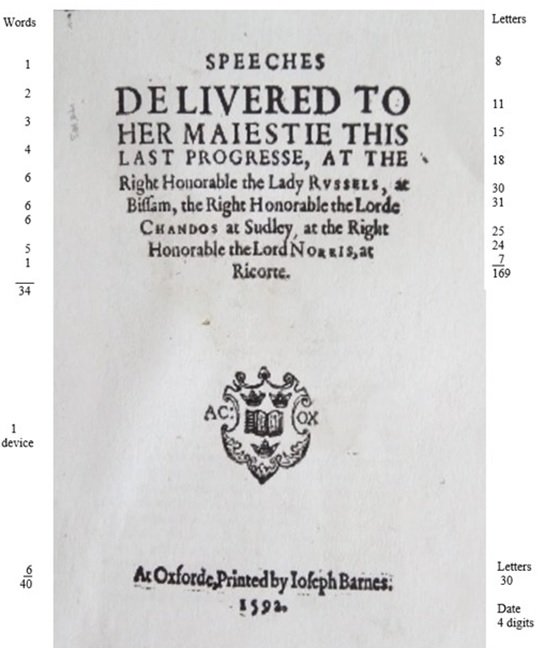
References
- Elizabeth Zeman Kolkovich, The Elizabethan Country House Entertainment: Print, Performance, and Gender (Cambridge University Press, 2016), p.143n67.
- Anon., Speeches Delivered To Her Maiestie This Last Progresse, At The Right Honorable the Lady Rvssells, at Bissam, the Right Honorable, the Lorde Chandos at Sudley, at the Right Honorable the Lord Norris, at Ricote (Oxford: printed by Joseph Barnes, 1590), ‘TO THE READER’.
- R. Warwick Bond, ed., The Complete Works Of John Lyly (Oxford Clarendon Press, 1902), I, pp. 404-6, see also, pp. 382-3.
- Ibid., I, p. 529.
- A. L. Rowse, Times, Persons, Places: Essays in Literature (London: Macmillan, 1965), ‘Bisham And The Hobys’, p. 205.
- Piers Compton, The Story Of Bisham Abbey (Maidenhead and Trowbridge: Thames Valley Press, 1973), p. 76. See also David M. Bergeron, English Civic Pageantry 1558-1642 (Columbia, South Carolina: University of South Carolina Press, 1971), p. 62 ‘attributed to John Lyly’.
- Elizabeth Zeman Kolkovich, The Elizabethan Country House Entertainment: Print, Performance, and Gender (Cambridge University Press, 2016), 62n21.
- Alexandra F. Johnston, ‘The ‘Lady of the farme’: The Context of Lady Russell’s Entertainment of Elizabeth at Bisham, 1592’ Early Theatre, 5 (2002), pp. 71-85, at pp. 71-2.
- Ibid., p. 79.
- Jessica L. Malay, ‘Elizabeth Russell’s Textual Performances Of Self’, Comitatus, 37 (2006), pp. 146-68, at p. 147.
- Ibid., p. 160.
- Peter Davidson and Jane Stevenson in ‘Elizabeth I’s Reception at Bisham (1592): Elite Women as Writers and Devisers’ in The Progresses, Pageants, and Entertainments of Queen Elizabeth I, eds., Jayne Archer, Elizabeth Goldring and Sarah Knight (Oxford University Press, 2007; reprinted 2010), pp. 207-226, at pp. 208-9.
- A. L. Rowse, Times, Persons, Places: Essays in Literature (London: Macmillan, 1965), ‘Bisham And The Hobys’, p. 205.
- Peter Davidson and Jane Stevenson in ‘Elizabeth I’s Reception at Bisham (1592): Elite Women as Writers and Devisers’ in The Progresses, Pageants, and Entertainments of Queen Elizabeth I, eds., Jayne Archer, Elizabeth Goldring and Sarah Knight (Oxford University Press, 2007; reprinted 2010), pp. 215-6.
- Patricia Phillippy, ed., The Writings of an English Sappho With Translations from Greek and Latin by Jaime Goodrich (Toronto: Centre for Reformation and Renaissance Studies, 2011), pp. 1-2 and pp. 2 n6, 147n1, see also, pp. 20, 29, 429n1.
- Ibid., p. 147.
- Gemma Allen, The Cooke sisters: Education, piety and politics in early modern England (Manchester and New York: Manchester University Press, 2013), p. 83.
- Ibid., p. 95n183.
- Ibid., p. 85.
- Ibid., p. 86.
- Chris Laoutaris, Shakespeare and the Countess: The Battle that Gave Birth to the Globe (Penguin Books, 2015), pp. 171-2; see also, Chris Laoutaris, ‘The Radical Pedagogies of Lady Elizabeth Russell’, in Performing Pedagogy in Early Modern England Gender, Instruction, and Performance, eds., Kathryn Moncrief and Kathryn R. McPherson (Surrey: Ashgate, 2011), p. 70.
- Elizabeth Zeman Kolkovich, The Elizabethan Country House Entertainment: Print, Performance, and Gender (Cambridge University Press, 2016), pp. 61-2.
- Ibid., p. 62n21.
- For a convenient modern reprinting Of Tribute, or, Giving that which is due see Brian Vickers, ed., Francis Bacon: A Critical Edition Of The Major Works Oxford and New York: Oxford University Press, 1996), pp. 22-51.
- Ibid., for the six speeches, pp. 52-60, and for the quotation see pp. 59-60.
- Ibid., pp. 61-8.
- Frank J. Burgoyne, ed., Collotype Facsimile & Type Transcript Of An Elizabethan Manuscript Preserved Alnwick Castle, Northumberland (London: Longmans, Green, and Co., 1904), pp. xi-xii, xx. The manuscript copy Of Tribute, or, Giving that which is due is reproduced on pp. 3-27 and Of Love and Self-Love on pp. 55-63.
- A. L. Rowse, Times, Persons, Places: Essays in Literature (London: Macmillan, 1965), ‘Bisham And The Hobys’, pp. 204-5.
- For analysis, interpretation, and commentary, on the political elements of this passage see Alexandra F. Johnston, ‘The ‘Lady of the farme’: The Context of Lady Russell’s Entertainment of Elizabeth at Bisham, 1592’ Early Theatre, 5 (2002), pp. 77-8; Peter Davidson and Jane Stevenson in ‘Elizabeth I’s Reception at Bisham (1592): Elite Women as Writers and Devisers’ in The Progresses, Pageants, and Entertainments of Queen Elizabeth I, eds., Jayne Archer, Elizabeth Goldring and Sarah Knight (Oxford University Press, 2007; reprinted 2010), p. 220; Patricia Phillippy, ed., The Writings of an English Sappho With Translations from Greek and Latin by Jaime Goodrich (Toronto: Centre for Reformation and Renaissance Studies, 2011), pp.155n32 & 33; Gemma Allen, The Cooke sisters: Education, piety and politics in early modern England (Manchester and New York: Manchester University Press, 2013), pp. 85, 95n194; Chris Laoutaris, Shakespeare and the Countess: The Battle that Gave Birth to the Globe (Penguin Books, 2015), p. 173; Elizabeth Zeman Kolkovich, The Elizabethan Country House Entertainment: Print, Performance, and Gender (Cambridge University Press, 2016), pp. 68-9, 152.
- Anon., Speeches Delivered To Her Maiestie This Last Progresse, At The Right Honorable the Lady Rvssells, at Bissam, the Right Honorable, the Lorde Chandos at Sudley, at the Right Honorable the Lord Norris, at Ricorte (Oxford: printed by Joseph Barnes, 1590), A3v.
- Spedding, Works, III, p. 519; Julian Martin, Francis Bacon, the State, and the Reform of Natural Philosophy (Cambridge University Press, 1992), p. 23, and for a discussion of Bacon’s early years see the chapter ‘The young statesman’, pp. 23-44.
- See Daphne Du Maurier, Golden Lads: A Study of Anthon Bacon, Francis and their friends (London: Victor Gollancz Ltd, 1975), passim and Lisa Jardine and Alan Stewart, Hostage to Fortune: The Troubled Life of Francis Bacon (London: Victor Gollancz, 1998), pp. 41, 50, 51, 54, 92, 94, 101, 105, 107, 110-12.
- Spedding, Letters and Life, I, pp. 47-56, at p. 52.
- Ibid., Letters and Life, I, p. 55-6, at p. 56.
- Brian Vickers, ed., Francis Bacon: A Critical Edition Of The Major Works (Oxford and New York: Oxford University Press, 1996), pp. 37-9, 50-1, 524-5, 530-1.
- Anon., Speeches Delivered To Her Maiestie This Last Progresse, At The Right Honorable the Lady Rvssells, at Bissam, the Right Honorable, the Lorde Chandos at Sudley, at the Right Honorable the Lord Norris, at Ricorte (Oxford: printed by Joseph Barnes, 1590), A2r-v.
- Michael Kiernan, ed., The Essayes or Counsels, Civill and Morall (Oxford Clarendon Press, 2000), pp. 27-9.
- Spedding, Works, II, p. 653; III, 219, 502.
- Ibid., Works, VI, pp. 713-4, see also, p. 705 and Works, IV, pp. 319, 326.
- Ibid., Works, VI, p. 712 and Works, IV, pp. 324-5.
- Susan Snyder and Deborah T. Curren-Aquino, eds., The Winter’s Tale (Cambridge University Press, 2009), pp. 192, 273.
- Anon., Speeches Delivered To Her Maiestie This Last Progresse, At The Right Honorable the Lady Rvssells, at Bissam, the Right Honorable, the Lorde Chandos at Sudley, at the Right Honorable the Lord Norris, at Ricorte (Oxford: printed by Joseph Barnes, 1590), A2v.
- Ibid., A2v.
- Ibid., A3r-v.
- Cyril Davenport, Royal English Book Bindings (London: Seeley and Co., 1896), pp. 18-9, 25; George Wingfield Digby, Elizabethan Embroidery (London: Faber and Faber, 1963), p. 97; Roy Strong, The Cult of Elizabeth: Elizabethan Portraiture and Pageantry (London: Thames and Hudson, 1987), pp. 68-71; Peter Davidson and Jane Stevenson in ‘Elizabeth I’s Reception at Bisham (1592): Elite Women as Writers and Devisers’ in The Progresses, Pageants, and Entertainments of Queen Elizabeth I, eds., Jayne Archer, Elizabeth Goldring and Sarah Knight (Oxford University Press, 2007; reprinted 2010), pp. 216-7.
- R. A. Foakes, ed., A Midsummer Night’s Dream (Cambridge University Press, 2013), p. 76; Harold F. Brooks, ed., A Midsummer Night’s Dream (Arden Shakespeare, 2006), p. 38; Sukanta Chaudhuri, ed., A Midsummer Night’s Dream (Bloomsbury Arden Shakespeare, 2017), 160.
- Elizabeth Zeman Kolkovich, The Elizabethan Country House Entertainment: Print, Performance, and Gender (Cambridge University Press, 2016), p. 65.
- Spedding, Works, VI, pp. 707-14. cf. Works, IV, pp. 318-27, and see also, p. 423.
- Ibid., Works, VI, p. 702.
- Ibid., Works, VI, p. 740
- Ibid., Works, VI, p. 728.
- Ibid., Works, VI, p. 587; Valerie Wayne, ed., Cymbeline (London: Bloomsbury Arden Shakespeare, 2017), p. 374. For a curious discussion of ‘the lion’s whelp’ passage in Cymbeline see W. F. C. Wigston, Francis Bacon Poet, Prophet, Philosopher Versus Phantom Captain Shakespeare The Rosicrucian Mask (London: Kegan Paul, Trench, Trubner& Co., Ltd, 1891), pp. 177-85.
- Frances A. Yates, Shakespeare’s Last Plays: A New Approach (London: Routledge & Kegan Paul, 1975), pp. 52-3.
- Ibid., p. 53.
- Frances A. Yates, The Rosicrucian Enlightenment (London and New York: Routledge and Kegan Paul, 1972; reprinted by Routledge, 1993), p. 6 and Spedding, Letters and Life, IV, pp. 343-4.
- William Aldis Wright, ed., The Advancement of Learning (Oxford Clarendon Press, 1889), p. 279; Brian Vickers, ed., Francis Bacon: A Critical Edition Of The Major Works (Oxford and New York: Oxford University Press, 1996), p. xl.
- Spedding, Works, II, p. 510, see also, pp. 514, 539.
- Ibid., Works, III, pp. 298-9.
- Valerie Wayne, ed., Cymbeline (London: Bloomsbury Arden Shakespeare, 2017), p. 340.
- Paul Arnold, Esoterisme de Shakespeare (Paris: Mercure de France, 1955), ‘La Tragedie De Cymbeline Et La Fraternite’, pp. 177-200; Frances A. Yates, Shakespeare’s Last Plays: A New Approach (London: Routledge & Kegan Paul, 1975), p. 101, see also, p. 91.
- Anon., Speeches Delivered To Her Maiestie This Last Progresse, At The Right Honorable the Lady Rvssells, at Bissam, the Right Honorable, the Lorde Chandos at Sudley, at the Right Honorable the Lord Norris, at Ricote (Oxford: printed by Joseph Barnes, 1590), A3v.
- Spedding, Works, VI, pp. 741-3.
- Alison Findlay, Women In Shakespeare A Dictionary (London: Bloomsbury Arden Shakespeare, 2014), pp. 203-4.
- Michael Kiernan, ed., The Essayes or Counsels, Civill and Morall (Oxford Clarendon Press, 2000), pp. 157/300; Brian Vickers, ed., Francis Bacon: A Critical Edition Of The Major Works (Oxford and New York: Oxford University Press, 1996), pp. 441/775.
- Michael Kiernan, ed., The Historie of the raigne of King Henry the seventh and other works of the 1620s (Oxford Clarendon Press, 2012), pp. 230/547-8.
- Brian Vickers, ed., Francis Bacon: A Critical Edition Of The Major Works (Oxford and New York: Oxford University Press, 1996), pp. 22/517; Spedding, Works, VII, p. 90.
- Spedding, Works, III, p. 465.
- Ibid., Works, IV, pp. 489-90.
- Michael Kiernan, ed., The Essayes or Counsels, Civill and Morall (Oxford Clarendon Press, 2000), pp. 68/219.
- Jessica L. Malay, Prophecy and Sibylline Imagery in the Renaissance Shakespeare’s Sibyls (London and New York: Routledge, 2014), p. 97.
- Ibid., p. 98.
- Ibid., p. 98.
- Ibid., p. 99.
- William Shakespeares Comedies Histories, & Tragedies. Published according to the True Originall Copies (London: printed by Isaac Jaggard and Edward Blount, 1623), ‘Histories’, p. 98.
- Jessica L. Malay, Prophecy and Sibylline Imagery in the Renaissance Shakespeare’s Sibyls (London and New York: Routledge, 2014), p. 101-2.
- Ibid., p. 103.
- Ibid., p. 107.
- Peter Davidson and Jane Stevenson in ‘Elizabeth I’s Reception at Bisham (1592): Elite Women as Writers and Devisers’ in The Progresses, Pageants, and Entertainments of Queen Elizabeth I, eds., Jayne Archer, Elizabeth Goldring and Sarah Knight (Oxford University Press, 2007; reprinted 2010), pp. 216-8.
- Gemma Allen, The Cooke sisters: Education, piety and politics in early modern England (Manchester and New York: Manchester University Press, 2013), p. 84.
- Alexandra F. Johnston, ‘The ‘Lady of the farme’: The Context of Lady Russell’s Entertainment of Elizabeth at Bisham, 1592’ Early Theatre, 5 (2002), pp. 71-2.
- Elizabeth Zeman Kolkovich, The Elizabethan Country House Entertainment: Print, Performance, and Gender (Cambridge University Press, 2016), pp. 65-6.
- essica L. Malay, Prophecy and Sibylline Imagery in the Renaissance Shakespeare’s Sibyls (London and New York: Routledge, 2014), p. 115.
- Ibid., p. 111.
- Ibid., pp. 118-9.
- Spedding, Works, VI, pp. 701-2.
- Anon., Speeches Delivered To Her Maiestie This Last Progresse, At The Right Honorable the Lady Rvssells, at Bissam, the Right Honorable, the Lorde Chandos at Sudley, at the Right Honorable the Lord Norris, at Ricorte (Oxford: printed by Joseph Barnes, 1590), A4r-v.
- Chris Laoutaris, Shakespeare and the Countess: The Battle that Gave Birth to the Globe (Penguin Books, 2015), pp. 176/440.
- Alan Stewart, with Harriet Knight, eds., Early Writings 1584-1596 (Oxford Clarendon Press, 2012), pp. 168/781.
- Ibid., pp. 273/810; Brian Vickers, ed., Francis Bacon: A Critical Edition Of The Major Works (Oxford and New York: Oxford University Press, 1996), pp. 41-2/526.
- Alan Stewart, with Harriet Knight, eds., Early Writings 1584-1596 (Oxford Clarendon Press, 2012), pp. 514, 534, 535, 542, 543, 544, 546, 548, 553, 554, 555, 556, 557, 558, 559, 562, 563, 564, 574, 580; See also Spedding, Works, VII, pp. 191, 193-4.
- Michael Kiernan, ed., The Essayes or Counsels, Civill and Morall (Oxford Clarendon Press, 2000), pp. 11/182.
- Michel Kiernan, ed., The Advancement of Learning (Oxford Clarendon Press, 2000), pp. 15/215.
- Ibid., pp. 26/227, 40/238, 73/274-5, 89/284, 124/321, 129/325, 167/347, 178/353.
- Michael Kiernan, ed., The Essayes or Counsels, Civill and Morall (Oxford Clarendon Press, 2000), pp. 118/256-62; Brian Vickers, ed., Francis Bacon: A Critical Edition Of The Major Works (Oxford and New York: Oxford University Press, 1996), pp. 416-7/759-60.
- Spedding, Works, VI, pp. 758-60.
- Alison Findlay, Women In Shakespeare A Dictionary (London: Bloomsbury Arden Shakespeare, 2014), p. 69.
- Stevie Davies, The Feminine Reclaimed The Idea Of Woman In Spenser, Shakespeare and Milton (The University Press of Kentucky, 1986), p. 128; Stevie Davies, The Idea of Woman in Renaissance Literature The Feminine Reclaimed (Brighton: The Harvester Press, 1986), p. 128. For her reading of the Ceres/Demeter myth in relation to The Winter’s Tale, see pp. 152-74.
- Spedding, Letters and Life, IV, pp. 303ff and pp. 343-4; Frank Kermode, ed., The Tempest (London and New York: Routledge, 1964, reprinted, 1989), pp. xx-xxiv; Frances A. Yates, The Rosicrucian Enlightenment (London and New York: Routledge and Kegan Paul, 1972; reprinted by Routledge, 1993), pp. 2-6.
- Frances A. Yates, Shakespeare’s Last Plays: A New Approach (London: Routledge & Kegan Paul, 1975), p. 130.
- John Nichol, ed., The Progresses And Public Processions Of Queen Elizabeth (London: printed by and for John Nichols and Son, 1823), III, pp. 130-6; Sir Egerton Brydges, Speeches Delivered to Queen Elizabeth, on her Visit to Giles Brydges, Lord Chandos, at Sudley Castle in Gloucestershire (Kent: printed at the private press of Lee Priory by Johnson and Warwick, 1815); R. Warwick Bond, ed., The Complete Works Of John Lyly (Oxford Clarendon Press, 1902), I, pp. 472-7; Jean Wilson, Entertainments For Elizabeth I (Woodbridge, Suffolk: D. S. Brewer, 1980), pp. 43-47; Patricia Phillippy, ed., The Writings of an English Sappho With Translations from Greek and Latin by Jaime Goodrich (Toronto: Centre for Reformation and Renaissance Studies, 2011), pp. 151-7.