
"Laws are made to guard the rights of the people, not to feed the lawyers." Francis Bacon
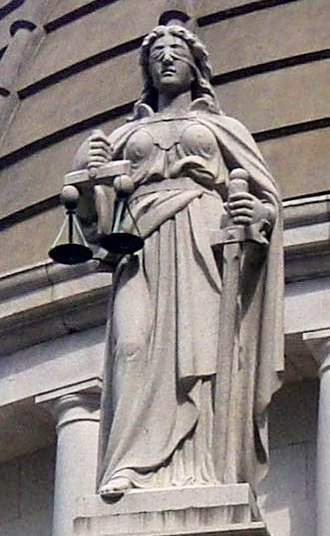 Francis Bacon has long been famous as a philosopher, scientist, politician and writer but, ‘his major contribution to Anglo-American jurisprudence’ and, ‘his career as one of England's greatest lawyers and jurists has been largely overlooked.’1 Professor Coquillette’s stated purpose in his 1992 legal work Francis Bacon was, ‘to restore Bacon to his rightful place as England's first true critical and analytical jurist, and to describe how his legal thought related to his other great intellectual achievements.’2
For Bacon, the law was not a dry, inflexible collection of rules, it was like all aspects of his philosophy, to be reformed and utilised for the betterment of humankind.
Bacon’s View of the Law
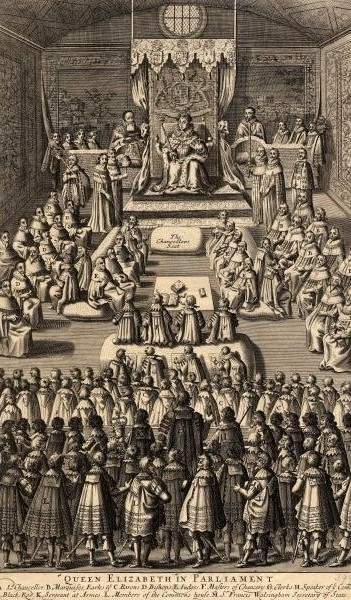 As well as a lawyer, Bacon was a parliamentarian for many years, an office particularly suited to his great reasoning and oratory skills. A liberal minded legal and social reformer, his tendency to speak according to his conscience regarding social and moral responsibilities, often got him into hot water with Elizabeth I and the Privy Council. He spoke out against royal subsidies and Crown monopolies and strongly opposed the Crown’s attempts to diminish the House of Commons’ powers by imposing heavy taxes on its citizens. Bacon argued the taxation was unjust and that the people were unable to pay.
In a public speech in the House of Commons on 26th February 1593, Bacon argued for a simplification and practicality of law reform that should be accessible and protect people’s rights.
‘Laws are made to guard the rights of the people, not to feed the lawyers. The laws should be read by all, known to all. Put them into shape, inform them with philosophy, reduce them in bulk, give them into every man's hand.’3
Bacon’s Legal Legacy
 Whilst the law may not have been Bacon’s first choice with regard to a profession, it was one to which he dedicated all his considerable powers to. He became the first Queen’s Council under Elizabeth I and later in James I’s reign, Solicitor-General, Attorney-General, Keeper of the Great Seal, and in 1618 Lord High Chancellor, the highest legal office in the land.
As a philosopher and scientist, he bought these disciplines to the law also, which made his insights and ideas for reform all the more wide reaching, practical and revolutionary. Professor Coquillette says, ‘If we focus fairly on the written record of Bacon’s work as a lawyer and a jurist, and particularly on his legal thought, the picture emerges of a creative, profound and innovative man, dedicated to his profession and to making genuine progress in the way we think about law.’4
Bacon & the Modern World
 Bacon is peculiarly modern in every sense of the word. He was a visionary that had a vast understanding of human nature and the uses and abuses of power generally but specifically with regard to law and science. He was one of the first to grapple with the inherent dangers of certain knowledge and a need for checks and balances in order to protect the vulnerable.
‘The issues of law in a technologically advanced society, including the fundamental dilemmas of balancing individual integrity with collective security, balancing religion and morality with a secular legal system, balancing access to information with the quality of information, and balancing the dangers and vulnerabilities of the ‘enchanted glass’ of the human mind against the eternal need for freedom and self-determination - all of these issues live with us daily. Bacon was the first English jurist fully to articulate their importance, and therein lay his greatness.’5
Francis Bacon of Gray’s Inn
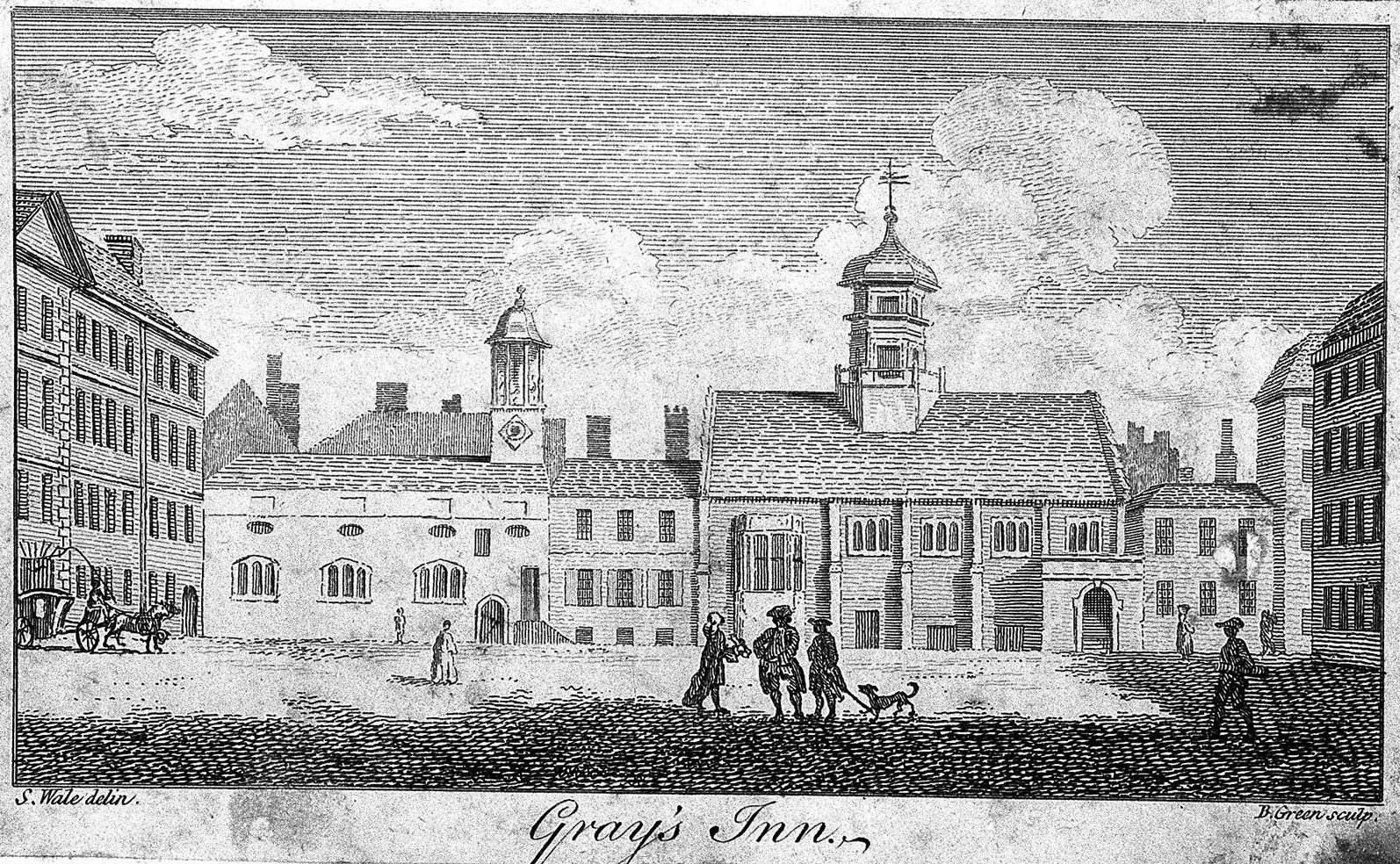 Gray’s Inn is still today one of the four Inns of Court to which students attend to study the Law. In Elizabethan England, for many young noblemen who attended the Inns they were sometimes more of a gentlemen’s club where they could meet and network with the benefit of being in close proximity to theatres, brothels and gambling clubs. Surveillance was lax and many members took advantage of this freedom.
Lord Keeper Sir Nicholas Bacon and William Cecil Lord Burghley, had been prominent Grayans and Francis Bacon had been admitted to Gray’s Inn in June 1576 aged 15 but didn’t take up his place until 1579 when he returned from the Continent working on state business. Both Anthony and Francis were installed in the Bacon family chambers and above their chambers was the library.
The hope was that the boys would follow in Sir Nicholas’ footsteps. Like the elder half-brothers Nicholas, Nathanial and Edward, Anthony had little or no interest in the law but saw the Gray’s Inn family chambers as a convenient London base to expand his social network that would become important for his work as an intelligence agent working for the English Secret Service on behalf of the crown.
The Reluctant Law Student
Similarly Francis Bacon intimated his dislike for law as it ‘drank up too much of his time’ which he had dedicated to other matters, namely the universal reformation of the whole world and the establishing and elevating of the English language through his writings.
With little state help, and out of necessity for furthering his vision, he was forced to study the law and eventually became the pre-eminent lawyer of the age elevated to the position of Lord Chancellor in 1618 emulating his father before him, meaning at least one son followed Sir Nicholas’ legal example.
Law & The Revels
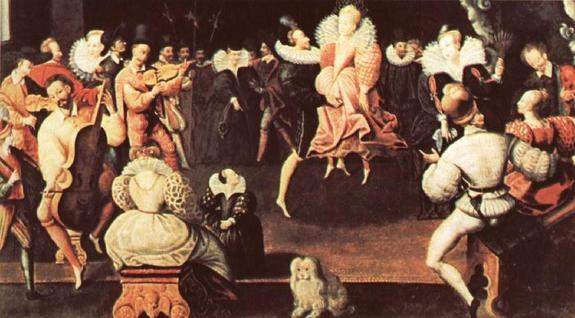 Law aside, there were compensations to be had at Gray’s Inn as it had a very fine reputation for producing masques, interludes and entertainments with Francis Bacon assuming the role of de facto Master of the Revels for these occasions.
At the famous Christmas Revels at Gray’s Inn of 1594-5, Bacon organised a mock meeting of the Privy Council presided over by the Prince of Purpoole, Lord of Misrule. It was during these revels that the first known performance of his Shakespeare play The Comedy of Errors was performed, a play about errors, confusion and mistakes, themes prominent in Bacon’s later acknowledged works.
As with many of the Gray’s Inn entertainments, the revels were attended by the most influential people of the day all within Bacon’s circle of family and friends, including his uncle Lord Burghley, his cousin Robert Cecil, Robert Devereux Earl of Essex, and his intimate friend the Earl of Southampton.
Later in the reign of King James, Bacon produced a masque to celebrate the marriage of the king’s daughter Princess Elizabeth to the Count Palatine and the following year The Masque of Flowers to celebrate the marriage of the Earl of Somerset to Lady Frances Howard.
Bacon’s many theatrical involvements confute the common false opinion (based on errors and confusion no doubt) that Bacon was not interested in drama and the theatre, when just a little look behind the curtain reveals exactly the opposite.
Famous Son
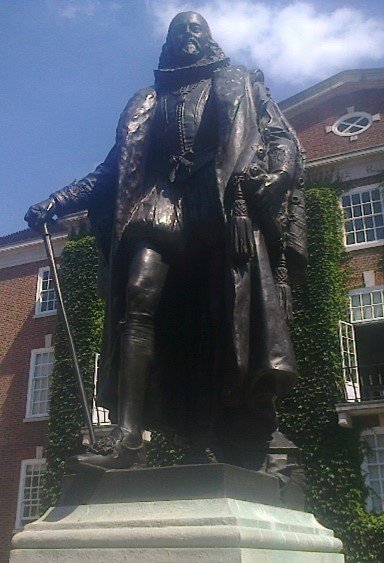 For many years of his life, Bacon spent much of his time at Gray’s Inn. Aside from his vast legal and dramatic contributions, he had been its treasurer and was also involved in laying out the expansive walks and gardens of the Inn which can still be seen today. In celebration and commemoration of his vast contributions to Gray’s Inn, a statue was erected in honour of its favourite son in 1912, by F W Pomeroy which stands in South Square.
The Law & Shakespeare
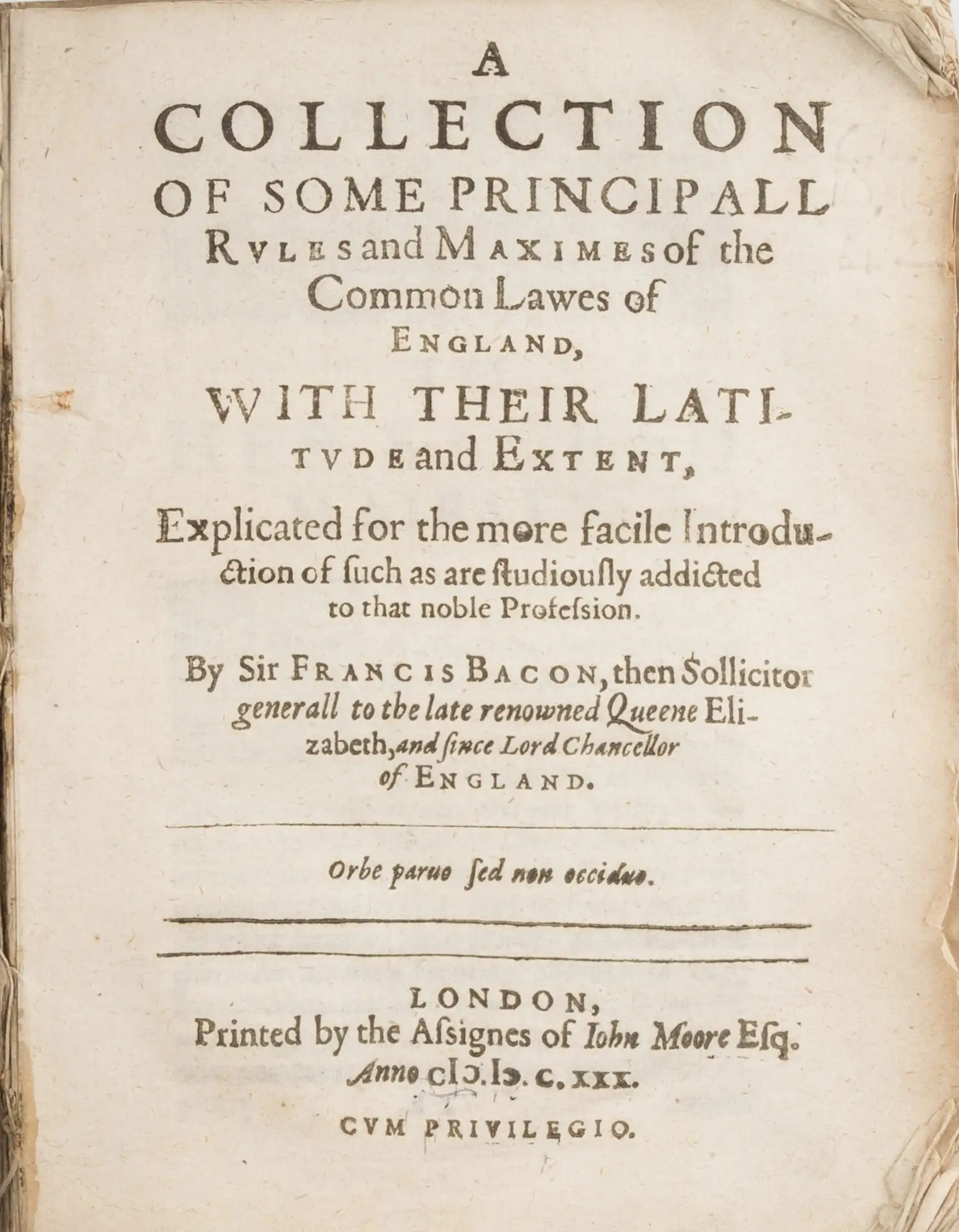 What is perhaps not apparent to a non-legal mind, is that the Shakespeare plays display an intimate and detailed familiarity with the principles and practices of all the major branches of the law: common law, civil law, statute law, and the maxims of English law, as well as its principles, complex technicalities, customs and jurisprudence. Their legal language and phrases readily flow from his pen and in the plays his characters talk in a language of the law straight out of Bacon’s Legal Tracts: from Slade’s Case, The Maxims of the Law, The Postnati Case, The Charge of Francis Bacon Touching Duels, through to The Elements of the Common Laws of England.
None of these legal tracts were published in Bacon’s lifetime, which raises the question, how did detailed aspects of Bacon’s legal writings come to appear in the Shakespeare’s Works?
Legal commentators on the Law in the Shakespeare Works
Having concluded my examination of Shakespeare’s juridical phrases and forensic allusions, - on the retrospect I am amazed, not only by their number, but by the accuracy and propriety with which they are uniformly introduced. There is nothing so dangerous as for one not of the craft to tamper with our free-masonry.
Lord Campbell, Shakespeare’s Legal Acquirements Considered, p. 107
Legal phrases flow from his pen as part of his vocabulary and parcel of his thought…
Richard Grant White, Memoirs of the Life of William Shakespeare, p. 74
 His works contain passages displaying not merely a knowledge of the principles and practice of the law of real property, but also of the common law, and of the criminal law, and a thorough intimacy with the exact letter of the Statute Law.
William Lowes Rushton, Shakespeare A Lawyer,
pp. 4-5
The lawyer, when he reads attentively the works of William Shakespeare, may not be more surprised by the poet’s correct use of law terms, and intimate acquaintance with legal customs and tenures and the lex scripta, than by his extensive and profound knowledge of the maxims of the English law.
William Lowes Rushton, Shakespeare’s Legal Maxims, p. 7
The abstrusest elements of the common law are impressed into a disciplined service with every evidence of the right and knowledge of commanding. Over and over again, where such knowledge is unexampled in writers unlearned in the law, Shakespeare appears in perfect possession of it. In the law of real property, its rules of tenure and descents, its entails, its fines and recoveries, and their vouchers and double vouchers; in the procedure of the courts, the methods of bringing suits and of arrests, the nature of actions, the rules of pleading, the law of escapes, and of contempt of court; in the principles of evidence, both technical and philosophical; in the distinction between the temporal and spiritual tribunals; in the law of attainder and forfeiture; in the requisites of a valid marriage; in the presumption of legitimacy; in the learning of the law of prerogative; in the inalienable character of the crown, this mastership appears with surprising authority.
K. Davis, The Law in Shakespeare, pp. 4-5
I allude to his perfect familiarity with not only the principles, axioms and maxims, but the technicalities of English law. . .The mode in which this [legal] knowledge was pressed into the service on all occasions to express his meaning and illustrate his thought, was quite unexampled. He seems to have had a special pleasure in his complete and ready mastership of it in all its branches. . .At every turn and point at which the author required a metaphor, simile, or illustration, his mind ever turned first to the law. He seems almost to have thought in legal phrases. . .To acquire a perfect familiarity with legal principles, and an accurate and ready use, of the technical terms and phrases not only of the conveyancer’s office, but of the pleader’s chambers and the courts at Westminster, nothing short of employment in some career involving constant contact with legal questions and general legal work would be requisite.
Lord Penzance, The Bacon-Shakespeare Controversy a Judicial Summing-up, pp. 83, 85, 87-8
 If anything is certain in regard to the Sonnets, the Poems, and the Plays, it is certain that the author was a Lawyer. . .In the Plays, every one of the characters talk law. Greek and Trojan, Roman and Syracusan, Ancient Briton and Scandinavian, Venetian and Illyrian, Lord and Lady, all discourse the jargon of the English courts. In Troilus and Cressida Pandarus talks of ‘a kiss in fee-farm,’ Thersites of ‘the fee-simple of the tetter,’ Troilus of ‘perfection in reversion,’ and the pre-contract which serves Cressida for a marriage concludes with the formula, ‘In witness whereof the parties interchangeably,’ of the draftsman. In Antony and Cleopatra the Roman Triumvir distinguishes between the title by purchase and title by descent. In The Merchant of Venice Antonio settles the property of the Jew in so lawyerlike a manner that Mr. Lewin, in his Treatise on Trusts, cites his language in illustration of a ‘use.’ In As You Like It the Duke orders his officers to make an ‘extent.’ In Lear the deluded Gloster proposes to make his bastard ‘capable.’ In King John the law of adulterine bastardy is laid down with the precision of a text-book. In Henry the Fifth the Archbishop Canterbury delivers a lecture on the Law Salique. In Henry the Sixth Somerset discusses the legal effect of an ‘attainder.’ In Henry the Eighth Suffolk cites the very words of the statute when he charges Wolsey with having brought himself ‘into the compass of a praemunire.’ In Hamlet the Prince of Denmark talks of statutes, recognisances, fines and recoveries, and double vouchers, as glibly as if he was fresh from reading Bacon’s Law Tracts. . .
Judge Webb, The Mystery Of William Shakespeare A Summary Of Evidence, pp. 166-8
Of course it became his [Bacon’s] duty in those various offices to deliver speeches, and to write papers on various subjects submitted to him for elucidation or judgement. Amongst the most important of these are Tracts on the “Use of the Law,” and “Maxims of the Law;” “Preparations for the Union of the Laws of England and Scotland;” “Proposals for Reforming the Penal Laws;” Speeches on the King’s Prerogative, on Duelling, and on Monopolies, with Some Charges to the Circuits on the Office of Constables, &c. …in these few Law Tracts, Speeches, and Aphorisms, are to be found all “the profound and accurate knowledge which Shakespeare displayed of juridical principles and practice.”
Quill-Driver, ‘Mr. Shakespeare, Q.C.’, Baconiana, Vol. I, New Series, August, 1893, No 2, pp. 93-4
 Just as his aspirations for natural philosophy were adapted from the aspiration of his father’s generation of Tudor statesmen, Bacon’s procedures in natural philosophy were adapted by him from procedures in English law. Specifically, certain procedures in legal investigation and court trials, when linked with Bacon’s own proposals for legal reform, not only exactly parallel his procedure for a reformed natural philosophy, but they were the model for it.
Julian Martin, Francis Bacon, the State, and the Reform of Natural Philosophy, p. 72
I cite the following instances, with some additional circumstances, as going to show, not only that the author of Shakespeare was a lawyer, but that lawyer was Francis Bacon.
Judge Nathaniel Holmes, The Authorship of Shakespeare, pp. 629-30
____________________________________________________________________________________
Notes
- Coquillette, Daniel, R., Francis Bacon, Edinburgh University Press, 1992, p. sleeve cover.
- Ibid., sleeve cover.
- Dixon, William Hepworth (of the Inner Temple), Personal History of Lord Bacon From Unpublished Papers, John Murray, London, 1861, p. 34.
- Coquillette, Daniel, R., Francis Bacon, Edinburgh University Press, 1992, p. viii.
- Ibid., p. 297.