
"Francis Bacon was a genuine midwife of modernity. He was one of the first thinkers to visualise a future which would be guided by a cooperative science-based vision of bettering human welfare." Professor Graham Rees
 For most of his life, Francis Bacon worked in the hope of helping to create a ‘new age’, an age of religious tolerance and technological progress: in short, a New Atlantis. To Bacon this was both a human right and a religious duty: the wisdom and power once commanded by human beings, and lost through the Fall into sin, would be restored. The power of Bacon’s vision inspired and influenced later thinkers to a remarkable degree, despite setbacks and misunderstandings in his own lifetime.
American Baconian Mather Walker summed up the vast reach of Bacon’s approach and legacy:
"We, who live today, dwell on the apex of a vast pyramid of human achievement; achievement accumulated through many long struggles in the service of science and technology. We reap these benefits each day in a thousand ways: electricity, television, telephones, aeronautics, and medicine; without giving thought to our debt. But it all goes back to Bacon. He set it all in motion. He was the one who prepared the unique soil that enabled it to grow, and he was the one who planted the unique seed from which it grew. Prometheus was a myth. Francis Bacon was real, and his achievements far greater than any imagination could conceive."
The ultimate fate of Bacon’s stated programme depends on the moral use of technology, which is often forgotten by Bacon’s followers and his adversaries. It remains to be seen whether Bacon’s science can be reconciled with his religion in practice, but there is little doubt he believed this possible, and indeed essential. This moral and practical emphasis is explored by American philosopher, anthropologist and natural scientist Dr Loren Eiseley:
"Bacon defined for us, the image of what a true scientist should be: a man of both compassion and understanding. He whispered into our careless ears that knowledge without charity could bite with the deadliness of a serpent’s venom. . .It is our opportunity now to share the ideas and visions of a statesman-philosopher whose influence has transcended, and will continue to transcend, his own century.”
 Bacon’s project was far-reaching, and required great intellectual and practical effort. He gave it the resonant title of The Great Instauration, a significant choice of words with ramifications that are seldom fully grasped. Yet he was modest enough to downplay his personal importance, describing the expected new age a Birth of Time. As his ideas were gradually understood by thinkers and put into practice, Bacon became perhaps the greatest single influence on the Enlightenment period that flourished in the 18th century.
His scheme contains parts that may be distinguished as theoretical and practical. But these are far from being separate: part of Bacon’s unique contribution was to annihilate the divide between theory and practice. He summed this up in his often misunderstood doctrine ‘knowledge is power’. Bacon was a practical visionary: as such his theory leads to practice and his practice enables the growth of theory.
Theory
The intellectual part of his method had two key features. The negative phase – diagnosing the characteristic errors in human thinking that lead to false and unproductive science – is followed by the positive – providing a remedy. They are:
1) A thorough critique of the cognitive functions of the human mind, summed up in the doctrine of the four Idols. Centuries after Bacon, many scientists and philosophers are still content to think in wilful ignorance of the psychological, characterological and intrinsic intellectual dynamics of their own minds. As such they exemplify the kind of abstract thought Bacon criticised, that judges everything but is unable to judge itself. Bacon’s analysis attained a psychological profundity seldom matched before or after his time. His attitudes were particularly influential among the great French thinkers of the Enlightenment, such as Voltaire or Diderot. To this day, the ideals of impartiality, openness and tolerance which are universally recognized as integral to enlightened society may be said to derive their essential formulation from Bacon’s main published works.
2) A new logic (Novum Organum) to replace the unproductive logic of Aristotle. It is most commonly known as the Inductive Method. This method would free us of hasty generalizations, of brain-born fancies spun out without a basis in experience. His view of induction was much more subtle than that of his followers, whose oversimplifications became associated with Bacon himself. This has resulted, too often, in Bacon’s philosophy being unread and underrated and it is arguable that there are truths in his Novum Organum that still await recognition. But the chief thought – that science should be cooperative and systematically experimental–inspired the most important intellectuals in 17th century England and led directly to the formation of The Royal Society in 1660.
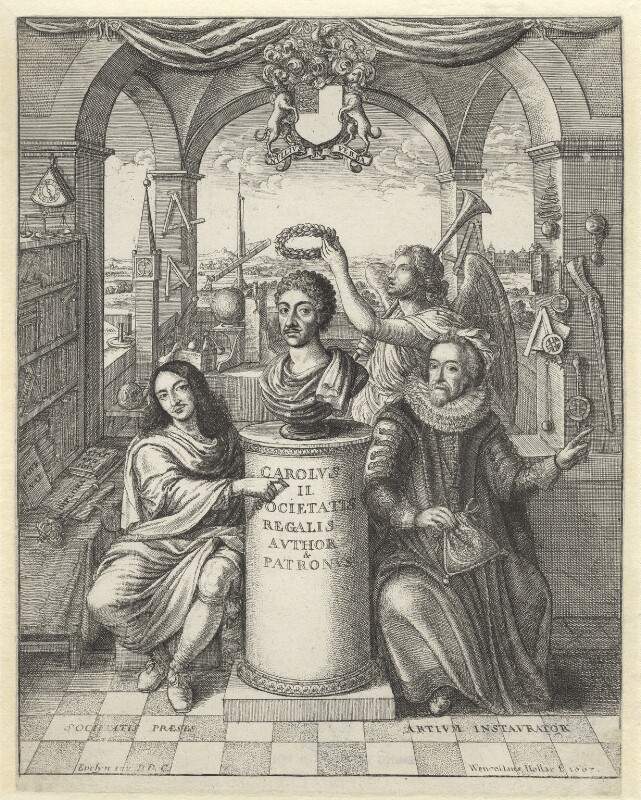
In 1667 Thomas Sprat the first official historian of The Royal Society left no room for doubt that its prime mover and great moving spirit was Lord Bacon from whom it all originated:
"I shall onely mention one great Man, who had the true Imagination of the whole extent of this Enterprize, as it is now set on foot; and that is, the Lord Bacon. In whose Books there are every where scattered the best arguments, that can be produc’d for the defence of Experimental Philosophy; and the best directions, that are needful to promote it."
His key approach-that science should be both collaborative and involve methodical investigation was grounded in one of Bacon’s central insights, which is so far-reaching that perhaps only since the late 20th century is it possible to appreciate it fully. Not separately articulated, it is pervasively implicit in Bacon’s printed works. It is that:
3) Science cannot be separated from moral and social concerns, i.e. its human and natural context. Knowing is a communal process, involving flows of information in complex systems, deeply bound up with the character of the individual members of the system.
Scientists have often disregarded the precise method outlined by Bacon in Novum Organum. However, there is reason to believe that as computer science, information theory, systems theory and even genetics develop and come closer together, Bacon’s theory will become utterly relevant, for good or bad, in accordance with those who use or misuse it.
Practice
His practical work involved a great social or fraternal effort to implement a society suited to, and supported by, true science and true religion. This society is depicted in a utopian form in New Atlantis, a visionary work of philosophy in the tradition of Plato’s Republic and Campanella’s Citta del sole. Bacon poured a great amount of time and money into his educational project from an young age – through book production, the employment of secretaries and his documented early involvement in theatre. When Bacon’s political career commenced in earnest, one of his first deeds was to dedicate his masterpiece The Advancement of Learning (1605) to the recently crowned James I, which as well as featuring a full and beautifully written anatomy of the current state of learning, was also a mission statement for learning as it might become. Throughout his career in high office, Bacon fought to provide time, facilities and money to kindling the spark of learning, at home and abroad.
But Bacon did not just work for the new age through direct communication and political action. In Valerius Terminus he commented:
‘That the discretion anciently observed, though by the precedent of many vain persons and deceivers disgraced, of publishing part, and reserving part to a private succession, and of publishing in a manner whereby it shall not be to the capacity nor taste of all, but shall as it were single and adopt his reader, is not to be laid aside, both for the avoiding of abuse in the excluded, and the strengthening of affection in the admitted’.
There is considerable evidence that a private transmission of Bacon’s thought occurred, although it is of course impossible to prove his connection with any oral traditions, whether preserved by Freemasons or others. Certainly, the distribution of his manuscripts after his death followed complex idiosyncratic channels. He was very selective in what he put into print: many manuscripts entered private hands and must have been accessible to a very limited circle; his existing correspondence also refers, tantalizingly, to hidden works.
The clearest evidence of Bacon’s time-release method of disseminating his influence is found in the writings of his successive executors, Dr William Rawley who had been Bacon’s chaplain, and Dr Thomas Tenison who was Archbishop of Canterbury.

Magic, Science and Renaissance Studies
The question of Bacon’s hidden cultural influence inevitably involves the evidenced based theory that he was a prominent member of a secret society such as Freemasonry or Rosicrucianism, and that this society carried on Bacon’s cultural intentions for decades or even centuries after his death.
This theory was first adopted within decades of Bacon’s death, and alluded to more or less explicitly in various 17th century writings, typically by advocates of magic but also of science, for these two were still closely linked.
Paolo Rossi’s groundbreaking Francis Bacon: From Magic to Science (1968) finally enabled the academic world to grasp what had been known and studied in the circles of the Francis Bacon Society for almost a century – that Bacon’s formulation of scientific method must be set in the context of the magical tradition.
The various ways in which Renaissance magical or hermetic philosophies contributed to the emergence of modern thought out of the previous European Catholic consensus, may be studied in the works of the great scholars of the Warburg Institute: Dr Frances Yates and D. P. Walker. These works gave a scholarly treatment to much of what had already been studied in a pioneering way by The Francis Bacon Society.
The methodologies adequate to this field only developed in the late 20th century, but there is still an abundance of material and insight already developed by the Society, which the academic world has yet to appreciate. The rise of interdisciplinary studies will surely place the work of the Society where it belongs, as a pioneering attempt to compensate for a traditional lack of professional attention given to the relationship between science, art and the hermetic or Rosicrucian philosophies involved in their reconfiguration. To understand their roles in 17th century England, the approach to Bacon and Shakespeare taken by the Society needs to be embraced and refined by the academic world at large.